
Native Instruments’ Drum Lab – new advanced drum layering instrument for Kontakt
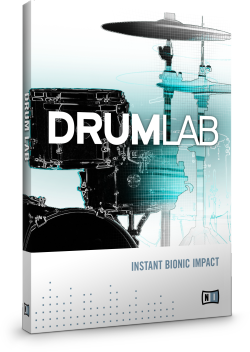
Native Instruments has released Drum Lab, an “advanced drum layering instrument” with an intuitive workflow designed for fast results for use with their Kontakt 5 Player (included in free Komplete Players), or Kontakt 5.
Drum Lab combines acoustic and electronic drum samples with a “groove library” of over 900 patterns for fast groove production.
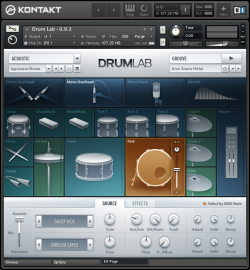
Drum Lab creates a hybridized layering technique from the combination of the organic sound of acoustic drums with the weight and punch of electronic samples. Drum Lab’s acoustic layer is made up of 38 individual drums, each recorded in three different rooms with high-end vintage and modern equipment on analog tape. For Drum Lab’s electronic component 380 drum hits were sampled from a range of classic and modern drum machines, then matched, phase aligned, faded, and pitched to blend with the acoustic drum samples.
Drum Lab’s interface provides all sound-shaping controls (TRANSIENT MASTER, SOLID EQ, G COMP, an optimized drum compressor, and a rich convolution reverb) directly on the front panel. Producers can choose individual acoustic and electronic layers, blend them via slider, and adjust details with some of Native Instruments’ studio effects listed above. Drum Lab also integrates perfectly with Native Instruments’ Maschine for the ultimate in hybrid drum groove production.
Feeling Groovy. Drum Lab also delivers some authentic grooves. A new set of patterns were recorded by a professional drummer, then converted to MIDI files and arranged by genre in Drum Lab’s groove library. Users can drag-and-drop these patterns into their sessions, using the software’s unique visual display to line up grooves in their tracks for added visual reference when creating beats.
Native Instruments’ Drum Lab is available now from the NI Online Shop for $99 / 99 Euro / ¥ 9800.
Europe Endless
Dotcom Q119 sequencer controlled from Digital Performer. Delay is Deluxe Memory Man.
Yamaha AN1x – demo
Demo of Yamaha AN1x synthesizer. Sounds, sequences & video editing by WC Olo Garb.
The AN1x is a powerful retro-analog synth with a really cool new feature that lets you record real-time editing and filtering and be able to store it as part of the sound! A major contender in the new wave of analog-digital synths using DSP modeling of analog waveforms to recreate the coveted sounds of analog synths with modern digital specifications. It offers truly traditional yet modern methods of analog synthesizing, 10 notes of polyphony, 8 knobs for tweaking, and an arpeggiator with dozens of inspiring patterns!
Although the AN1x is not a follow-up to the CS1x (which has since been followed by the CS2x and the CS6x) it has borrowed many functions and technologies from the CS1x synth. First, it’s built in an almost identical case with the same layout of buttons and knobs as the CS1x. However the function of every knob and button has been greatly expanded. The AN1x also has 2 Scene memories for instant recall of any envelope and filter settings and the mod-wheel can be used to morph between the two scenes. On-board effects and a state-of-the-art arpeggiator section also are on-board for giving your sounds life and motion.
The AN1x adds a new Ribbon controller for increased real-time control. It also includes pulse width modulation, ring modulation and oscillator syncing. The AN1x may not be the next evolution of the CS1x but it is basically a more advanced synth capable of increased sound potential and quality. It has a better feeling keyboard than the CS1x as well assuming that the AN1x is for those looking for something more professional than the CS1x.
KORG Volca Keys & Beats : UNISON mode
Playing with Volca keys UNISON mode 😉
Doepfer Dark Energy & minicase with two VCOs A-110, a mixer A-138 and a multiple A-180
The music has been made using a Doepfer Dark Energy and a minicase with two VCOs A-110, a mixer A-138 and a multiple A-180.
Music Machine / RenoidPlayer+Robozawa-200kg
RenoidPlayer + Robozawa-200kg
Web-Based Vocal-Synth Demo
Renoid is a virtual singer system using Renoise XRNI or SoundFont SF2 sound library and cascaded pitch-corrector. By this, virtual singing is available without any special program.
This page trying a little different approach that singing engine is implemented as a web-based app using a SoundFont Renoid file.
Details of Renoid are available on
Renoise-gate
Renoid
GenoQs Machines Octopus Meets Ableton Live 8
Just a quick little demo to show the Mother of ALL Sequencers controlling four virtual instruments in Abelton Live 8. The plugins where: Arturia MiniV, Artutia ModularV, 2 instances of Alchemy and drum Impulse
While sequencers are machines to control synthesizers, Octopus stands out for a broad user base as a musical instrument. The merit lies in the directness, intuitiveness and creativity that gets unleashed by interacting with Octopus.
User experience and musical creation are the centerpieces of the Octopus design: a no-compromise machine built from metal, wood, and modern real-time software technology. The thorougly structured user interface, its stunning looks, the materials and our care going into hand-assembling every unit make each Octopus a unique piece to stand the test of time.
Octopus’ tactile and visual feedback is a physical experience so typical for traditional musical instruments. Music is being felt, heard and played with Octopus. And the numbers behind it all.. no display? Well, do you really care? Yes, computers love them. We love light, color, and most of all music!
The family of Octopi has three members which differ in the enclosure they come in: Octopus New Classic for the piano lacquered wood look, comes with white painted panels and a red-green-yellow LED matrix. Octopus Lion Head carries on the nature wood look legacy that our original (and now discontinued) model has set, and which many users still long for. And finally Octopus The Shell– thisone you will never have to leave again! Built in an industrial strength road case, it features black anodized panels, and sparkles with red-green-yellow LEDs.
Synthesis Technology Morphing Terrarium Modulation of Wavetables
A short exploration of modulating the wavetables of the Synthesis Technology E350 Morphing Terrarium. Sound and Video by Raul Pena.
Drumtraks, Six-Trak, and Juno-60
A slow piece with Sequential Circuits Drumtraks & Six-Trak, and Roland Juno-60.
Owl theremin
The theremin control voltage outputs can be used to play the synth in the background. The theremin is in fact an excellent PAiA Theremax, the same as used for the Badgermin. The owl rests on a sliding carriage, which can slide along four vertical bars fixed inside the log. When the motor is turned on a winch mechanism winds a length of sash cord, which loops over the top of a second pulley, which in turn lifts up the sliding carriage. When the carriage reaches the top, a limit switch is automatically pressed, switching off the motor. For the owl to descend, the owl activation switch is flipped once more, reversing the polarity of the motor, allowing the carriage to be lowered down onto another limit switch. The antennae disconnect for ease of transportation, and the lower half of the stand can be unbolted.
More details: www.nervoussquirrel.com/owltheremin
DATAMASKIN

