
Time machine: ROLAND SUPER JX-10 PG800
Released in 1985 the JX-10 (Super JX) combines two individual JX-8P’s for an outstandingly warm, rich and analog sound which is still used in many modern studios all over the world. This synth was the first Roland Synth to be fitted with a quality 76 note keyboard with velocity and aftertouch. Two DCO’s per voice, two ADSR envelope generators per voice, and a resonant lowpass & non-resonant highpass filters are only the beginning. It has a 12 voice polyphony for a total of 24 oscillators and it is by far one of the most programmable synths of its time! However, as on the JX-8P, knobs and sliders have been replaced by low-profile buttons and a nice LCD display. Although this may look sleek and elegant, it makes editing a chore. Assign parameters to the alpha dial for tweaking, one at a time, or get the optional PG-800 Programmer to provide traditional, hands-on, dedicated sliders for editing the JX-10’s parameters.
The JX10 has a Chorus effect and a chase-play Delay function. The chase-play function allows programmable delayed repeats of voices by alternating patches of the upper and lower modules. The simple chorus effect is either off, slow or fast. It has two programmable sliders (if you don’t use the PG-800) for some real-time control which can be recorded along with other effects and keyboard modes into one of the 64 Program Patches. This is in addition to its standard 50 preset and 50 user patch memory. A simple sketch-pad 1-track real-time sequencer is also on-board. It stores sequence data directly to an M16C card, or an M64C card for Patch/Tone OR sequence data. The M16C has a capacity of 400 notes, the M64C 1440, according to the manual.
The JX-10 also comes in a rack-mount version known as the MKS-70. It’s worth noting that the JX-10 can not be edited via SysEx, however the MKS-70 can which is one reason many have chosen the rack version over the keyboard. The JX-10 can make bulk dumps of its sounds over sysex, but only with (discontinued) Roland M64C RAM cartridges.
Moog Sub Phatty Demo
Quick soundcheck of the Sub Phatty from Moog. No EQ, compression or external FX.
“This thing is pretty freaky ;)”
Mello – free software recreation of the iconic tape-based Mellotron
French audio developers UVI have announced the immediate availability of Mello, a free software recreation of the iconic tape-based Mellotron.
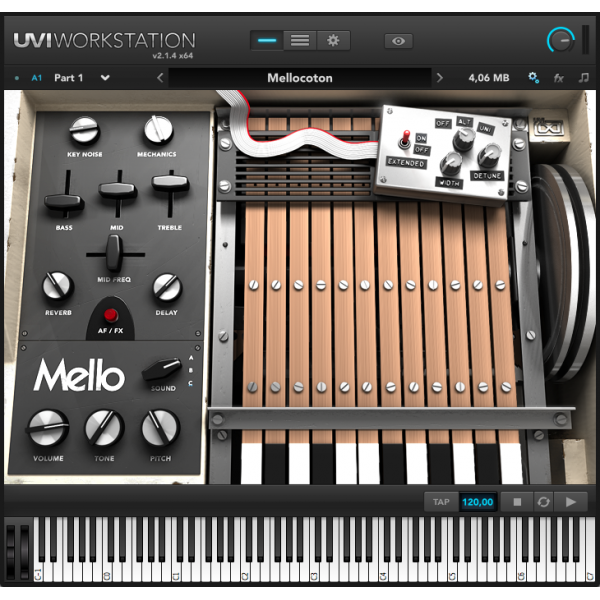
The Mellotron was made famous by John Lennon, and in the spirit of the Lennons’ ongoing humanitarian effort, UVI are pledging to match donations made by its customers to the Japanese Red Cross to help survivors of the Fukushima earthquake over the next three months, during which time Mello (normally $99) will be available for free.
For those unfamiliar with the Mellotron, it was one of the earliest samplers and used tape to capture the desired sounds. When a key was pressed, the Mellotron would pull a section of tape through a magnetic play head to produce a sound. Originally built in 1963, the Mellotron became popular throughout the ’60s and 70s with bands and artists such as The Beatles, Pink Floyd and David Bowie, and although they fell out of fashion for a time, they have been used more recently in big tracks from Radiohead and Vampire Weekend.
UVI have multisampled dozens of original tapes to create the most faithful recreation of the original intstrument. Being a sampler, the Mellotron had a whole range of available sounds and Mello provides 28. These are: Brass, CelestaAndVoice, Cello1, Cello2, ChoirFemale, ChoirMale, ChoirTron, ChurchOrgan1, ChurchOrgan2, ChurchOrgan3, Clarinet, Flute1, Flute2, Guit12Str, GuitElectricA, GuitElectricB, GuitSpanish, Harp, Oboe, Piano, Sax, Strings1, Strings2, Strings3, Strings4, Vibraphone1, Vibraphone2, and Viola.
Free iLok from UVIUVI’s Mello requires an iLok, which UVI are also doing a great deal on. If you buy an iLok from their web site you’ll receive a coupon for the value of the iLok plus shipping ($78), which can then be redeemed against any future purchase from the UVI store.
For more information on the iLok deal, go here: http://www.uvi.net/en/store/ilok-smart-key.html
For more about Mello, go here: http://www.uvi.net/en/vintage-corner/mello.html
New features in Live 9.1 revealed
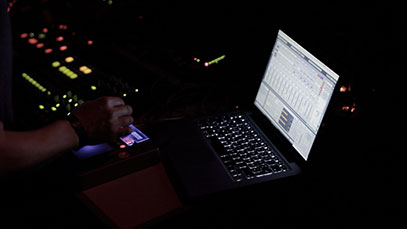
Ableton offered a sneak peak at an upcoming update to Live 9 at an event held with Kompakt Records in Berlin. Ableton offered a preview of Live 9.1 – a free update that promises dual-monitor support and other frequently requested features.
New in Ableton Live 9.1:
- Dual-monitor support – view Arrangement and Session views on different screens.
- New integration with Push – this will include step sequencing of melodies (not just drums), and step sequencing of automation
- Improved rendering when downsampling on export, which, depending on your workflow, may result in better final audio quality.
Ableton has not made an official announcement for Live 9.1, so details on the upgrade are to come, along with timing for the release
Sound Design Tutorial: Creating Synth Leads Using ‘Sync Modulation’ in Native Instruments Massive
In this tutorial, electronic music producer Evan Sutton (a.k.a. Astrolith) shows you how to create synth lead sounds using ‘sync modulation’ technique in Native Instruments’ Massive.
Cubasis DIY send effects using Audiobus
Cubasis tutorial showing how to use 3rd party iOS effect apps with Audiobus as ‘DIY send effects’ within Cubasis.
Novation Launchkey Mini – Overview
Launchkey Mini is an exciting new compact mini-key instrument/controller featuring 16 velocity sensitive, three colour illuminated launch pads – use them to launch loops, sounds, effects, transport controls, and more.
Launchkey Mini also features a 25-note keyboard, eight assignable rotary controls, seven function buttons, and a further two performance buttons. Compact and portable, Launchkey Mini is great for producing and performing at home or on stage.
—
Launchkey Mini key features:
‘Go anywhere, play anywhere’
– Ultra-lightweight and easy to carry
– Fully powered by iPad® or USB
• 25-note mini-keyboard
• 16 velocity sensitive, three colour launch pads
• Knobs and buttons for total control
• Fully-integrated with Novation apps for iPad
• Hands-on control of included synths and music software on Mac and PC
For more details, check out the product page here:
http://global.novationmusic.com/midi-…
—
Performance courtesy of Peter Lyons –
New DVD from In Strict Confidence
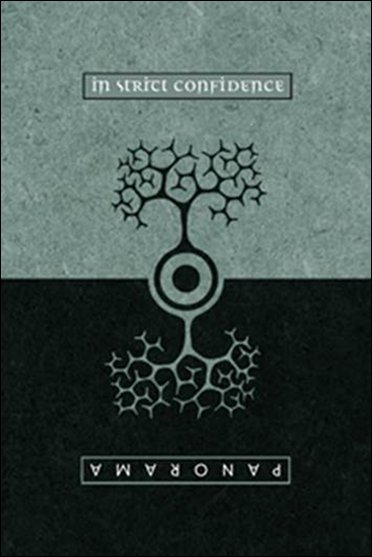
Out on September 29th is the first official live DVD for German act In Strict Confidence. Out on Minuswelt, “Panorama” brings a mix of current and older material, plus previously unreleased videos und slideshows.
The tracks included on the DVD are:
- My Despair
- Morpheus
- Silver Bullets
- Forbidden Fruit
- Tiefer
- Ewige Nacht
- Heal Me
- Engelsstaub
- Karasevdah
- La Parade Monstrueuse
Slideshow
- Seven Lives
- Promised Land
- Kiss Your Shadow
- Schlecht geträumt
Debut singel from Delaykliniken – Everywhere
Everywhere video with actor Helena Helena Sandström. Filmed on location in Stockholm at Skogskyrkogården, Skokloster and Bar Side Track,
July 2011. Director and cinematographer Johan Svenson
Wersi Bass Synth and Korg Microkorg
Sounds. Footage. Recording. Music. Self-explanatory.
The Wersi Bass Synth is a mono VCO machine built in 1977 – it’s not really a ‘preset synth’ but it doesn’t have standard vco/vcf/lfo controls either. It features a bassguitar sound with adjustable release, a pulse and saw wave which can be filtered with a formant filter with adjustable envelope and lfo (only the depth, speed and polarity) and a sine wave. There also is a pitch envelope (called glide) and a tremolo (adjustable depth and speed).
More on the Wersi:
Billed as two instruments in one: an Electric Bass Guitar and Synthesizer, this compact light-weight instrument from German organ builders WERSI was aimed at keyboard and organ players. The purpose was to give the organist/keyboardist some Bass Guitar and Synthesizer sounds they could incorporate into their performances. It is a monophonic analog synth with funky controls, decent sounds and a unique character.
The Bass Guitar sound is actually very realistic, really capturing the sound of an electric bass guitar or acoustic bass. It has an attack control called “On” that lets you adjust the initial attack to make it sound like a picked bass or a fingered bass. A “Damp” control is essentially a sustain envelope that can be used to create more of a muted bass sound.
The Synthesizer section is pretty basic, and definitely designed using organ player lingo as opposed to synth player lingo. There a five flute stops (sine) from 16′, 8′, 4′, 2′, to 1′, two brass stops (sawtooth) at 16′ and 8′ and a woodwind stop (square) at 8′. Multiple stops and waveforms can be simultaneously engaged to create more complex tones. These waveform sections, as well as the Bass Guitar section, have independent volume controls to balance their mix.
There is a filter section—a formant filter referred to as “Wah-Wah”—that the brass (sawtooth) and woodwind (square) waveforms can be effected by in either automatic or manually adjusted modes using the “Wah-Wah” slider. No frequency cutoff or resonance knobs or anything usual like that here. Just an “On” switch, direction switch (“Up/Down”), a manual switch and a “Rotor” (auto) switch. A simple envelope section is available with attack and sustain parameters.
A unique “Glide” slider can be used to pitch shift the keyboard by an entire octave. The octave shift can also be automated up or down at variable speed. A really interesting feature is the “Hawaii” button—an intermittent switch that drops the pitch by a half-tone. It is effectively like a pitch bend but only goes down and at a quick fixed rate. A Vibrato effect is available as well, with rate and depth controls and either continuous or delayed modes.
The WERSI Bass Synthesizer was available in kit form but also came pre-assembled with many keyboard/manual options. The idea being that you could connect it to the keyboard or pedals of your organ, or you could choose from WERSI’s 13-, 25-, and 30-pedal claviers. WERSI provided connector kits and a wiring diagram to help connect your own keyboard or pedals to a 16-pin connector interface on the rear of the unit. It was encased in a carry-case-style chassis with a handle and cover.
If looking to buy one of these, potential units should be closely examined, as the original assembly may have been done by the factory or second hand. As a result, a unit may not always be fully functional. Also, some units may have been modified over the years with the original push buttons and knobs replaced by alternative switches and knobs. Other things to consider: is the cover included, are any of the pedal board and connector kit options available and are the owner’s manual and assembly instructions available.
DATAMASKIN

