
Modular synthesizers: 69 chord machine²s
Modular madness – tech specifications below:
Flame two Chord Machines CM1 arp out to CM2 in, CM2 arp out to CM1 in
4ms Peg ,RCD
Doepfer A 143-1, A 134 panning by A 143-9 , Maths ,Moog MP 201
foh choices to A 152 (4 ms RCD all outs to A 152)
Make Noise,Maths, 2 x Moddemix (Ringmodulators Antis & Uncles),
Optomix,QMMG, 2xWogglebug
Malekko 4x Anti Oscillator cv by CM1, 3x Uncle cv by CM2 ,Noisering
Moog Freqbox 4x
Tip Top Audio Z 8000 cv source for Chord Machine 1&2 chord input
Toppobrillo 2x Quantimator (~CM²s), Sportmodulator filter S&H
SSL Modulation Orgy
Logic midi masterclock to
Kenton Pro 2000
drums 12/8
kick RS 110 QMMG
snare Noisering RS 110 QMMG
FX Boss VF 1, Lexicon PCM 80 / 90
KORG Volca Keys : Experimental play
Background video description:
Trying noisy sound making on Volca keys.
Fake avant-garde music 😉
( Sorry if you don’t like this kind of kidding play. )
Checking in with Native Instruments’ supergroup Mostly Robot
Meet a supergroup formed by Native Instruments, that includes artists Jamie Lidell, Tim Exile, Jeremy Ellis, Mr. Jimmy and DJ Shiftee. Watch as they explain how the group works and show of the tech that powers it.
Adam Fielding on music creation and working with Reason
For more information on Reason:
http://www.propellerheads.se/tryreason
When Adam and his brother tried programming their own computer games as kids his own attempts were terrible. Fortunately however, the music Adam made for those games using ProTracker software on the old Atari ST computer wasn’t terrible. In fact, it was so good he quickly outgrew what he could achieve on such a basic set up. After a recommendation from a friend and seeing the rack cables in action for himself, Adam was quickly a Reason user and now even pushes Reason to its limits with his epic full-bodied synth soundtracks.
After a couple independent releases, Adam Fielding’s music caught the attention of Distinctive Records in the UK who promptly signed him for those and future releases. Now Adam splits his time between producing his own albums and soundtracks for TV and film use.
We caught up with Adam to check out how he builds up his ideas and arranges them in Reason using Blocks.
——————-
Project Genesis appears with permission from Conspiracy – www.conspiracy.hu
Anaphobia Destro 1.0 arrives!
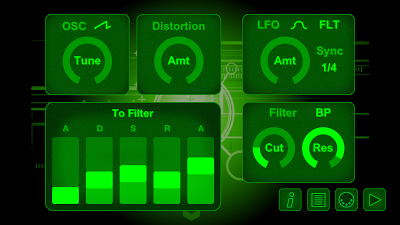
Destro is another monophonic virtual analog synthesizer and goes on where AnaMini ends. Once again a monophonic virtual analog synth, Destro features one VCO, two LFOs, a noise generator, a VCF and a VCA. On top of the synthesizer, Destro also provides a programmable step sequencer so you can create your own patterns and songs. Furthermore, Destro adds a noise generator and foldback distortion unit, as well as a 3-part drum synthesizer module!
Features (Synthesizer)
- One main oscillator (VCO) with selectable wave type (saw, square, noise and sine) and scalable within the range of -1 and +1 octaves.
- Two low frequency oscillators (LFO) with selectable wave type (saw, square, noise and sine) and selectable frequency/rate and depth. LFO1 modulates VCO1 frequency while LFO2 modulates VCF cutoff frequency. LFO’s synchronise to MIDI/sequencer tempo at 1/32, 1/16, 1/8, 1/4, 1/2, 1, 2, 4, 8 or 16 notes.
- One VCA with fully customizable ADSR(A) envelope.
- One 24dB/octave VCF with three filter types (Low Pass, High Pass and Band Pass), selectable cutoff frequency and resonance and a fully customisable ADSR(A) envelope.
- One noise generator with fully customisable ADSR(A) envelope.
- Foldback distortion unit with adjustable threshold.
- 5 factory presets.
- 10 custom presets.
Features (Sequencer)
- 4 beats-per-pattern, 4 steps per beat step sequencer.
- Adjustable tempo from 20-200BPM.
- Adjustable swing.
- Supports note on, note off and legato commands.
- Supports MIDI Clock IN synchronisation
- 5 factory patterns.
- 10 custom patterns.
- Features (drum synthesizer)
- Bass drum, snare drum and hihat parts, using the same synthesizer technology as the main synthesizer.
- Each part has its own track in the sequencer.
Note: first content update will follow soon and will contain the following features:
- 3-Octave keyboard/ribbon controller
- AudioBus support
- Audio record and export function
Anaphobia Destro is priced at $1.99.
Grids and Jupiter Storm Euro Modules
Video demonstrating several instances of Grids and Jupiter Storm.
Kick:TipTop BD909 Cwejman BLD Open Hat:Jupiter Storm Noise>WMD Synchrodyne BPF Noise Percussion:Jupiter Storm Noise>Synchrodyne BPF>WMD MMVCA (stereo panning) Bass:Grids>Cwejman BLD Clap:Grids>Tip Top 909CP>Make Noise Echophon Chords:Grids>Cwejman ADSR-VC2. Bubblesound VCO>Erthenvar Patch Chord>SynchrodyneLPF>Make Noise Echophon Snare:Grids>Jupiter Storm>Echophon No Midi No EQ Sync to Pro Tools>Innerclock IILS
Interview: Karl Bartos talks Kraftwerk, synths and his latest album
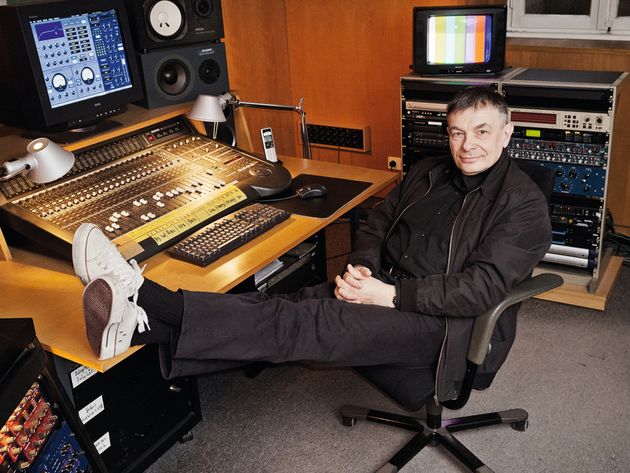
Here’s a new interview with Karl Bartos where he discusses everything from vintage machines to his latest album:
Never meet your heroes, or so the old maxim goes, but FM is delighted to report that our recent encounter with bona fide Electronic music legend Karl Bartos put paid to the notion that meeting one’s heroes is inevitably doomed to end in disappointment. In the flesh, Bartos is a charming, erudite man with a philosophical take on Electronic music that reflects itself in the pristine synthesized contours of the music contained on his latest LP, Off The Record.
From his time as a member of seminal German Electro Pop purveyors Kraftwerk, through his consequent Electrik Music project and collaborations with Bernard Sumner and Johnny Marr on their Electronic albums, Bartos has been a key figure in the synthesised music story. Off The Record, released in March, saw Bartos revisit his ‘secret acoustic diary’ of musical sketches and ideas built up during his Kraftwerk days and fashion them into an album that manages to simultaneously sound contemporary and timeless. With trademark vocoded vocals to the fore and his keen ear for a digital melody line still intact, we met with Bartos for a whistle-stop tour of the gear he employs to such stellar effect in his ergonomic Hamburg nerve centre.
How did you set about the Herculean task of trawling through your digital media archive to begin creating Off The Record?
“Well, I’m over it now but it was a hell of a job! There were tons of cassettes, 1/4″ tapes and various other stuff. I moved my archive when we went from Düsseldorf to Hamburg and there was boxes and boxes of it and various rooms full of it along with old synthesizers. I always avoided going through the archive to put things in order until Gunther from Bureau B [Bartos’ German record label] said, ‘Karl, do you have any old recordings?’ I refused initially but finally gave in… I’d always wanted to do it, and knew I had to, but it took me several weeks and the sound quality was rotten with many tapes broken. Eventually, I managed to get most of it into the computer. I saw that everything was dated 1977, 1978, etc, and I thought, ‘That’s a diary. An acoustic diary.’ So I made it a concept. You do that kind of thing but usually just inside your brain – you refer to the things you’ve done before. It’s the way we organise our brains. I also had to write about the concept and where the songs came from.”
Were you quite meticulous about correctly marking or naming ideas back in the days when you were building your archive?
“You do what you do. I’d come up with a name, ‘Neon Piano’ or whatever, and I’d sometimes write the date. Sometimes not. Most cassettes had a name or a date on them. I also found a lot of stuff on Zip and Jaz drives but even some of those were damaged or didn’t work. Between all the different media I pretty much managed to retrieve everything eventually, though.”
Were there a lot of nice surprises?
“It was all such a surprise and funny to hear a song I’d done without a trace of emotion sitting beside something like Computer World [Kraftwerk, 1981]. It made me feel a little sentimental at times. Once I had them in order, it was easy for me to collate and collage them.”
Your first computer set-up was the IBM XT running Voyetra Plus sequencing software. That must have felt like going supersonic after using tape?
“It was a real revelation. We were recording Electric Café [Kraftwerk, 1986] at Kling Klang [the band’s private studio originally located in Düsseldorf, Germany], then we took it over to Right Track Studio in New York where François Kevorkian and Fred Maher introduced me to the Voyetra Plus software he had running on a laptop.
The full interview from Music Radar can be found here >>
Fresh electronic music videos from Austra, Goldfrapp and Tyske Ludder
Music video for Painful Like performed by Austra.
Buy Painful Like at iTunes – http://smarturl.it/PainfulLike
Buy Olympia at iTunes – http://smarturl.it/Olympia
Buy Olympia at Domino – http://www.dominorecordco.com/olympia
Directed By: Exploding Motor Car
Camera: Adama Makarenko, Sylvain Chaussée
Production Design: Winston Hacking
Editor: Brett Long
Puppeteer+Puppet Build: Brett Long
Production Assistant: Max Parr, Amanda Wyman
Stunt Doubles: Martin MacPherson, Tony Wallace, Winston Hacking
Produced By: Winston Hacking
Animation: Brett Long
Skaters: Daniel Lefebre, Aaron Wheat, Taylor Ritchie
Chef: Yukiko Hara
Colourist: Evan DeRushie
‘Drew’, from the forthcoming album “Tales of Us” (out 9th Sept UK / 10th Sept US).
Having trouble viewing the video ? See it here: http://vimeo.com/70190035
Pre-order “Tales Of Us”: iTunes: http://smarturl.it/talesofusitunes
Direct: (including the exclusive Deluxe Box set): http://goldfrapp.sandbaghq.com
CD: http://smarturl.it/talesofusCD
LP: http://smarturl.it/talesofusLP
Trailer and all films are co created by Alison Goldfrapp & Lisa Gunning.
Trailer and all films written, directed & edited by Lisa Gunning.
Produced by Stephanie Zari. Cinematography by Brian Strange.
Information:
Mit der limiterten EP “Bambule” präsentieren Tyske Ludder einen Vorgeschmack auf das kommende Album. Eine markante Stimme, treibende Beats, schwebende Synthflächen und coole Ideen verleihen der EP den Schuß Charakter, den ein ordentliches Electro-Release heutzutage braucht. Tyske Ludder! Noch Fragen? Erscheint im exklusiven nummerierten Digifile, streng limitiert auf 1000 Exemplare (keine Nachpressung)!
Tracklist:
01. Bambule (Mexican Edit), 02. U-Boot (Dive into Fear Edit), 03. Bambule (EvvilKing-Mix by Steril), 04. Bambule (Harmbule-Mix by Harm Joy), 05. Bambule (Tikka Masala Remix by Implant), 06. Bambule (Feindflug Rmx)
Ableton Live 9 in 9 Minutes (straight to the point)
Here’s a quick guide to Ableton Live 9 in 9 minutes.
“There are dozens of videos out there that explain the new features, but I didn’t manage to find one that covers everything in the shortest amount of time possible (including mine!) – so I made one. I hope you like it.”
Stone in the heart — Midera — Korg EMX electro house
“A little different than what I’m used to. The EMX houses some awesome sounds within it, though.”
The ELECTRIBE MX is a major step up in power and quality from the original ElecTribe series of dance music sequencer/synthesizers from Korg. The EMX-1 comes in a sturdy metal chassis with larger back-lit LCD display, expanded memory, voices & multitimbrality, more real-time controllers and vacuum tubes! Effects, Motion Sequencing, and Pattern length have also been expanded. And a new ribbon controller and slider have been added, providing a remarkable realtime interface for accessing the powerful arpeggiator.
Starting with its synth engine, the EMX-1 uses MMT synthesis (Multi Modeling Technology) which offers sixteen different oscillator algorithms, providing powerful analog synthesis models as well as sophisticated additive, PCM, chord, unison, combination, wave shaping, formant models and more. The built-in PCM library includes 207 drum PCM sounds and 76 synth PCM sounds ready for immediate use, ranging from powerful kicks and snares through amazingly unique organic sounds. External audio signals can be manipulated using the Comb Filter oscillator algorithm, and then further processed by the internal filter and effects. The EMX-1 allows you to create up to nine drum parts, five synth parts, plus accent parts that let you add dynamic accents to the drum and synth parts (for a total of 16 parts). Each part features extensive LFO and EG modulation. Each algorithm of the synthesis engine has two realtime adjustable parameters, plus some other menu-based parameters like waveform type, or chord quality. The brand-new filter lets you chose Low Pass, High Pass, Band Pass or Band Pass Plus.
The two Vacuum tubes (Valve Force Circuitry) create an analog tube circuit to add warmth and presence to your sounds. The tube gain knob adjusts the level of the output signal passing through the vacuum tubes, creating dynamic sounds with the distinctive tonal quality that only tubes deliver. Three stereo effect processors are available for simultaneous use. Each part can be independently routed to any of the three effects processors, and you can even use the Chain function to link multiple effects in series. Each processor offers 16 effect types including reverb, delay, flanger and chorus, tempo-based delay, talking modulator, grain shifter, decimator and more. The edits you make to each of the effects processors can be saved with each pattern.
As for the sequencing capabilities, up to 256 patterns can be created and stored to the internal memory. The EMX-1 ships with 196 assorted patterns covering house, hip-hop, R&B, electronica, drum n bass, techno, trance and more. You can combine patterns, add mute data and knob movements to create up to 64 songs, the EMX-1 ships with 3 demo songs. Favorite patterns can be assigned to Pattern Sets for instant access. Data can be quickly saved and loaded via SmartMedia cards. Realtime recording lets you record phrases as you perform, and step recording allows you to input the timing, pitch and duration one note at a time. Motion Sequencing records your realtime knob tweaks and plays them back as part of the pattern. Two types of motion sequence are provided; one for effects and one for parts, and you can also edit the value of individual steps. Up to 24 motion sequences can be used in a single pattern, allowing you to control virtually every sound parameter. And, using Auto BPM detection, the EMX-1 can follow the tempo of an external audio source. You can also use Tap Tempo to input the beat, set the tempo internally, or sync up to an external MIDI clock.
DATAMASKIN

