
Auria LE has arrived – the professional digital audio recording system for iPad
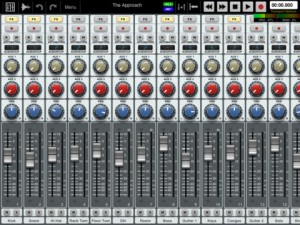
Auria LE – the professional digital audio recording system for iPad.
The mobile DAW you’ve been dreaming of has finally arrived. Auria LE is a 24-track digital recording system designed from the ground up for the iPad. With professional-level features and optional third-party plugin support from names like PSPaudioware, Overloud, Fab Filter and Drumagog (available via In-App purchase), Auria clearly sets a new standard for mobile recording.
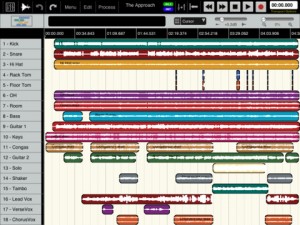

FEATURES:
- 24 tracks of simultaneous playback of stereo or mono files (upgradable to 48 tracks).
- Up to 8 tracks of simultaneous recording when used with compatible USB audio interfaces (upgradable to 24 tracks of recording) Camera Connection Kit required.
- 24-bit recording
- Supports sample rate of 44.1KHz only (upgradable to support 48K and 96K sample rates)
- Vintage-inspired ChannelStrip on every channel by PSPAudioware includes Expander, Multiband EQ and Compressor
- MasterStrip on all subgroup and master channels featuring PSPAudioware BussPressor, EQ and Mastering Limiter
- Third party VST effect plugin support available via in-app purchase (only iOS-version plugins are supported. All plugins must be purchased through the in-app store)
- ClassicVerb reverb plugin included
- StereoDelay and StereoChorus plugins included
- 2 Assignable subgroups(upgradable to 8) and 2 aux sends
- Powerful waveform editor with features like cut/copy/paste, duplicate, separate, gain, and more
- Flexible snapping tools allow snapping to events, cursor, bars, beats and more
- DropBox, SoundCloud and Audio Copy/Paste support
- Full automation support on all controls with graphical editing
- True 100mm faders when used in Portrait Mode
- Optional video import feature allows sample accurate sync of video to an Auria project with adjustable offset times and video export capability
- Timeline ruler options include minutes:seconds, bars:beats, samples and SMPTE time
- Auto-punch mode
- Full delay compensation on all tracks and subgroups
- Adjustable metering modes, including pre or post fader, RMS and peak
- Adjustable pan laws
- Sample accurate loop function
- Automatic sample rate conversion
- Built-in metronome
Includes a demo song mixed on Auria by Grammy winning producer/engineer David Kahne.
REQUIREMENTS:
iPad 2 or later strongly recommended.
Requires iOS 5.0 or later
USB audio interfaces require Camera Connection Kit
David Bowie on the move after 10 years of silence – listen to the new track here
“Where Are We Now?” is David Bowie’s return to the music business and was produced by Tony Visconti and written by Bowie. The single is taken off his upcoming “The Next Day” album and is only available from iTunes (direct link) as part of the new 17-track album (when you buy the new album you can already download the track). It’s been over 10 years since we got a new album from Bowie. Together with the new track, Bowie also released a brand new video . The music video was directed by Tony Oursler and features footage from Bowie’s time in Berlin.

The track – a gently affecting work of understated melancholy, framed by resonant piano-and-guitar treatments – and its parent album were both produced by longtime Bowie collaborator Tony Visconti. Where Are We Now? is accompanied by a haunting video directed by Tony Oursler and recalls the singer’s mid-to-late ’70s Berlin period. Bowie is seen in the clip looking in on footage of the auto repair shop beneath the apartment he lived in at the time.
The release of Where Are We Now? and The Next Day was announced on the singer’s website in a statement which reads: “Throwing shadows and avoiding the industry treadmill is very David Bowie despite his extraordinary track record that includes album sales in excess of 130 million not to mention his massive contributions in the area of art, fashion, style, sexual exploration and social commentary. It goes without saying that he has sold out stadiums and broken ticket records throughout the world during this most influential of careers.
“In recent years radio silence has been broken only by endless speculation, rumor and wishful thinking… a new record… who would have ever thought it, who’d have ever dreamed it! After all David is the kind of artist who writes and performs what he wants when he wants…when he has something to say as opposed to something to sell. Today he definitely has something to say.”
No news yet as to whether Bowie will tour in support of The Next Day. For more information, including the album’s tracklisting, visit the official David Bowie website.
IK Multimedia Rocking the World of Mobile Music Accessories
IK Multimedia has announced iRig Recorder for the Android operating system.
iRig Recorder is a simple to use audio recording app that can start recording immediately when it is launched making it a perfect “on the spot” field recorder. Users simply launch the app and hit the record button, or can also configure the app to start recording audio immediately upon launch.
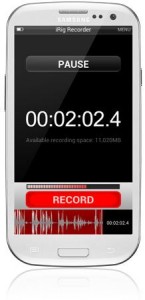
The app automatically groups recordings by date, tags them with geographic location information, and saves the original file as a backup. Recording time is limited only by the available memory on the device.
iRig Recorder also provides a waveform editor, which allows for selecting, cutting, and cropping of the audio content. Automatic onboard audio processing options can optimize recording levels and tone, remove background noise and more. The app can also speed up or slow down a recording without changing the timbre.
Export Options
Finished recordings can be shared by e-mail and FTP, over Bluetooth, through USB cables, from an SD card, or via apps installed on the device. Files can be exported as CD-quality WAV files, or as compressed .ogg files, ranging from 64 to 192 kbps.
A free version of iRig Recorder is also available, which provides the same recording, level-optimization and export features as the full version, and users can add the editing and additional processing via in-app purchase.
Pricing and Availability
iRig Recorder will be available at the end of January on the Google Play Store, and is priced at $4.99.
Video description:
See it all NOW at CES!!! More information: http://www.ikmultimedia.com/news/events/?item_id=1983
iRig HD: http://www.ikmultimedia.com/news/events/?item_id=1978
See latest IK products, photos and more happening at this year’s CES
The best and the brightest come to CES to display their new innovations for the year and at the IK Booth you’ll see no one rocks the world of Mobile Music Accessories like we do!
Get latest product announcements, images and more by visiting the CES Show Report. Also follow us on Twitter, Facebook and YouTube for more CES coverage. Or check back here on the IK site for new IK product announcements that will rock CES socks off!
Show attendants can also come by the IK Booths for hands on demonstrations of current and upcoming products.
Consumer Electronic Show (CES)
Las Vegas, Nevada
January 8-11, 2013
10am-6pm
North Hall, Booth 5625
Moog Factory Tour: Minimoog Voyager
Jim Debardi from Moog Music takes us on a tour of the Moog Factory to give us a history of the Minimoog synthesizer and to show us how they handcraft the Minimoog Voyager.
Maschine Meets Modular – A Lo-Fi Hip Hop Instrumental
Maschine Meets Modular in this grimey, lo-fi hip hop instrumental featuring the Intellijel Korgasmatron analog multi-mode filter. The faux-sample is the sound of the frequency modulated Korgasmatron self-oscillating low pass filter. No oscillators were used. The bass and drums are Maschine.
Logique Analogique – Simulation of a real circuit board on iPad
http://apps4idevices.com/read/logique-analogique
Logique Analogique is a simulation of a real circuit board that includes an 8-bit binary counter, analog implementation of logic functions, and 4 channel, 1-bit sound generation.
To quote the developer, “The Logique Analogique sequencer consists of an 8-bit binary counter and four tracks which generate pulse waves when a user-defined majority function depending on the counter bits is true. Switches which select the counter bits (or their logic inverse) and a threshold voltage define the majority function. The output is calculated as the XOR function of the four tracks’ signals, which produces a ring modulation like effect.”
“Complexities aside, this app creates incredibly powerful sounds, with a seemingly endless amount of rhythmic possibilities. The sounds can be layered to create ring modulation type effects, with both pitch and threshold control to further shape the sound. The sequencer makes it possible to create evolving patterns or complete songs, using the tap & drag method to easily create your sequence. I would suggest starting slowly with this app, to hear the effect of each switch or dial, but then dive in and explore. It has to be noted that this app does not offer any method of recording yet, but both MIDI and Audio Copy are currently being considered for the future. Despite these missing necessities, I have to say that I’m incredibly impressed with the power of this app, and for the first time, I’m willing to connect my iPad to another source to record my creations. I haven’t found another app that creates such intense sonic delights as this does. I’m so taken with Logique Analogique, that even without recording or MIDI, I still have to rate it … A Killer App!”
NAMM 2013 – Rumors of a MonoMoog coming
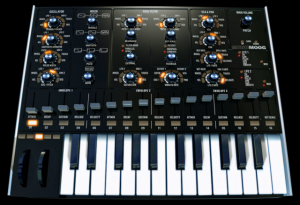
As we are well accustomed to rumors are starting to spread on what will be released at the NAMM show, only three weeks away now. Expectations are high for a new synth from Moog Music – perhaps something like this MonoMoog, which likely comes from the special category of Photoshop synths.
The Yamaha CS-50 – The Oscillator
Here is part 1 of a series of demonstrative videos regarding the Yamhaha CS-50. This is a demonstration of the oscillator section of the Yamaha CS-50.
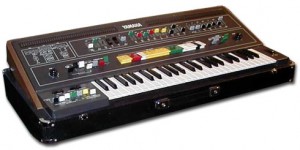
The CS-50 was released just one year before its famous big brothers, the CS-60 and CS-80. The CS-50 looks like a scaled-down version of the monstrous CS-80, and it is! This will benefit those who crave the famous classic Yamaha synth sound without the struggle of lugging around the 215 pound CS-80! The CS-50 weighs in at about 100 pounds. The CS-50 is also just 4-voice polyphonic, and lacks the quality weighted 61-note keyboard of the CS-80. The CS-50 has just a 49-note standard keyboard. It does feature pressure (aftertouch) sensitivity route-able to several destinations, however.
The CS-50’s sound is unmistakably related to other classic CS-series synthesizers. At just four voices with one osc. per voice and lacking warm filters (at just 12dB/oct) the CS-50’s sound can be thin. There are 13 preset sounds of various instruments and synth sounds but, unfortunately, no on-board memory storage for your edited presets. At its low street price, the CS-50 makes a great way to get your hands on these classic sounds without going broke! It’s too bad their tuning is just as unstable as the other CS-series synths. It’s housed in a built-in travel-case like the other (big) CS-synths.
30th Anniversary of MIDI – by Roland
One standard started it all. One technology allowed different musical devices and computers to all speak the same language and make beautiful music together. Thirty years ago, MIDI was born…and the rest is history.
Time machine – Exploring the Moog Taurus 1
A voyage into the heart of the Moog Taurus 1 bass pedal from the year 1976.
Exploration by Marko Ettlich (RetroSound)
analog bass pedal
2 VCOs, VCF, VCA
three basic preset sounds: Taurus, Bass, Tuba + Variable Sound
used by Genesis, The Police, Pink Floyd, Marillion, Saga, Jarre, Yes and many more
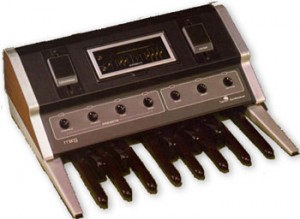
Inspired by organ pedal boards, Moog released the Taurus Pedal Synthesizer – a monophonic analog bass synthesizer you play with your feet (so you can play other instruments with your hands). Originally, the Taurus was going to be part of a larger ensemble system called the Constellation. It was to include two keyboard synthesizers, the Apollo (polyphonic) and the Lyra (monophonic), and the Taurus foot pedalboard synthesizer. The Constellation project never made it to production, but the Taurus was released on its own, while the Apollo keyboard went on to evolve in to the Polymoog.
The Taurus has three Preset sounds and one User programmable. The three preset sounds are Bass, Tuba and Taurus. Most users prefer the Variable preset which lets them synthesize their own sounds using the simple VCO, VCF and VCA controls. The shaping controls are hidden behind a plastic window to prevent accidental foot tweaking.
The Taurus is monophonic, with sound generation coming from a simple two-oscillator design that can be tuned across a 5-octave range. An Octave button lets you shift the pedal keyboard up or down an octave, the direction must be set using the Octave switch in the Variables section. There’s also a Glide (portamento) effect and a Decay effect. The amount of Glide and Decay are also set in the Variables section. Like any Moog, there is a 24 dB/oct lowpass filter with controls for Emphasis, Contour Amount/Attack/Decay and Cut-Off. Two gigantic foot-sliders flank the sides of the Taurus and they are used to adjust the Filter cut-off and VCA Loudness on the fly using your feet.
DATAMASKIN

