
Skoda – Glass Harp
Director: Sehsucht
KORG iPolysix for iPad mini & iPad
The new “KORG iPolysix” polyphonic synth studio for the iPad mini!
iPolysix is an analog polyphonic synthesizer that’s been carefully designed to take full advantage of the 7.9-inch display of the new iPad mini as well as the iPad. Bringing together a sequencer, drum machine, and even a mixer, it transforms your iPad or iPad mini into the ultimate analog synth studio. Pack an amazing set of early-’80s analog equipment into your iPad, and time-travel back to the dawn of polyphonic synthesizers!
Available on the App Store
http://itunes.apple.com/app/id579232173

Full description below:
The new “KORG iPolysix” polyphonic synth studio for the iPad mini & iPad!
Special Introductory Sale – 50% OFF! Offer valid until December 31th!
iPolysix is an analog polyphonic synthesizer that’s been carefully designed to take full advantage of the 7.9-inch display of the new iPad mini as well as the iPad. Bringing together a sequencer, drum machine, and even a mixer, it transforms your iPad or iPad mini into the ultimate analog synth studio. Pack an amazing set of early-’80s analog equipment into your iPad, and time-travel back to the dawn of polyphonic synthesizers!
❮Highlights❯
● The world-wide best-selling Polysix polyphonic synthesizer, fully replicated on your iPad
● Use the newly developed Polyseq polyphonic step sequencer to control the Polysix
● A music production environment including two Polysix units, a drum machine, and a mixer
● Dual Kaoss Pads with chordal support make it easy for anyone to play analog synth sounds
● Polyshare powered by SoundCloud lets you publish, share, and remix songs with iPolysix users
☐ The world-wide best-selling Polysix polyphonic synthesizer
Korg’s Polysix, a six-voice analog polyphonic synthesizer, went on sale in 1981. While a popular synthesizer of that time was able to produce only five notes simultaneously, the Polysix had six-note polyphony, and its name was an expression of its designers’ pride. iPolysix uses Korg’s proprietary “CMT” (Component Modeling Technology) to simulate the actual electronic circuits of the original unit, perfectly reproducing the original Polysix.
☐ The newly developed Polyseq polyphonic step sequencer
Polyseq is a polyphonic step sequencer that provides up to 64 steps, newly developed in order to take full advantage of the Polysix’s capabilities. Polyseq provides a different operating feel than a conventional piano-roll sequencer or even a step sequencer; it’s a new yet somehow familiar experience, as if you were retracing the evolution of electronic musical instruments. Don’t miss the opportunity to try out this perfect match; the Polysix+Polyseq.
☐ A music production environment including two Polysix units, a drum machine, and a mixer
iPolysix has been created as a professional music production tool. In addition to two Polysix units, it provides a six-part drum machine, and an analog mixer that’s reminiscent of the KMX-8 mixer. You’ll have everything you need to produce great sounding music. Surrounded by analog equipment, you’ll imagine that you’ve time-traveled back to the early ’80s.
☐ Dual Kaoss Pads with chordal support
The large multi-touch display shows two Kaoss Pads which you can control using both hands to perform music. This enables creative performance even for those who have no musical knowledge. These Kaoss Pads have been customized for iPolysix to allow not only single-note performance, but also chordal playing with just one finger; a new experience made possible only by a combination of new and old technology, the Polysix+Kaoss Pad.
☐ Polyshare powered by SoundCloud lets you publish, share, and remix songs with iPolysix users around the world
Polyshare is a function for iPolysix users to share their songs. It’s based on SoundCloud, the song sharing service favored by music creators. You can make your song available to iPolysix users around the world simply by uploading the song directly from the app. You can download and upload remixable tracks. It’s easy to enjoy remixing and collaboration with users around the world.
*You’ll need a SoundCloud account to use Polyshare. A variety of account types are available. For details, please refer to the SoundCloud http://soundcloud.com. Use of SoundCloud is subject to the usage conditions specified by the SoundCloud company, including prohibition of copyrighted songs.
Compatibility
– iPad mini or iPad series (iPad 2 or later is recommended)
– iPolysix is a dedicated iPad app.
Follow Us!
● Facebook : http://www.facebook.com/korg.iapps
● Twitter : http://www.twitter.com/korg_iapps
Cubase 7 – Mixer Window demonstration
Cubase was on show at the Music Production Show at London’s Emirate Stadium this week.
“We grabbed product specialist Andy to show us more about the new Mixer Window”
Audiobus: Filtering FunkBox and Sunrizer with NLog into Loopy HD
Sebastian uses Loopy HD to loop Sunrizer and FunkBox being filtered by NLog. Audiobus is a communications channel for sending live audio, like the audible output of a synthesizer app, or the output of a guitar amp effects app, for example.
http://audiob.us
Funkbox: https://itunes.apple.com/app/funkbox-drum-machine/id350437349?mt=8
NLog Synth PRO: https://itunes.apple.com/app/nlogsynth-pro/id393879841?mt=8
Sunrizer: https://itunes.apple.com/app/sunrizer-synth/id443663267?mt=8
Loopy: https://itunes.apple.com/app/loopy-hd/id467923185?mt=8
Grain Bender Bending!
Grain Bender, a synthesizer that shapes the sounds using the real time bend button. Lots of potential.
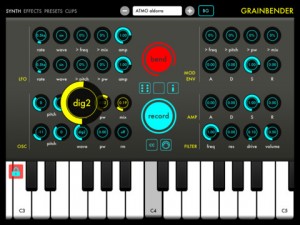
GrainBender is a new iPad synthesizer that makes designing new sounds easier than ever before. Just tap the bend button and sculpt your new sound directly in realtime. GrainBender is capable of making a wide range of sounds, from traditional analog favorites to exotic digital effects.
Key Features:
– unique, intuitive sound design interface
– versatile oscillators with analog & digital waveforms
– audio clip recording and export to other apps via AudioCopy
– extensive but easy-to-use modulation
– effects ranging from chorus and delay to digital grunge
– core midi support, both as a controller and sound module
– background audio support. control grainbender with other apps
George’s Sequencer Decorated for the Holidays
Modular synthesizer: George decorated his sequencer for the holidays.
Via Modd3d on Youtube
MacBeth Nexus 1 – complimentary synth to the micromac serie
Below the comments to the video from MacBeth:
This is the first demo of the complimentary synth to the micromac series. 4 Oscillators, Dual State Variable Filter and 4 Envelope generators should get you started, The touch keyboard rounds it up! See you at NAMM ’13!
Moog Source “Get The Drive”
Synthesizer demo track by RetroSound
“Get The Drive”
Moog’s Source was their first to offer patch memory storage as well as some other new features. It boasted 16 memory locations so you could finally save and recall your synth patches. A casette-tape jack was also implemented to transfer your patches to and from an external tape and free up the on-board memory for additional new patches. But in an effort to modernize with the eighties, the Moog had replaced all buttons, knobs and sliders with flat-panel membrane buttons and a single data-wheel assignment format. At the time, this may have seemed far-out, but in all actuality it is the Source’s downfall.

Parameters are edited not with hands-on sliders and knobs but by assigning a selected parameter to the dedicated data wheel. This is very tedious and does not allow for true hands-on tweaking during performances nor can you adjust different parameters simultaneously or while playing. These days, the membrane buttons don’t always seem to work quite right either. However, those famous monophonic Moog sounds are still inside this synth which has two fat analog oscillators and the legendary 24 dB Moog filter.
all sounds: Moog Source Analog Synthesizer + EHX Big Muff guitar effect pedal
drums: Korg ES1 MkII
recording: multi-track without midi
fx: a little bit delay and reverb
Attention! this is not a soft ambient track! 😀
the track @ soundcloud:
http://soundcloud.com/retrosound-ii/moog-source-get-the-drive
Overview of synthesis components in LuSH-101
The multilayer architecture guarantees that both the sound design possibilities and number of unique situations in which LuSH-101 can be used are virtually limitless. Layered sounds can be created simply by assigning the layers to the same MIDI channel; the results can sound as massive as anything imaginable! Assigning the layers to different keyboard zones allows you to create even the most sophisticated splits. Of course, you can always assign the various layers to different MIDI channels for 8-part multitimbral usage. And, virtually any combination of splits, layers, and multitimbrality is possible with just a single instance of LuSH. With each layer working as an independent synthesizer with its own polyphony, parameters, enhanced arpeggiator, and a palette of only the finest insert effects, LuSH-101 can push your creativity to unprecedented levels!
Want to express yourself even more? In addition to a very sophisticated MIDI-learn implementation, an advanced modulation matrix is built into each layer. Even the Arpeggiator’s MIDI output can be used as a modulation source, unleashing your creativity to build complex sequences and progressions.
LuSH also comes complete with a powerful built in mixer, complete with layer-independent parametric equalizers and compressors. Three send effects in superb quality allow you to put the finishing touches on the final output.
LuSH plays perfectly in any genre. For funkier styles, the Gate may be used instead of the VCA for instant staccato sounds full of energy and rhythmic pep. When creating Ambient or Chillout, longer attack and release times along with the smooth, rich spaciousness of the built-in reverb are enough to satisfy even the most ardent purists. Is Dubstep or Drum & Bass more your thing? No problem! Filters modulated by the LFOs and envelopes in conjunction with Unison mode can lead to the sickest, nastiest, and most novel vibrations—your sound system won’t know what hit it (and you won’t, either), so watch out! No matter what you want to play or how you want to use it, LuSH will get the job done.
Sound like never before
Innovative oscillator algorithms developed by D16 make LuSH-101 sound exactly like a sampled hardware analog synth—but without the sampling! There is no aliasing in the oscillators, even at 22kHz from the note’s base frequency. Vibrato and pitch bend do not affect the spectral quality of the oscillators, allowing LuSH-101 to sound completely authentic under all conditions.
A problem present in many virtual analogue synths is that the harmonics of generated sound waves start to disappear well below (and up to) the Nyquist frequency, causing the them to sound dull and lacking in clarity and punch. LuSH-101 was designed from the ground up to avoid this, resulting in a very rich and clear sound, even from the simplest waveforms!
Resonance is constant across the entire frequency domain, which makes the filter sound totally authentic, especially when controlled via the envelopes or an LFO. Turning resonance to maximum and turning all the oscillators down will produce a pure and pleasant sine wave as the filter is driven into self-oscillation, exactly as with true analog gear. Of course, keyboard tracking can also be applied to the filter for a smooth, adjustable cutoff gradient across the keyboard range.
“Circuit Glyphs” – Analogue Solutions / Phobos Red Square
An Abstract Electronic solo piece sequenced in 5/4. The Phobos (aka Analogue Solutions) Red Square Semi modular mono synth is choosing most of the tones through it’s Sample and Hold circuit. Rhythmically driven with 10 step sequencer modulating LFO frequency clock speed in steps which is sent to the S&H modulating the the cut off freq and pitch. Note values are all contained or tied within subdivisions of an eigth note (16ths, eighth note triplets, 32nds, eighth note quintuplets, and some faster) in 5/4 time. Notes that hold or sustain always begins on an eigth note value in 5/4 time, whether or not if it’s carried over the barline. The midi clock is never interupted, but counting bars isn’t the intent here, without any intentional bar markers, it opens up the minds perception of the quintuplet family of notes in contrast to space. Rather than having an obvious 5/4 structure, the mind defaults to 4/4 perception, thus making the eigth notes perceived as permutations of eighth note quintuplets, becoming the perceived base note being subdivided.
a 4 step sequencer modulates pulse width at times. playing SD-1 keyboard strictly as a midi controller. No overdubs, one live performance,with some Lexicon MX300 spring reverb added.
Scene: Year 7800, Location: In the sands of Massachusetts, in an area formally known as technology highway. Explorers discover remnents of circuit boards and believe it to be a lost language or art.
Note: Circuit boards shown are not of the Red Square’s internal boards.
DATAMASKIN

