
Access Virus TI Black Snow synthesizer released – all the details

Access has officially announced the Virus TI Black Snow synthesizer.
Here’s what they have to say about it:
We’re celebrating 15 years of ACCESS!!
For that reason we’re releasing
15 black TI Snows on this black friday!
10 are available right now in our online shop – the other 5 will be for sale at 20:00 MET.
Go to http://virus.info/shop/start if you want
to get a grip on one of those black beauties!

The Virus TI series comes in different flavors. You’re looking for something ultra compact and yet powerful? The sturdy Virus TI Snow features exactly the same sound engine like its bigger Virus TI brothers. It fits on an issues of Time magazine and has proven itself to be an ideal companion for musicians on the road or with limited desktop estate.
The Snow features 4 multimode parts and about 50% of the polyphony in comparison to the bigger models. Those result in everything in between 10 and 50 voices cranking out the same powerful signature sound like all other Virus TIs. Each and every voice can use up to four oscillators in parallel including Virtual Analogue, Wavetable, HyperSaw and Grain Oscillator models. The filter section comprises two independent multi-mode filters with optional Mini Moog emulation and self-resonance. An extensive array of parallel effects enable you to compose highly complex sounds in virtually no time.
In Multi mode, your patches sound 100% identical and include all of the effects. The 4 independent parts can be routed to 1 Stereo Analogue or 3 USB outputs streaming audio directly into your sequencer workstation. The software suite includes a VST, RTAS and AU compatible plug-in allowing for total recall, sample-accurate timing and modern automation features.
The audio inputs and outputs can be optionally used as a sound card in your sequencer. The hardware knobs can be used to either control the Virus’ sound engine or compatible third party software plug-ins.
Teaser on the new Metropolis sequencer – demo
More features of upcoming metropolis sequencer demonstrated including:
quantizer scale selection
root note
skip stage (blinking leds via double click)
current step note display
tb-303 style slide
This is a proto module (hence some of the crazy wires and lack of panel). Code is %95 done and this is set to be released very soon.
FXpansion Maul Tutorial
Maul: a multi-band distortion and tone-shaping plugin with advanced modulation.
http://www.fxpansion.com/index.php?page=193
FXpansion is proud to present Maul: a multi-band distortion and tone-shaping plugin with advanced modulation. Maul is suited to all music requiring powerful sound-sculpting abilities – everything from subtle warming and loudness generation to shredding distortion and experimental creative effects. Maul features 3 separate drive stages, each of which can act on a different frequency range with any of 32 distortion types. The available algorithms include DCAM-modelled germanium diode, tube and transistor-based circuits, clippers, overdrives, waveshapers of various kinds and bit-crushing devices for digital distortion flavours. Each drive stage also features control over transient-shaping, saturation circuitry and additional post-process tone filtering.
Availability & Pricing
Maul is available as a download-only product from the FXpansion web shop!
Pricing is USD $99.00, EUR €79.00, GBP £69.00 inc VAT where applicable
Cubase 7 – It’s in the mix
The completely new MixConsole excels not only in terms of usability, look and feel, but also sounds better than anything before it! Featuring full-screen mode, total scalability and quick in-place access to the parameters most relevant to the task, MixConsole adjusts seamlessly to notebook screens and large-scale displays.
With its extremely flexible channel layout, 12 dB boost and dedicated processing power per channel, an exceptional feel to the controls and comprehensive online and offline automation tools, MixConsole provides uncompromising audio quality and routing flexibility from the outset, with plenty of pristine headroom and a fundamentally transparent sonic signature.
Cubase 7 brings extraordinary workflow improvements to the table, delivering a genuine benefit to professionals working regularly with the mixer. Highlights include A/B comparison and global bypass for all audio effects, a plug-in search function as well as drag-and-drop support throughout.
Plus, dynamic sends and inserts provide a streamlined overview, whereas the professional meter bridge lets you keep track of your signals. Aiming on providing barrier-free accessibility to the blind and visually impaired, MixConsole is compatible with screen reader software and can be operated using only the computer keyboard.
Anushri Drum Tweaking
Mutable Instruments latest analog DIY synth Anushri. Tweaking the digital drum sounds with a Doepfer Pocket Control sending Midi CC.
DCO – ‘precision’ synth for Kontakt 5
Background information below:
Playing with one of the multi patches.
Apologies for the breaking up of the audio – levels were a bit high…
DCO can be used as a companion synth with Tronto.
www.tronsonic.com
Rob Papen Secrets of Subtractive Synthesis masterclass
More info here – http://bit.ly/XFjhIO
8 years in the making, Secrets of Subtractive Synthesis is a 200+ page book, which is accompanied by four DVDs with over 10 hours of content. Written by Rob Papen, the book gives an in-depth insight into his approach of working with subtractive synthesis — the most commonly used method of synthesis.
Rob Papen is a globally renowned sound designer whose sounds and virtual synthesizers, including Predator, Blue and Blade, to name just a few, are used and loved by many synthesizer players and music producers.
Time machine: ROLAND ALPHA JUNO-2 Analog Synthesizer 1986
Synthesizer Demo of the polyphonic analog synthesizer Roland Alpha Juno-2. The Alpha Juno-2 is played dry without any additional effects.
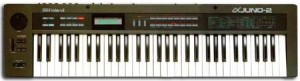
This is an upgraded version of the Alpha Juno 1. It adds an extended 61 note keyboard with velocity and aftertouch and an external memory cartridge slot. Other than that it has the same great sound and features as the Juno 1. Sliders and buttons were replaced by membrane buttons and the Alpha Dial which is used to edit and browse through the extensive selection of parameters: DCO digitally controlled oscillators, LFO, bend, ENV, pulse, waveforms, noise, PW/PWM, high pass filter, VCF (filter) with freq/env/res/lfo/kybd, VCA envelope, chorus, and more.
Adequate in the studio or on the stage, the Juno 2 has 64 presets and 64 user memory patches, a nice LCD display, an LFO capable of a very slow rate for some cool sweeping effects, and a great bass sound (especially nice for acid basslines) and noise effects! It also has chord memory which is perfect for rave & techno, portamento and keyboard transposing. The PG-300 Synthesizer Programmer gives you traditional slider control of each parameter for much easier and faster editing.
First teaser from the new album from Karl Bartos – listen here
OFF THE RECORD – THE NEW ALBUM FROM KARL BARTOS, EX-KRAFTWERK – RELEASE DATE: MARCH 15TH 2013
Karl Bartos’ new album is an audio-visual sensation! Lost for many years, some of his early music has been reconceived and re-contextualised in a thrilling modern setting. Here’s the story: during Kraftwerk’s heyday Karl Bartos wrote – off the record – a secret acoustic diary. Based on his musical jottings – rhythms, riffs, hooks, sounds, chords and melodies – this is what he has come up with today: twelve brand new, exciting, timeless songs.
KARL BARTOS – THE MELODY MAKER
Karl Bartos is well-known as one-quarter of the “classic” Kraftwerk line-up. Many of their most influential rhythms and memorable melodies were actually conceived in his home studio. They would later be used on an unstoppable succession of hits from the Düsseldorf band as they ascended to the lofty heights of popular music culture.
As a major contributor to The Man-Machine (1978) and Computer World (1981) Bartos has had a decisive influence on Kraftwerk’s music. Rolling Stone author Mike Rubin says of this years: “there’s something timeless and universal about their songwriting of this period.”
The Kraftwerk team went on to achieve worldwide success and cult status: in 1982 The Model became a UK number 1. The track has become a classic in the history of music, along with The Robots, Metropolis, Neon Lights, Numbers, Pocket Calculator, Home Computer, Tour de France, Musique Non-Stop and The Telephone Call. Kraftwerk have been one of the most sampled artists of all time, and there have been countless cover versions of their songs. In 2005, perhaps the biggest rock band of the time Coldplay incorporated the melody from Computer Love into their hit Talk. Almost all of the group’s best-known tracks date back to the “classic” line-up. In 2012 Kraftwerk performed a retrospective of this repertoire in the Museum of Modern Art, New York.
Karl Bartos left the band in 1990. Subsequently he became an independent producer and writer – for his project Electric Music, as a solo artist, and also together with fellow friends and musicians – Bernard Sumner (New Order), Johnny Marr (The Smiths) and Andy McCluskey (OMD).
In 2004 he co-founded the Master of Arts course “Sound Studies – Acoustic Communication” at the Berlin University of the Arts (UdK), where he was a visiting professor, teaching Auditory Media Design up until 2009.
OFF THE RECORD – THE ALBUM
For Off the Record, Karl Bartos has opened up his music archive for the very first time. He rediscovered and analysed hundreds of tapes, piles of sheet music, and years of digital media. Inspired by his acoustic diary and adding his experience as a composer and producer, he has created twelve brand new songs – written and performed with masterly skill.
It took him two years to accomplish this original Bartos album: iron crystal music, vocoder newspeak, robot sounds, digital glitch, techno pop, catchy melodies, electronic avant-garde, roaring silence, futurism, and, of course, those rhythms! Rhythms of brutal minimalistic impact as found on the much-sampled Numbers recorded three decades ago and described by Mike Banks of Underground Resistance as “the secret code of electronic funk.”
ON TOUR – LIVE CINEMA
For Bartos, music alone has never been enough! Fascinated by the interplay of image and sound Bartos also works with the medium of film – the latest example of which will be seen on the Off the Record tour in 2013. Forget about technical nostalgia in 3-D; instead tune into LiveCinema: 90 minutes of music and film – rhythmical, modern, intelligent.
Website: http://bureau-b.de/karlbartos.php
Released by: Bureau B
Release/catalogue number: BB079
Release date: Mar 15, 2013
You may also read the interview we did with Karl during the spring of 2012

Akai EWI4000s plays SampleTank and Addictive Synth on iPad
Playing SampleTank on my iPad2 with my Akai EWI4000s via iRig MIDI. (Note: I meant to say CC74 for “Cutoff” not CC64). Be sure to watch the last minute (from 10:55).
Playing Addictive Synth on my iPad 2 with my Akai EWI4000s thru iRig MIDI. Here’s a first look at this breath control freindly, fun and powerful synth! Breathy Flute 00:39 Solo 8:00 Tribal 12:54 Bernzilla Brecker EWI 15:33
Via Bernie Kenerson on Youtube

EWI stands for electronic wind instrument; this one is basically an analog modeling synth within a wind controller, so don’t expect realistic sounds without hooking the MIDI out to another sound generator that has high quality samples or physical modeling.
DATAMASKIN

