
DM fans gets more nostalgica
A couple of days ago Vince Clarke twittered “collaborating with Martin (Gore) (from Basildon)” on a track called “Zaat”. Clarke has been working intensely on the new Erasure album for some time and apparently Clarke and Gore, who are both living in USA (Maine and California respectively) have decided to work together professionally for the first time since Clarke left Depeche Mode.
But there s more…
Gore will be appearing to DJ at an aftershow DM/Recoil party. Martin has graciously agreed to appear just for this event to spin a collection of his favourite tracks, Alan Wilder writes regarding his Recoil stop in Santa Ana, California, on October 24.
Vince Clarke & Martin Gore are working on a techno-ish track called Zaat.
Vince Clarke & Martin Gore are working on a techno-ish track called Zaat.
No word on how soon you’ll be able to here this reunion of early Depeche Mode members. Clarke’s keeping busy working on a children’s record for Rounder Records, the latest Erasure album and a possible collaboration with Amanda effin’ Palmer.

Clarke wrote most of the songs for the band’s 1981 debut “Speak & Spell”, before departing to form the synthpop duo Yazoo with Alison Moyet and later, the duo Erasure with Andy Bell.
During the touring and promotion for “Speak & Spell”, Clarke began privately to voice his discomfort at the direction the band were taking. In November 1981 Clarke publicly announced that he was leaving Depeche Mode. When asked about his departure from Depeche Mode in the VH1 Behind the Music television series he added: “We were pretty young and very lucky, and things had happened very quickly for us and I don’t think we were really mature to handle the situation”.
Initial talk of Clarke continuing to write material for the group ultimately amounted to nothing (Clarke offered the remaining members of Depeche Mode the track “Only You”, but they declined. It went on to become a UK top ten hit for Yazoo).Gore, who had written “Tora! Tora! Tora!” and the instrumental “Big Muff” for Speak & Spell, was forced to become the band’s new songwriter.
The Dark Snuggler EP

We Collect Enemies – the label formed by Andrew Phillpott (Depeche Mode), Glen Brady (The Glass, Plant Music, Awesome Agency) and Daryl Bamonte (Depeche Mode, The Cure) – has announced a brand new 12″ hot on the heels of the Das Shadow and Broad Bean Band releases. This time it’s DJ Wool (aka Glen Brady, one 3rd of the originators of the label clique) bringing “The Dark Snuggler EP”. The release holds remixes by Lars Moston (Moston & Malente), Boeoes Kaelstigen (Adrian Recordings, Sweden) and Jetlag (collab. between The Smiths’ bassist Andy Rourke and Russian/NYC DJ Ole).
Depeche Mode’s Violator tour on excellent soundboard recordings
Two excellent soundboard recordings made during the 1990 ‘World Violation Tour’ by the English electronic group Depeche Mode in support of the act’s seventh studio album, “Violator”, have made their way to the grand public after being available before in a rather small circle.
The shows that are on the street now were recorded in San Francisco and Los Angeles in 1990 and thus most probably originate from tapes that were recorded by the band to see “how the show was sounding generally, or how well or badly it was being mixed out front”.
The 1990 ‘World Violation Tour’ has been on of the most sought after live recordings especially because the band and its label, Mute Records, never released a single live recording from it. We asked Wilder why no release from this tour ever saw the light of day: “Remember we had not long released ‘101’ so no-one in the band camp would have been keen on doing another live album at that time. They are much more commonplace these days with the obligatory ‘live’ DVD post every tour etc. In those days, people didn’t do them so nearly so readily.”
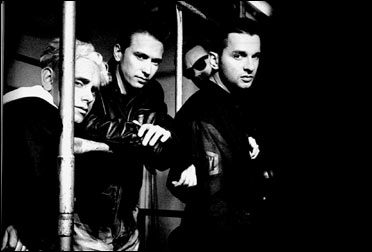
The following songs were included in an acoustic set performed by Martin Gore during the said tour:
- “I Want You Now”
- “Here Is the House”
- “Little 15”
- “World Full of Nothing”
- “Blue Dress”
- “Sweetest Perfection”
Depeche Mode becomes a musical

A musical featuring Depeche Mode songs is set to open early next year. Called “Playing The Angel” (taken from the name of their eponymous 2005 album), the ‘jukebox musical’ will run at the MITP theatre in Valletta, Malta and will feature a storyline which some media have already branded as being ‘controversial’. Writer Adrian Buckle (see photo) explains: “It is a story of two boys growing up, coming of age and discovering love. They are abused, used, taken advantage of. It’s their sad way of discovering life.”
NEW WAVE 2.0
![[ASHBURY+HEIGHTS.jpg]](http://3.bp.blogspot.com/_9Lz_iQ__-HM/SPFWm4WgzhI/AAAAAAAAAGk/6-98-TWS7ik/s1600/ASHBURY%2BHEIGHTS.jpg)
John Fryer (Depeche Mode, Nine Inch Nails, Fad Gadget) has once again been sitting in the producer’s chair when the electropop duo Ashbury Heights records. The second album “Take Cair Paramour”, with what Ashbury Heights calls “new wave 2.0”, will be released one month from now by Out of Line in Berlin. The first pressing comes with a nine track bonus disc.
Ashbury Heights 2010 is Anders H, new member Kari Berg and on stage, also live keyboardist Johan Andersson.
Nice interview with Alan Wilder
Produced by fans in Italy 
Lady Gaga wants to make a cover of Depeche Mode

Lady Gaga has said she wants to record a cover of Depeche Mode’s 1984 hit song “People are people” adding “I could really give it the melody it never had”. 24-year old Lady Gaga who wasn’t even born when the Depeche Mode track was released, has been inspired by the many mash-ups between Depeche Mode and some of her songs that are floating on the Internet.
So she says: “I spend literally hours on YouTube each day checking what people post about me, reading the comments and so on. And I was so surprised that many Depeche Mode fans appeared to be Lady Gaga fans. I didn’t know the band existed until I saw a mash-up of ‘Paparazzi’ with ‘Just Can’t Get Enough’. I advise everyone to check out Depeche Mode, they are so underrated.”
In the same interview she appears to believe that Vince Clarke (Erasure) is still part of the band: “I’m a huge fan of Erasure and it was so funny when I heard that Vince is also a part of Depeche Mode! It’s so unlike his Erasure sound!” So how did she end up choosing “People are people”? Simple: “My manager choose the song for me, he knows things so much better.” Ok… well, you all know what to expect: an Erasure version of “People are people”. That promises to be funny!
Speaking of Lady Gaga and Depeche mash-ups check out the two shots below:
http://www.youtube.com/watch?v=IfP-5qT5Q5s
Exclusive interview with Swedish synth-maestro Eddie Bengtsson
Page is currently celebrating 30 years as performing artsist on the Swedish synthpop stage and are currently planning summer gigs after the release of their first new album in 10 years. Stereoklang got an one on one interview with the synth pioneer Eddie Bengtsson, who’s electronic music really kick started the Swedish synth-pop scene in the 80’s, active in Page, Sista Mannen På Jorden (Last man on earth) and This Fish Needs a Bike. Page really became the Swedish answer to Yazoo/Erasure, OMD, and Depeche Mode, and made ground for popular acts like Elegant Machinery, S.P.O.C.K and many others. In this interview we have invaded Eddie’s home studio to take a closer look at the synthesizers and music production gear he uses and what it really takes to make a great synth-pop song.

Neatly mounted in a corner of a 10sq/m room, sharing the space with Star Trek memorabilia and a huge vinyl record collection, several of the classic hardware synthesizers are hooked up and ready to bleep. Although Eddie tells me he have had to sell of several synthesizers from a logistical point of view I enjoy finding vintage gear like the Moog Rouge, a Korg DW 6000 and the personal favorite of Eddie’s the Yamaha CS15 (used on every album), coupled with recently acquired gems like the Moog Little Phatty, the Moog Voyager and then some modern virtual analogs like microKORG and Yamaha CX1x.
What is used use for what
The CX1 is used as the mother keyboard and the DW 6000 mainly for strings. ”Sound 11 is a personal favorite” Eddie says☺. You can for example find it also on all S.P.O.C.K songs. If Eddie on the other hand only were to take one synthesizer with him to a deserted island it would be the CS15. In fact Eddie tells me that due to the flexible routing and filters; he’s able clone the bass sounds of all other synthesizers with it, if you treat it nicely. Perhaps the only drawback is the useless noise generator, which is too weak, although a weakness that many synthesizers has as he puts it.

Neatly tucked under racks of synthesizers a well hidden Roland S760 sampler can be found. Curious about the fact that this particular device hasn’t been replaced by software versions already, Eddie admits that years of collecting disketts has made him somewhat lazy, somewhere among all those hundreds of disketts there is always that one with the right sound. But I wouldn’t be surprised if that device will be left out from future productions in favor of software alternatives.
The lazy side of Eddie shines through on several occasions during the interview and for the last two records other people have contributed in replacing sounds with updated versions. However, the new Page album actually came as a turning point for him and a lot of hard work has gotten into it, resulting in more focus on sound search and music production then before.
Moving on to the next rack of synthesizers Eddie tells me that the microKORG is actually a very capable machine used primarily for strings and pads. The Rouge on the other hand is the real stage machine and a trade mark for Page in live sets. It’s compact and easy to bring, cool looking and splendid for single oscillator sounds. (Indecently the Rouge uses the same circuitry as the Taurus II Bass Pedals). (Listen to this song, all sounds by the Rouge by Hannes Rasmus. http://www.vintagesynth.com/audio/moogtheroguedemo.mp3 ) Other old gems like the Roland SH02 and Moog Prodigy have been replaced with new bass and sequencer gear; the Moog Little Phatty, as you can easily spot on the new Page album.


Why all the Moogs?
Easy answer would be that everyone is talking about them, prestigious and expensive stuff that is. And although proud to have them, some drawbacks can be found also here; the sound is a bit chilly and there is no noise generator to be found at all, as with the Prophet 8, it takes forever to heat up and sometimes the oscillators are not really in sync. The Voyager is really a beast and lit up it looks really impressive. Currently it’s mainly used to discover cool sounds in the studio it might end up on the stage some day. “But why on earth did they implement this totally useless performance pad on it, when turning the knobs is the way to do it and it is not even multi-touch, which might have given it some extra advantages”. I asked what’s next and Eddie kind of suggests that a DSI Mopho might end up on the rack within short.
Where do you start making a song?
“Never, or very seldom, I have an idea or the song in my head. When I feel like making new songs I always start off with a bass, then adding drums, melody and finally the vocals. I really need to get the beat going first.” >>>>>
Read the rest of the article here >>
Electric Independence feat Vince Clarke

Vince Clarke is a man synonymous with synth pop and a legend in the history of electronic music. He’s famous for founding three of the most popular and lasting musical acts in history: Depeche Mode, Yazoo and Erasure. But his distinct sonic output depends upon another feat: he has spent the last 30 years amassing one of the world’s most impressive collections of rare, ‘holy grail’ analogue synthesizers.
In 2004, Clarke left England for the unsynthesized woods of Maine, where he constructed a temple for these monolithic machines he calls ‘The Cabin,”. and began branching out into (gasp!) software synths too. Recently Motherboard made a pilgrimage to Clarke’s purpose-built digital/analogue studio to meet the musical titan, hear the story of his musical journey, learn how to make the perfect pop song, and get a little demonstration of one of his signature moves: building a drum pattern from a wall of modular synths. To Clarke, music is still magic even now, an alchemy in which he gets to make “something from nothing.
DATAMASKIN

