
Two new stage pianos from NORD and Kurzweil

The Nord Piano is a dedicated stage piano with 88 keys and a weighted hammer action. It is designed with the performing musician in mind and extremely lightweight at 39.6 lbs, without compromising build quality, sound quality or means of expression. As all the other Nord units, it is designed with a firm focus on extremely fast response and accessibility of every important function from the panel.

Kurzweil Music Systems is proud to announce the release of the SP4-8 stage piano, a premium instrument designed for musicians who require exceptional sound quality and expression. Top professionals and hobbyists alike will be able to appreciate the responsive 88-note hammer-weighted action, nuanced sound design and advanced
performance features, all of which set the SP4-8 apart.
Studiologic Ships the Numa Organ Joey DeFrancesco Model
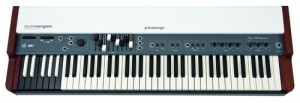
Studiologic Ships the Numa Organ Joey DeFrancesco Model. Studiologic is proudly shipping the Numa Organ Joey DeFrancesco Model, an integrated organ and high definition keyboard controller, including Fatar’s finest TP/80 Premium Waterfall Action keyboard, the Numa Organ offers a spectacular physical model of the classic electro-mechanical organ complete with rotary and scanner emulation.
The Numa Organ was developed in conjunction with Joey DeFrancesco making sure that every detail and nuance is properly produced with stunning results. 9 classic drawbars control upper, lower, and pedalboard sounds. Features include 12 presets on the first reversed octave, keyboard split with lower or pedal to the left, chorus and vibrato on upper and lower, rotary with on-off-brake and slow-fast (with mod wheel), transpose, and a complete percussion section with soft/normal, slow/fast, and 2nd/3rd options.
An Effects section offers variable Reverb, Drive, Keyclick, and Leakage levels,and an on-board Equalizer provides the final tailoring of the organ’s magnificent tone. Velocity action can be switched between normal organ or Fatar Dynamic Touch modes. USB and MIDI in, out, and through connections open the Numa Organ up as a master keyboard controller for standalone and plug-in software instruments. Despite the rugged metal housing and real wood side walls, the Numa Organ at 22lbs. is lightweight, portable, and gig ready. For more info please visit http://www.americanmusicands…
How to make a toy keyboard into a sequenced input device
Took a very basic cheap toy keyboard and turned it into a rad sequenced control voltage input device. Check it out and learn how to do it yourself!
Ancestral call – Alba Ecstasy
adimsimion shared this video with us – First synth jam on 2011 using the usual gear: Roland MC-307, Evolver DSI, Korg microX, Korg Z1, Waldorf Blofeld.
This year will start soon with new acquisitions: Korg microKorg, Clavia Nord Wave, a Mopho keyboard, and I want to upgrade my audio monitors: Adam A7x or Focal CMS50 I think. I didn’t decided yet what monitors to choose in 1000 euros price range. Will see!
Playing with Xtrument virtual keyboard
Playing with the amazing Xtrument created by Rob Fielding. It works as a virtual MIDI controller for your Mac using the keyboard. The Xtrument is open source.
Fielding is the programmer behind the iPad music app Mugician.
Xtrument is available here (.tar).
More about MusicApps and Mobile Music on www.MusicApps.com.br
Akai gives you the MPK mini

Akai Professional is now shipping the MPK mini, an ultra-compact mini-keyboard with an impressive array of buttons, knobs and pads to provide “hands-on” performance and production control no matter your location.
MPK mini strikes the perfect balance between portability and comprehensive software control by melding together the complete control offered in the popular Akai Pro MPK family with the grab-and-go convenience of the LPK25 and LPD8. With a 25-note keyboard, 8 back-lit, MPC-style pads and 8 Q-Link knobs, the MPK mini is the ultimate portable controller to get your music moving.
MPK mini features
- Ultra-portable software MIDI controller.
- 25-note, velocity-sensitive mini keyboard.
- Eight backlit, velocity-sensitive MPC-style pads (2 banks, 16 total).
- Pads can send note information, MIDI CCs and program changes.
- Eight assignable Q-Link knobs to adjust virtually any parameter.
- Built-in Arpeggiator with adjustable resolution, range and patterns.
- Tap-Tempo button to quickly adjust pace of the Arpeggiator.
- Dedicated Octave Up, Octave Down and Sustain buttons.
- Program Recall button to restore up to 4 separate global settings.
- Solid Akai Pro design.
- Powered through USB; no AC adaptor required.
The Akai Professional MPK mini is now officially available and ready to ship for $199 USD (MSRP) / $99 USD (street).
More information: Akai Pro / MPK mini
New sampling toy keyboards of the 80’s like the ones produced by Casio and Yamaha
Sir Sampleton is a sampling keyboard, which means it can record sounds through the microphone that you can then play on a keyboard. If you want the sound of bagpipes or bells, then just use Sampleton to sample some bagpipes or bells. Or if you want more unique sounds, you can make samples with your own voice or noisy objects you find around the house.

Sir Sampleton is inspired by sampling toy keyboards of the 80’s like the ones produced by Casio and Yamaha. These classic keyboards were great toys, but are now expensive because they are sought after by professional musicians for their warm, low-fi sound and simple operation. Now, it’s possible to have similar sound and functionality in an app, plus the features that you wish the old keyboards had, like the ability to save samples.
FEATURES:
◊ Sample through the microphone and then play your samples on the dual keyboards
◊ Save and recall your samples
◊ Add rhythm with the built-in beats and random beat generator
◊ Tweak advanced sound settings such as vibrato, note trail length, and sample time
◊ Put one sample on each keyboard in dual-sample mode”

The making of an album
Joseph Raglani has shared a couple of videos covering his process towards a new album
Decided to chronicle the making of the follow up to Of Sirens Born. We’ll see if I can keep it up. I’m just in the demo stage and getting some ideas down. What you see here is all played live (well with a few sequencers). I’ve found that long hair and funny hats help with this process.
I’m playing a Dave Smith Mopho keybord with a Tetra in tow. Doepfer A-100, Synthi-R, Moog Voyager Old School (sequenced by the MFB Step64) and the Tip Top Audio Z8000 is doing some modulation sequencing. Left hand is playing the melodic part, right hand is tweaking. I only say that because it’s a little hard to see what’s going on from this angle. Recorded Dec 6th, 2010.
A couple of patches featuring my Synthi clone, A Doepfer A-100 Modular system and my first first two or three runs with the Tip Top Audio Z8000 sequencer. In the last clip, all three of the aforementioned are being triggered by an old Univox SR-55 drum machine via the Doepfer A-119. Headphones are a must here. There is a lot of V.C. panning going on.
Some of the modules featured here are the
Buchla clones –
A-149-1, A-101-2 and the Plan B Model 13.
Analogue Systems –
Rs95e, Rs95, EMS Synthi filter, Ems Trapezoid Filter, VCA and EG.
Tip Top Audio Z8000
Plan B Model 14 and plenty of multiples are functioning as substitutes for the EMS pin matrix.
The rest are standard Doepfer modules with a little bit of history behind them… (I bought them from Bill Leeb about 10 years ago)
Demo of the experimental Manta
Rasmus Nyåker of the Copenhagen Noise Lab has shared these two videos on Youtube. Speaking with webzine CDM he explains; The Manta only supplies me with one continious controller per finger/zone/hexagon. It’s much like any polyphonic aftertouch keyboard in that way (I have a Roland A80 which is a marvellous controller as a keyboard). The Manta has two great things going for it, though: it is much more compact and I can route a separate CC-number from each of its hexagons.
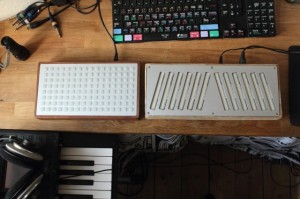
In this video I just route CCs from the hexagons to the Nord Modular G2. I control FX for rhythms on the top row and toggles Delay/Reverb too. On the very left I use CCs to control pitch and amplitude of 4 oscillators. On the other buttons I just control amlitude of 36 different tuned Sinus oscillators. The second and forth row from the bottom is just detuned oscillators of the ones controlled in the row below.
First thing I did with my new Snyderphonics Manta. Using a standard midi-patch in MAX/MSP to control the Nord Modular G2. The sound is just a pad with some extended control for the manta.
StudioBLADE and iKeyDOCK
Austin-based startup Music Computing has announced their new line of keyboard workstations.
The StudioBLADE and iKeyDOCK are complete, portable production stations, which either include a built-in Windows 7 64-bit PC with touch-screen and DAW software and virtual software instruments, or a docking system for any PC/Mac notebook.
- The StudioBLADE series are complete music production workstations powered by Intel processors and 64-bit Windows 7, and each model ships with a studio package with DAW (digital audio workstation), virtual instruments, mastering effects, and utilities to customize the exclusive ControlDAW MIDI control surface.
- iKeyDOCK keyboard workstations are designed to be compatible with both Windows and Mac notebooks. The iKeyDOCK provides a dockable solution for any notebook; simply plug-in and start playing.
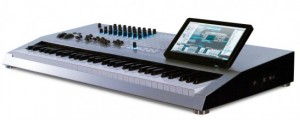
A combination of hands-on control begins with the tilt and telescoping 10.1-inch touch panel (more than twice the size of most workstation screens), the 61-key synth action, or 88-key weighted piano action keyboard; and ControlDAW interactive knobs, buttons, and sliders, managed by GeoMIDI mapping software.
The large 64-button grid control surface, in addition to knobs and sliders, is a tool for musicians using grid-style programs like Ableton Live, or classic drum pad boxes like the Akai MPC. Music Computing’s TriggerGrid sample trigger player for drum pads turns the grid surface into a 64-pad virtual percussion instrument.
Each StudioBLADE also includes Studio One Pro from Presonus, a DAW solution with virtual instruments and mastering FX, plus 10GB of sounds. Music Computing’s included SonicSource VSTi soft-synth contains thousands of sound presets providing an 8GB starting point for both analog and digital textures.
“The StudioBLADE is one of the most powerful keyboard instruments ever built,” said company CEO, Victor Wong. Wong previously headed keyboard workstation maker Open Labs.
Pricing starts at $2599 (US/SRP) for the 61-key Intel Core2 base configuration with 24/48 audio, 2 combo XLR and 1/4-inch mic inputs with phantom power, 2 balanced outs, and headphone jack. Optional upgrades include 24/96 audio and 8 inputs, more RAM, and internal hard drives, to suit the user’s needs.
DATAMASKIN

