
Checking out the new arcadish Pianocade – teaser
Demonstrating some of the features of the Pianocade, a chiptunes-style synthesizer and MIDI controller. More information (and preorder information!) at www.pianocade.com
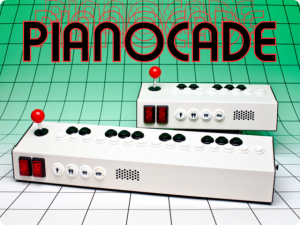
The Pianocade Synthesizer
The Pianocade is a synthesizer designed to sound, look, and feel like vintage arcade games.
The Pianocade’s built-in synthesizer is based on the sound hardware of the Nintendo NES and Game Boy (specifically, one of the square wave channels: it’s a monophonic square-wave synthesis engine with a 4-bit digital-to-analogue converter). Because it’s monophonic, it does what many early games did in lieu of chords: it cycles through the notes of the chord rapidly (arpeggiation).
Pianocade MIDI Support
The Pianocade has traditional 5-pin MIDI ports (in, out, and through) as well as USB MIDI. You can use the Pianocade to control any device with MIDI in, or control the Pianocade via an external controller or sequencer. The Piancade’s arpeggiator automatically syncs with incoming MIDI clock signals, too. You can also reprogram the MIDI messages of the joystick, coin buttons, and player buttons for a totally custom MIDI controller.
- MIDI In, Out, and Through, plus experimental USB MIDI in and out
- Integrate MIDI velocity and aftertouch into sound banks for amazing effects
- Synchronize the arpeggiator to external MIDI clock signals, with adjustable tempo
- Add “extra” controls via pitch and CC messages
- Reprogram the MIDI message sent by each control
Magic Piano on Android
OK so more game then music creation, but still
Download Magic Piano for Android devices here, FREE:
http://bit.ly/MagicPianoAndroidYTRainbow
Download Magic Piano for iPad, iPod touch and iPhone here, FREE:
http://bit.ly/MagicPianoYT
For more videos featuring Magic Piano and our other apps, subscribe to Smule’s YouTube channel: http://www.youtube.com/smule
About Magic Piano:
From Bruno Mars to Mozart, play the hottest songs effortlessly on the #1 piano game, now available on Google Play for Android devices! Get free songs every day and enjoy the largest catalog of songs in any piano app. Turn on game mode to unlock achievements and free songs, or just relax and play your favorite tunes. Join the over 13 million Magic Piano players and experience the fun of playing piano – no lessons needed!
HUNDREDS OF SONGS – NEW SONGS ADDED EVERY WEEK!
Songs by Selena Gomez, Justin Bieber, Lady Gaga, Rihanna, Bruno Mars, and more!!!
Native Instruments GIANT Piano – Extended Video Review
As reported on yesterday – NI’s new instrument The Giant – here’s a fresh review:
Russ from Pro Tools Expert takes a look at the new Native Instruments GIANT piano.
See what he thinks in the extended review.
http://www.pro-tools-expert.com
Native Instruments: The Giant – based on the world’s biggest upright piano

Native Instruments has a new instrument they’ve named The Giant – based on “the world’s biggest upright piano.” The Giant features the sound of the Klavins Piano Model 370i, described as “a super-sized instrument delivering a colossal sonic spectrum equally well-suited to urban pop projects, soft piano ballads, driving rock riffs and jazz numbers, as well as providing a separate ‘Cinematic’ version of the piano for darker, atmospheric projects and sound design.” This upright piano stands over three meters high and weighs over two tons, with a soundboard roughly twice the size of a typical 9′ concert grand piano soundboard. The Giant was produced by sampling expert Uli Baronowsky – creator of the ‘Galaxy’ piano series – and comprises two separate instruments in one (‘day’ and ‘night’ versions), as well as controls for shaping and modifying the sound, and 40 production-ready presets to provide instant starting points for numerous musical styles.
Click for more details and sound samples.
The Giant runs in Kontakt 5 or the free Kontakt 5 Player, and is available now for $119 at the Native Instruments online shop.
Slow Electronica with SH-101, TR-909, W-30
A slower, relaxing electronic ditty featuring:
TR-909: “Balearic-style”, relaxed electronic beat
SH-101: smooth, “Moog-like” synth bass
W-30: custom-made Syn Vox / Piano split patch
The Completion – real time modular
A generative real-time recording of the modular synthesizer and Kontakt5.
The synthesizers.com Q172 quantizer Aid module is sending midi pitch data back into my DAW (Steinberg’s Cubase 6) and I’m routing it to Kontakt 5 with an instance of Sonic Couture’s “Bowed Piano” sample sets. I also routed the midi through to the Yamaha TX816 with 8 modules playing a superb piano rendering.
Days worth of patching on the modular for everything else.
Some modules of note are the Ken Stone BiNTic filter/oscillator, J.Haible Tau “Pipe” phaser, Ian Fritz ChaQuO and 5 Pulser, two CGS01 sub oscillators and one CGS01 in Harmonic Sequencer mode.The HS mode is generating the pitch data for the formerly described piano patches and the high pitched sliding sounds in the background.
The dotcom sequencers and STG sequencers are producing voltages for the BiNTic dark ambient industrial sounds in the background.
A final white noise to the Q107 filter, Sputnik VCS, Cynthia QLPG, SSL digital delay and Oakley Deep Equinoxe phaser and STG signal amps round out the sound voices.
Arturia Wurlitzer V Piano Review Extended
As we reported on a couple of days ago – Arturia released their emulated version of the classic Wurlitzer electric piano, here’s a nice review of it via AUB:
“Russ gives a first look and show and tell, plus his opinion on the new Arturia Wurlitzer V Piano.
Check it out for yourself.”
ARTURIA – Introducing Wurlitzer V
The Wurlitzer V is a high end software recreation of the classic Wurlitzer 200A electric piano.
Unlike sample libraries, its physical modeling engine reproduces the very acoustic properties of reeds, key action and amplification, bringing you high realism while offering maximum flexibility on sound.
As most producers know, the legendary bright and overdriven Wurlitzer sound heard on classic records also comes from the use of fine amplifiers, micing and processing. This is why the Wurlitzer V goes further by putting you in command of a studio from the 70’s, filled with vintage stompboxes and classic tube amps… everything you need to get a true classic vibe!
If you are looking for a lively electric piano combined with inspiring studio tools, the Wurlitzer V is the ultimate package.
More details here : http://www.arturia.com/evolution/en/products/wurlitzer-v

One of the most cult proclaimed keyboard instruments in the history of music is the Wurlitzer Electric Piano. With its rough and phat sound, the Wurlitzer has left an immense mark on several classic recordings with a variety of performers such as Ray Charles, Steely Dan, the Doors, Sun Ra and Queen just to mention a few.
The Wurlitzer’s basic principles were developed in America in the middle of the 1930s by a man named Ben F. Meissner (b. 1890). In 1932 he patent and licensed several new revolutionary electrical ideas e.g. several TV-components, electron pipes and the Wurlitzer principles (the string less piano). Meissner came up with the idea to place electromagnetic pickups on each string inside an ordinary acoustic piano. In order to achieve a more powerful tone he added reeds inside the piano which he blew air into. His concept caused great interest from different piano manufactures around the country, and his ideas were sold to the Everett Piano Company who came to develop his original ideas. They started to work on the concept but what from the start was supposed to be an electric form of a piano, instead became a more electric organ under the supervising of the Everett Piano Company. But the idea had now reached the big jukebox and organ company, Wurlitzer who realized that the invention had a far greater potential. They took over the development of the piano and instead tried to come up with a electric version of a piano more similar to the Rhodes, than to an organ. To achieve their goals they designed a felt dressed hammer which was placed in the piano in order to stroke the metallic reeds. The vibrations from the stroke on the reeds produced a big fat and rich tone, which was picked up by a pickup system converting the tone into electric energy and leading the tone out of the built in speakers on the front of the piano. The Wurlitzer Electric Piano was born.
The Wurlitzer was in some ways relatively similar to the Rhodes regarding it’s construction and it’s design, but it was also in many ways different. The Wurlitzer was a lot lighter than the Rhodes (who weights at least twice as much) and therefore a lot easier to transport and to carry on the road. It also had built-in speakers with a separate monitor speaker, and a built-in tremolo which early Stage models of the Rhodes did not have.
Wurlitzer released their first electric piano in the beginning of the 1950s. The piano received great attention from the branch organizations and in 1956 the first Wurlitzer album was made by Sun Ra and Demons at Play. Another contributing fact which helped launch the piano was Ray Charles elegant Wurlitzer playing on his huge hit “What I’d Say” from 1959 which gave the Wurlitzer increasing attention. The most famous models are the Wurlitzer 100 and its improved version, the Wurlitzer 200 which replaced the 100 in 1969. The Wurlitzer quickly reached great successes, in particular during the 1960s and the 70s. The piano quickly became popular among touring bands who found it to be a lot lighter than the Rhodes and that the Wurlitzer’s sound more easily could fit into a guitar based band than a Rhodes. The Wurlitzer proved to be useful in more pop and rock oriented music were the Wurlitzer’s thicker and rougher tone easily could be used as a replacement to the guitar. As the popularity of the Wurlitzer grew, keyboardists seemed to become more and more divided into two camps, Rhodes or Wurlitzer. The Wurlitzer however, do work very well in soul/funk music as well as in pop and rock. A great example of that is the soul and funk music of legendary Donny Hathaway, who easily fits the Wurlitzer into his music.
Today it is quite hard to get a hold of a Wurlitzer in good condition. They are sadly not the most frequently used keyboard instrument in the music industry and are quite rare these days. However, if you are not into to much rush, got a fat wallet, and are a bit lucky there are some for sale.
Introducing the Wurlitzer library from Acousticsamples
Wurlitzer library from Acousticsamples, it features effects, acoustic and electric volumes, complete control over the velocity parameters, amp simulation and more… Visit Acousticsamples.net/wurlie to purchase it.
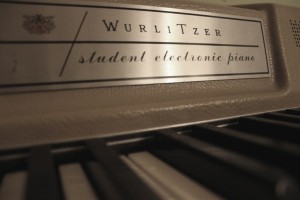
Wurlie is a 64 keys Wurlitzer 206A piano, and as the Wurlitzer company named it, a “Student Electronic Piano”.
The 206A is a student model, and is very similar to a 200A except for its beige color and built in amp/speaker (it also did not come with a tremolo). It was designed to be paired with a 206, which is the teacher model and they were mainly used in conservatories. The teacher had a headphone and microphone to be able to listen to each student individually and talk to them without others hearing them.
Moog Minitaur Analog Bass Synth with Critter and Guitari Pocket Piano
Here is the all new Moog Music Minitaur analog bass synthesizer being triggered by the Critter and Guitari Pocket Piano MIDI.
More on the Critter and Guitari Pocket Piano:
The Pocket Piano MIDI has all the functionality of a Critter & Guitari Pocket Piano synthesizer, now with MIDI capabilities! It can interact with many other MIDI devices: drum machines, sequencers, computers, synthesizers, and other Pocket Piano MIDIs. It is both a sound module and a controller, sending and receiving MIDI note messages, and MIDI clock signals.
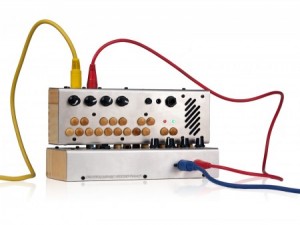
In addition to its intuitive interface, maple keys, built-in speaker, and aluminum and wood enclosure, it features the same six unique synth modes found on our original Pocket Piano:
• Vibrato Synth
• Harmonic Sweeper
• Two-Octave Arpeggiator
• Octave Cascade
• Mono FM Synth
• FM Arpeggiator
As a controller, the Pocket Piano MIDI sends out key presses as note messages, useful for triggering other synthesizers, samplers, or software. As a sound module the Pocket Piano MIDI responds to all 88 notes of a full size piano, so you are not limited to the 16 key range of the Pocket Piano. Using a full size controller, you can take advantage of the Pocket Pianos unique sounds and arpeggiators over a much larger range. Larger range = more fun !
But the fun doesn’t stop there! The Pocket Piano MIDI also sends and receives MIDI clock, so you can synchronize the Pocket Piano’s arpeggiators with your favorite drum machine, sequencer, or computer software. The Pocket Piano MIDI passes all received clock messages to its output, allowing you to chain many Pocket Pianos together to create an orchestra of Pocket Pianos.
DATAMASKIN

