
Cinesamples – Piano in Blue Walkthrough
Walkthrough of this piano library from Cinesamples.

Background information:
With a mind to the handful of historic pictures from the recording Kind of Blue our engineer Tim Starnes (Drums of War, HollywoodWinds, Cinesnares, Cinetoms 2, CineCrash) set up three sets of microphones. The first pair – the U49’s from old Columbia set up in historical position (note that the original was in mono), the two other pairs each set back a touch further from the other.
We recorded two signal chains for each mic, a clean signal going through the Neve board and one going through a historic tape machine and finally into pro tools. We highly suggest exploring the charming colorization of the tape signal but both are provided for your convenience. For some of the youngsters out there note that tape will alter the sound of medium to high gain velocity layers and that often engineers go through great lengths to achieve this distortion.
Due to the delightful variances in timbre with each key the piano was sampled chromatically; this was the only way to get a true representation of the instrument. Barry was the pianist for the sampling and he employed a unique strategy.
“Perhaps this library benefits from having someone so intimate with sampling striking the keys. The way this particular piano was voiced was very unusual and charming. Certain notes when struck with matching velocities would sound rather different in tone from one another. One would scarcely notice this in a session but it would be greatly amplified via sampling. We decided the most faithful way to capture the samples was to do it by ear, rather then by touch. Instead of concentrating on a perfect velocity match across the keyboard we listened for sweet-spots/landmarks, identifiable, pleasing string to hammer ratios. This is a method employed by pianists to layer notes upon one another with clarity. I think the end result is better for recording in this manner rather then a straight key-weight dependent system.”
We sincerely hope you enjoy this piano as much as we do.
PIANO SPECS:
- 1949 Steinway D via Neve 8078 Console
- 8 Velocity Layers Sampled Chromatically
- 9300 Samples
- 3 Microphone Positions
- Close/Vintage – 2x Neumann M49 near the lid
- Mid – 2x B&K 4007 at the tail of the piano
- Far – 2x Sennheiser MKH20′s in the hall
- 2 Processing Paths (Tape; Direct in)
- Studer A800MKIII 24 Track Analog Tape Machine
- Programmed by Sam Estes; scripted by Greg Schlaepfer; recorded by Tim Starnes
As always we share our revenue with our brilliant team of programmers, engineers, editors and musicians.
The Upright – virtual piano instrument for Windows
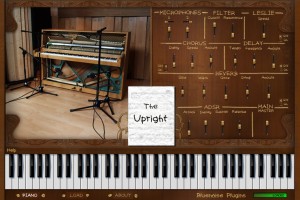
Bluenoise Plugins has released The Upright, a virtual piano instrument for Windows.
The Upright is a great sounding upright piano recorded in a professional studio. The piano recorded is a Hellas. It’s not the most expensive thing made but this particular piano has already been used for several major artist because of its great sound.
The Upright features
- Interface with a smooth look and controls for microphone outputs, a cutoff filter, chorus, leslie, reverb, delay, ADSR and main output.
- Recorded with 4 microphones (2 sets consisting of Neumann KM184 and AKG C414 B-XLS), merged into 2 outputs (left and right). The microphones were sent into a Universal Audio 4010 micpres, then through pristine RME converters into Nuendo
- Samples are raw 24 bit, 44.1 kHz wave files, 4 different velocity layers.
- The sound is left unaltered, this piano can go from sweet sounding to lo-fi.
- Effects included: cutoff filter with resonance, a built in leslie with different speeds, a soft chorus, a great sounding reverb for more room and a delay to create that John Lennon sound we love.
- Easy to use with a logical workflow.
- Includes 10 presets included from the classic upright sound to really old Lennon sounding stuff like Imagine.
- MIDI Learn makes it super easy to use an external controller to control the plugin.
The Upright for Windows (VST) is available to purchase for 23 EUR/$30 USD/£19 GBP.
Rhythmic Robot releases Boss DR55, Magnus Reed Organ and StyloDrum Kontakt Instruments
Rhythmic Robot have released three new instruments for Kontakt 4.2.3 and later:
- Doctor 55: a sampled recreation of the Boss DR55 analogue drum machine.
- Magnus: a reed organ emulating a 1950s Bakelite Magnus organ and a 1970s plastic version.
- StyloDrum: a glitchy drum machine with four kits sampling scratches, crackles, pops and squeals from vintage Stylophones which have been pitched, looped and trimmed to form electronic drum sounds.


Doctor 55 costs £4.95. Magnus and StyloDrum cost £3.95.
Doctor 55 is a Kontakt version of the Boss DR55 analogue drum machine. It samples the original with great precision at 24-bit. Each of the four original kit pieces (kick, snare, hats and rimshot) are covered, plus an additional “hidden” snare sound that only showed up on the original during programming. This additional snare has been given its own Attack and Decay parameters, hidden on the rear panel, which allow the user to create brushed snare sounds or snares with long decay tails.
Additionally, as usual with Rhythmic Robot drum machines, multiple samples have been taken through the entire travel of the DR55’s “Accent” control. These differently-accented samples can then be accessed either by tweaking the “Accent” control on the GUI panel, or by velocity from a MIDI keyboard (or by drawing velocity automation straight into a DAW lane). Accent amounts change the tonality of the kit pieces considerably, and can be dialed in on a per-kit-piece basis, which of course was not possible on the original instrument (where Accent functioned globally).
The Doctor 55 rounds things out with a Tone control, plus effects control over tube saturation, bit-crushing effects, Drive distortion and an output compressor / limiter for “gluing” and pumping effects.
Features:
- All the sounds of the DR55 captured through the entire travel of the Accent control.
- Kit pieces individually adjustable for level, pan and Accent.
- New “hidden” snare sound sampled, and adjustable for attack and decay.
- Velocity Retrofit button allows incoming velocity to vary the Accent level dynamically (for humanised beats).
- Bitcrusher, tube saturation, distortion and compression / limiting on the outputs.
Magnus is a reed organ instrument sampled from two vintage Magnus reed organs: a Bakelite model from the 1950s, and a red plastic model from the 1970s. The Bakelite model was Magnus Organs’ first ever model and is extremely rare.
Magnus allows the user to blend the “Bakelite” and “Plastic” samples to taste via the front panel controls, and adds Tone and “Electrify” — which brings in tube harmonic distortion to the sound. Attack and Release controls are available for the amplitude envelope, and longer release times invoke a slight pitch drop-off as the sound decays, which mimics the behaviour of a real reed organ having its keys very slowly let up (air pressure through the reeds drops, and the pitch falls as a result). Stereo spread, chorus and phaser effects are available on the rear panel.
Magnus is designed for unusual organ sounds and breathy pad textures.
Features:
- Bakelite 1950s and Plastic 1970s samples can be blended to taste.
- “Electrify” control for adding harmonic distortion; Tone control for high-end roll-off.
- Attack and Decay parameters.
- Original pitch drop-off emulated on long ADSR release settings.
- Stereo spread, chorus and phaser controls on rear panel.
StyloDrum is an analogue drum machine built from sampled scratches, bleeps, bloops, fizzes, noises, crackles, thumps and glitches — all taken from vintage Stylophones. These have been pitch-shifted, looped, trimmed and fiddled with as necessary to turn them into old-school-style analogue hits. StyloDrum incorporates four kits spread over four octaves, each with at least two kicks and two snares. Most have hats, some have crashes, toms, claps or other “classic” sounds. Interspersed are a lot of random scratches, glitches and other Stylophone-based weirdnesses.
Kit pieces can be adjusted in level and pan position, and there’s a comprehensive effects section with Saturation, Drive and “Pump” compression to really kick things into gear. StyloDrum is a unique source of left-field electronic sounds for any genre, with a glitchy, grainy edge.
Features:
- Four kits built entirely of Stylophone scratches, glitches, squeaks and squeals.
- Pan and level controls.
- Tube saturation, Drive distortion and “Pump” compression.
- Unique and unusual electronic elements for any genre.
Stoner Planet T sampled Electric Piano for Kontakt
A sampled Hohner Pianet T, overdriven with vintage valves and recorded to tape.
Over 40 presets for Kontakt 4.2.3 or later, with the emphasis on stoned 70s sounds 
Just doodling through some of the presets…
Many patches have an auto wah style feature, and all of the effects/vibratos etc in this video are from Kontakt, mapped via the modulation wheel.
Another demo on soundcloud:
http://soundcloud.com/tronsonic-1/stoner-planet-t-electric-piano
New stage pianos from KORG
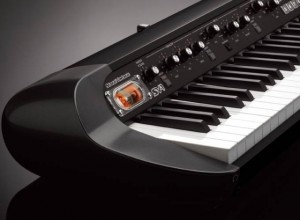
Korg has announced two new editions for its SV-1stage piano.
- SV-1 Black: The Korg SV-1 Stage Vintage Piano has been given an elegant matte black stage finish; available with 73 or 88 keys.
- SV-1 Reverse Key Limited Edition: The SV-1 Reverse Key is going to be available in a limited edition of 500 of each model.
While not a new keyboard design, the new Korg SV-1 are stylish variations on a stage piano that’s proven to be popular.
Pricing & Availability:
- The Black Stage Vintage Piano will be available mid January, 2012 priced $2,700 USD (SV-1BK73) / $3,000 USD (SV-1BK88).
- The Reverse Key Stage Vintage Piano will be available May, 2012, priced $2,900 USD (SV-1R73) / $3,200 USD (SV-1R88).
NAMM: A whole range of new stuff from Clavia/Nord has been revealed – check them all out here
So NAMM has started and NORD brings us lots of goodies – including the previously teased Nord Drum
Nord Piano 2 – 88 key hammer action stage keyboard with Nord Sample Library support


The Nord Piano 2 HA88 lets you easily play, split and layer stunning Grand, Upright and Electric Pianos from the Nord Piano Library with sounds from the versatile Nord Sample Library. All this in a streamlined portable package with 88 Hammer Action Weighted keys.
The Nord Piano 2 comes with a wide range of quality acoustic and electro-mechanical instruments from the Nord Piano Library, all with their own unique character. The included Nord Triple Pedal features a dynamic sustain pedal that can also recreate the mechanical “stomp” and “sizzle” noises that occur when the lifting or releasing the dampener in an Acoustic Grand or Upright Piano. The Advanced String Resonance feature simulates the subtle phenomenon that occurs when piano strings cause other un-dampened strings to resonate, further adding to an amazing level of realism.
The Nord Sample Library offers more than 1000 high quality sample-instruments ranging from Strings, Brass, Synths and Basses to the legendary vintage sounds of the Mellotron and Chamberlin.
Both the Nord Piano and Nord Sample libraries are continuously updated and are available as free downloads for all Nord owners.
All of the sounds in the Nord Piano 2 HA88 are replaceable, making it an instrument that is built to evolve with you. It’s even possible to create your own sample instruments using the Nord Sample Editor.
We think technology should be transparent to the user, which is why the Nord Piano 2 has dedicated buttons and knobs for all functions the performing musician needs instead of confusing menus.
We’ve made it amazingly simple to layer and split sounds, and there’s a volume pedal input for sneaking in those strings while you keep playing.
The Nord Piano 2 also sports an extensive effects section, covering everything from Phaser, Wah-wah, Flanger, Chorus and Delay effects to a 3-band Equalizer, Amp Simulations, Compressor and Reverb
The Nord Piano 2 will be shown at the AM&S Nord Booth #6464 at NAMM Show 2012″
Nord C2D Combo Organ – Dual manual organ with drawbars


Complete with 2 sets of physical drawbars per manual the Nord C2D is the ultimate portable organ for musicians that play with their drawbars as well as the keys. The new left-hand preset sections offer an unsurpassed level of hands-on control and the upper manual and panel has been tilted for better ergonomics. A LCD-display has been added for easier access to programs and settings.
The Nord C2D features a redesigned simulation of the characteristic mechanical key clicks that are an essential component of the classic tone-wheel experience. Furthermore, the redesigned percussion model offers increased control over the percussion levels when playing near-legato.
The Nord C2D also includes a redesigned Rotary Speaker simulation of a vintage 122 unit.
Naturally, the Nord C2D also includes both the Vox and Farfisa transistor organ simulations and the sampled Baroque Pipe Organ from the acclaimed Nord C2 Combo Organ.
The Nord C2D will be shown at the AM&S Nord Booth #6464 at NAMM Show 2012″
Clavia releases Nord Drum Virtual Analog Drum Synthesizer


The Nord Drum is a revolutionary 4-channel drum synthesizer that is the result of a creative collaboration between Clavia and drum/music technology enthusiasts Bruniusson & Berg. With an amazingly vast sonic palette and an astounding level of playability it is guaranteed to change your perception of what’s possible with synthetic, sample-free percussion.
The Nord Drum lets you create classic retro-futuristic percussion with analog waveforms or use the harmonically complex waveforms together with different colors of noise for results that both sound and respond stunningly organic. The Nord Drum is designed with the performing musician in mind and its extreme dynamic range and super-fast triggering add to the feeling of playing a real instrument.
4 high-sensitivity inputs and MIDI lets you play the Nord Drum with a wide range of Electronic Drum Pads, Acoustic Drum Triggers and MIDI-pads/Sequencers for easy integration into any existing drum-kit or the starting point for something completely new…
The Nord Drum will be shown at the AM&S Nord Booth #6464 at NAMM Show 2012″
iPhone’s SIRI plays the piano
SIRI plays a YAMAHA Disklavier WIRELESSLY via WIFI & Airplay, complete with moving keys in full expression and moving pedals. Presented by the inventor of SmartKEY for Disklavier, Craig Knudsen.
Take a standard MIDI songfile and convert it to an audio file (while maintaining the MIDI data). The songfile is then sent wirelessly via WiFi to an Apple Airport Express (which is mounted underneath a Yamaha Disklavier reproducing piano. The audio output of the Airport Express is then connected to the analog MIDI inputs of the Disklavier, using a standard audio cable.
Then, you simply ask Siri to play your favorite song from your iTunes library, and Siri responds immediately, by making the Disklavier’s keys and pedal move up and down, recreating the performance, including full orchestration.
The result is nothing short of magical.
Pocket Piano Music
This is a VideoSong, a new medium with 2 rules:
1. What you see is what you hear (no lip-syncing for instruments or voice).
2. If you hear it, at some point you see it (no hidden sounds).
Here’s the soundcloud link if you wanna just listen to it, download it or even share it (who knows?) : http://soundcloud.com/antwaanmusic/pocket-piano-music
And this is a videoSong filmed with an iPhone 4s
Website : http://www.antwaan.net
Free grand piano instrument for Native Instruments Kontakt
PrecisionSound has released a free grand piano instrument for Native Instruments Kontakt, Amore:

We recorded a Yamaha grand piano, close miked in stereo and kept it small, under 200 MB.
The 3 page GUI is intuitive and easy to understand with controls for decay, EQ, IR reverb, Delay and Keyboard response.
You need the full version of NI Kontakt version 3, 4 or 5 to use this SampleSet.
Download Amore from the PrecisionSound site.
NOTE: This is only if you cannot afford one of these at home hehe
MIDI-triggered Pocket Piano MIDI + Catalinbread Montavillian echo
Here is the Critter and Guitari Pocket Piano MIDI being triggered by the Mellotron M4000D (we are not hearing the Mellotron, just the Pocket Piano).
The output of the Pocket Piano is going to the Catalinbread Montavillian Echo pedal. Sweet sound, huh?
http://bigcitymusic.com
All post delivered from Moscow this week

DATAMASKIN

