
Worlds in a small room – interview with Steve Jansen (former member of Japan)
Steelberry Clones had the great opportunity to talk to Steve Jansen during his recent visit to Sweden. Steve Jansen was former percussionist in the legendary 1980’s new romantic act Japan (also featuring David Sylvian, Richard Barbieri and Mick Karn). After the band decided to quit in 1982 Steve has embarked on a long and successful journey, some times in collaboration with his brother David Sylvian on his solo albums, sometimes in more unknown appearances together with Japanese artists like Yukohiro Takahashi (YMO), but also driving more pop orientated endeavors with the Dolphin Brothers, which he started together with Richard Barbieri. Steve Jansen has at many occasions been dubbed as one of the most important percussionist of his time, and the characteristic sound that gave way for their all time selling album Tin Drum, has provided him with the opportunity to play with most of the leading artists since then. I wanted to know more on what has happened since then, his views on today’s music scene and the evolution of electronic music, as well as discovering his more recent works in the border lands between pop, ambient, arts and experimental music.
Today’s music scene
Steve Jansen is a highly productive musician, if it is not something on his own doing you will certainly find Steve in collaborations with David Sylvian, John Foxx, or as part of the band on tour with Ryuichi Sakamoto in Japan. So I asked Steve to give me an update on what he is up to right now and his collaboration with Sugizo.
Most recently Steve has been involved in finalizing Mick Karn’s new Dalis Car album, partly to keep his spirit alive, but also as a fund raising initiative for his relatives. Steve has therefore been active both as a mixer and performer of the new album and engaged in the process of reworking some of the new tracks. The yet untitled album is due out in the October – November time frame. As most of you know Mick Karn died recently and one of things that Mick Karn was doing at the time was to produce a new Dalis Car album. Dalis Car’s first album “The Walking Hour” released in 1984 was an interesting album where the borders between various musical styles were mixed to create a very unique album at the time. With Sugizo Steve recently contributed a rhythm track to a new recording, a track also featuring Mick Karn on bass.
With some thirty years as a musician, working across most prominent genres – as a new romantic pop star as part of Japan, to exploring the fields of ambient electronics and jazz fusion, to bridging the gap between modern art visuals and experimental music, it is highly relevant to ask Steve’s view on today’s music scene. Steve says that today’s scene is of course in many ways very different from back when he started his career. The power of the record companies put a lot of constraints and pressure on the bands to deliver on time, but also to make music in line with what they and the fans were requesting – “pleasing the record label almost became a means to an end”, Steve says. Today you have much more freedom to explore and the artists does not work under the same pressure. So although it is harder to make a living you are the one in control. With modern music technology you almost have endless possibilities to manipulate sounds and craft your own ideas – inside your head.
Back to Japan
You really cannot write about Steve without touching on the subject of Japan, both as a band and as the country where both David and Steve over the years has continued to find inspiration, collaborations and a solid fan base. When Japan ended as a band in 1982, (doing their last tour in Japan, followed by a live album), the band members ended up doing several projects on their own or in collaborations with each other.
I wanted to know how this fascination with Japan as a country came to shape their music going forward. Steve tells me that it has probably been more that they have all individually made their own subjective interpretations of the music. And although it was a strong influence on the Tin Drum album, Steve says that more recently it has been more important for him to embrace modern rhythms and electronic sounds, although that he has in his collaboration with Sugizo been working to incorporate the sounds of traditional Japanese Taiko drums.
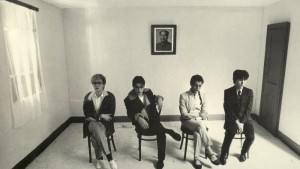
Steve and David Sylvian have over the years done several highly acclaimed albums where they have been exploring the boundaries of ambient, electronic and jazz. As a listener you can easily picture late night improvisations where Steve and David together with other musicians like Harold Budd and Robert Fripp, would jam together beautiful ambient landscapes. I wanted to know if this was an accurate image of the music production process and how the songs took their shape.
What does the future sound like? – An exclusive interview with Andy McCluskey of OMD
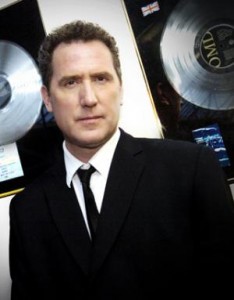
Time for yet another synth-pop pioneer to enter the front stage, here at Stereoklang. I had the pleasure to talk to none other then Andy McCluskey, 50% of the legendary act Orchestral Manoeuvres in the Dark, OMD for short. Few other acts have had such an influential role in the development of the electronic pop music scene, with classic hits like Maid of Orleans, Enola Gay, Messages to name but a few. I wanted to ask Andy all about OMDs re-emergence on the music scene, their work in the studio, past and present, and of course their most recent album “History of Modern”.
Looking back
For those growing up in the late 70’s and 80’s, OMD was as well-known to “synthpoppers” as any of the other leading acts at that time, i.e. Kraftwerk, Depeche Mode, Tears for Fears, Gary Numan, Yazoo to name but a few. I asked Andy how it all started. He lets us know that he and Paul started composing music when they were about 16, basically making music with what they had at hand (consider this was mid 1970s really primitive in other words). Andy was asked to join the band that Paul was involved in, but pretty quickly realized that they had much more in common and decided to go on their own. So in the very early days, what was later to become OMD, it all started as a pure hobby. Back in Liverpool it is easy to picture two young guys at home listening to Kraftwerk and dreaming of success. It was also in Liverpool that their first real gig came about, at a club called Eric’s. It was also at Eric’s that they saw other bands that were thinking along the same lines, like The Normal (featuring Daniel Miller) that made Andy and Paul realize that what they were doing had relevance on the music scene.
Steelberry Clones – “where did the band name come from?” Andy – “we were assigned to do a one off event and we really wanted to come up with the most preposterous name they could ever think of – Orchestral Manoeuvres in the Dark – having absolutely know meaning whatsoever”. “There were no master plan!”.
Biggest milestone
With a career covering decades I certainly thought that Andy would think of any of their great concerts or when any of their now legendary albums like the poetic “Architecture and Morality”, ecstatic “Junk Culture” or “Dazzle Ships” hit the shelves, selling millions of copies, being the obvious choice. But no, Andy tells me that the biggest milestone for him was when he, in his own hands, was holding their first ever 7” vinyl single “Electricity”. “This was a record by Paul and I!”, Andy says. This must truly have been a magic moment, as a any teenager at that time with a passion for music would browse through the import boxes in your local record shop as a weaken treat, finding rare issues of cool acts, imagine then to find your own piece of work.
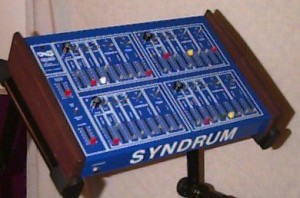
With the single in hand, gigs started to come and OMD played as warm up act to Joy Division. Then Gary Numan, who had just bought their single Electricity asked if they would like to perform with him. The following year OMD themselves were the main attraction. Andy also remembers that this was also the first time, when performing with Joy Division, that they saw a real Pollard Syndrum in live action. The Pollard Syndrum was one of the first electronic drums and was capable of many different sounds. The sound favored by most recording artists was a sine wave that pitch-bends down, most famously heard at the beginning of “Good Times Roll”, the opening track of the Cars’ 1978 debut album.
History of Modern
“History of Modern” represents a highly anticipated come back from one of the most influential electronic pop acts to date. Skeptics were questioning if they could re-invent themselves and why are they doing a retro-flirt. I kindly asked Andy about the retro-flirt and although Andy was not so keen on the term retro in relation to the new album he admits that if going back to your roots and re-discover that unique and distinctive OMD sound, ”then yes let us call it retro”. For Paul and Andy it was really important to get that “voice” of OMD back, that sound they left behind. “We spoke with our own authentic sound”, Andy says.
Starting to work on the new album it was important to OMD that it shouldn’t be a copy; they needed to have new and fresh ideas. According to Andy “there are too many bands of our generation that do not have anything more to say.”
Read the full interview here >>
Exclusive interview on its way – guess who?
Any day sooooon we will publish a new great interview with a leading synth pioneer, can you guess who?
Clue?
Hmmmm, they work by the mantra “What will the future sound like?”
Leave your guesses in the comments section 

BTW This is a KORG Micro Presets…..
Robert Marlow has a new album coming ‘The Future’ out on Electro-Shock-Records
Synth-pop veteran Robert Marlow and his partner in crime Gary Durant are working on the final mix for the new Marlow album “The Future”. The album will be released on the German label Electro-Shock-Records by the end of this year.
The album is the follow-up to 2009’s “Inside/Outside” and brings a mix of 80s synth-pop and melodic electro-pop. A very limited fan-edition with 5 new tracks from the album “The Future” was released on the Depeche Mode-Fan-Exhibition/Meeting in Basildon on Saturday July 23.
You can view a cover-version of Depeche Mode’s track “New Life” as performed by Marlow in Basildon after the jump or in our mobile videoplayer.
Via SL
Drum machine in action – Roland CR 78 Demo
Although primitive by today’s standards, the CR-78 represented an important advance in drum machine technology at the time. The wood effect cabinet and preset rhythms of the CR-78 such as Waltz, Bossa Nova and Rhumba suggest that it was seen by its designers as primarily an accompaniment for an electric organ, but the CR-78 became one of the favorite instruments of Pop and electronic musicians in the late 1970s and early 1980s. Songs that make prominent use of the Roland CR-78 include “Heart of Glass” by Blondie, “In the Air Tonight” by Phil Collins and “Duchess” by Genesis. John Foxx expresses his love for the CR-78 in this interview.

The CR-78 used analog drum voices, which sounded very little like real percussion instruments, but they instead had their own distinctive sounds. The unit also incorporated an early Intel microprocessor to provide digital control of its functions. Previous Roland drum machines had offered only a selection of preset rhythms. The CR-78’s key new feature was that in addition to offering 34 preset rhythms, it provided four programmable memory locations for storing patterns created by the user. These could be created by using step programming with the WS-1 box, which was available as an optional extra.
The CR-78’s front panel allowed the user to customize the preset rhythms by altering the volume balance between bass and treble sounds, canceling some sounds altogether, and adding ring modulation (“metal beat”) to the cymbal sounds. Many of the preset rhythms have a memorable character, and the ability to manipulate them further made the CR-78 a versatile instrument.
No digital control of tempo was provided on the front panel, with only an analog knob for the function. However, the CR-78 would also accept an external V-trig clock, allowing a control voltage to be fed in from another device such as a music sequencer. A selection of preset fills and rhythm variations were also available, either to trigger manually, or automatically every 2, 4, 8 or 16 bars. Some of these fills were used in synth-pop songs such as “Enola Gay” by Orchestral Manoeuvres in the Dark, “Underpass” by John Foxx and “Vienna” by Ultravox.
Roland also produced a simpler drum machine, the CompuRhythm CR-68. This was essentially the same as the CR-78, but without programmable patterns or the ability to fade drum sounds in and out. At the same time Roland also sold the TR-66, a smaller unit which offered fewer preset rhythms and no programmability.
In this video:
Mostly playing around with rhythm selections (incl. A/B variations), voice cancel, tempo, automatic fills, automatic fading, etc.
Back in the days – Indians in Moscow
Indians in Moscow are synthwave pioneers, originally formed in Hull (UK) in 1981. They had a No.1 indie hit in 1983 with “Naughty Miranda”, followed by “Jack Pelter and his Sex-Change Chicken” and the “Big Wheel e.p.”. The original band split just as their first self titled album was released.
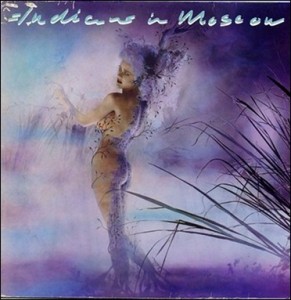
Expanded version of Indians in Moscow 1984 masterpiece will be available for the very first time on CD with large bonus section via Other Voices Records.
Catchy, Quirky and Unique. Absolutely not to miss!!!
Tracklisting:
1.Big Wheel
2.Meeting Place
3.Witches & Heroes
4.Howard’s at Lunch
5.Jack Pelter and His Sex -Change Chicken
6.Puppet Dance
7.Square Dance in the Sepulchre
8.Love Song
9.I Wish I Had
10.Singing to French
11.Naughty Miranda
12.Underneath the Tree
13. Slide
14. Dies Irae
15.Naughty Miranda (Extended Mix)
16. I Wish I Had (Extended Mix)
17.Jack Pelter (Extended Mix)
18.Naughty Miranda (7″ Single Mix)
Indians In Moscow :
Adele Nozedar
Pete Riches
Richard Hornby
Stuart Walton
Their first release was a contribution to the various artists compilation “Your Secret’s Safe With Us” in 1982. They came to fame on the cult 1980s Channel 4 music TV show The Tube as part of the show’s Hull music special, and had three hits on the UK Indie Chart with “Naughty Miranda”, “I Wish I Had” and “Jack Pelter & His Sex Change Chicken”. After a fourth single, the “Big Wheel” EP, the band’s only (self-titled) album was released in 1984. The band split up shortly afterwards, with Nozedar forming a new band, The Fever Tree, who released one single, “The Pixie Shop” late in 1985. Riches and Walton reformed the band in 1998 with singer Chris Guard and moved into techno / house territory.
Klaus Schulze performs “Rheingold” live
Pioneer Klaus Schulze is soon to release a DVD and this clip is a teaser for you to enjoy. Klaus Schulze is a German electronic music composer and musician. He also used the alias Richard Wahnfried. He was briefly a member of the electronic bands Tangerine Dream and Ash Ra Tempel before launching a solo career consisting of more than 60 albums lasting five decades.
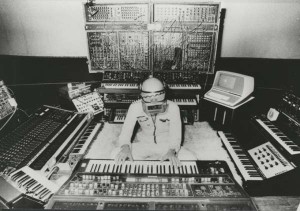
Pioneers of electronic music
Slices – Pioneers Of Electronic Music Vol. 1 – Richie Hawtin. The 70 min documentary features an extensive archive of unreleased photos, video and interviews.
The launch of this DVD special series, Slices – Pioneers of Electronic Music celebrates in detail the life and work of prominent artists or “pioneers” in the global electronic music scene. The first edition is a documentary film based on electronic producer, performer and industry icon, Richie Hawtin. The film draws from the important stages and events in Richie Hawtin’s personal and artistic life, revealing the journey of an introverted and transplanted computerminded teen that develops by way of Detroit’s radio and records fueled by pure driven passion into a successful techno-entrepreneur and global DJ entertainer. Assembling an extensive archive of both new and un-released photos, video and exclusive interviews, the film provides an extraordinary insight into the life and career of one of the most successful activists in techno history: Richie Hawtin.
Cool interactive video with DEVO
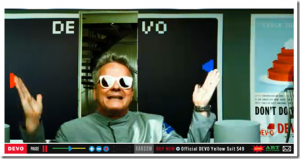
DEVO has a released a new interactive video for “What We Do”. There are some marketing lessonsto be learned by watching DEVO work social media.
Jump over to Mashable to check the video out.
Instructions from their web site:
“SPUDS: The wait is over! Here’s DEVO’s new “What We Do” video! View it repeatedly, explore by moving your viewpoint, and see something new each time.”
In the studio with John Foxx
“We went to visit John Foxx deep in the darkest depths of Shoreditch, East London, at the studio of his latest collaborator, Benge. The studio isn’t far from where Foxx’s infamous “The Garden” studio once laid (on top of multiple Roman graves no less) and it’s also the location where the duo cut Interplay, the latest album by John Foxx and the Maths.
The notoriously quiet man sat down with Jordan to wax nostalgic about Foxx’s time in Ultravox, synths (obviously) dub techniques, drinking and eccentric sex. Finally, John was kind enough to demonstrate his infamous drum machine and play us some of the patches from his highly influential first album, Metamatic.”
Shared by Motherboard
DATAMASKIN

