
Roland MC-505 / MC-303 Promo Video revitalized
Here is a video Jordan Passmore created using segments of a Roland promo video they released sometime in the late 90’s.
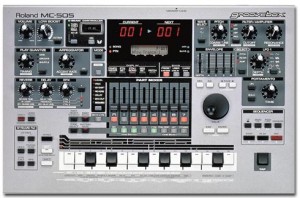
An all in one techno music production studio, this machine has it all. A massive collection of professional and coveted electronic synth and drum sounds, effects, built-in real-time VCF and envelope knobs for tweaking, a sequencer/arranger, and many other great additions. This is the successor to the MC-303 and is now much more advanced. Its sounds will be familiar to any techno-head.
The LFO and resonant filters allow quick and easy sound manipulation. The new D-Beam allows you to randomly tweak your sounds by passing your hand over an infrared beam! It has a great sequencer for building your songs (with groove quantizing and part level faders for mixing) as well as many idea catchers like the phrase sampler and arpeggiator.
This is an all-in-one music machine that’s great for DJ’s or anybody else who wants to create slamming dance tracks. Designed as a stand alone machine, they do not work quite as well when incorporated into a multi-synth keyboard rig. It’s perfect for beginners and advanced users, but offers the most possibility to those who will use it exclusively. By the way, in comparison to the MC-303, this is far better especially in the quality and quantity of sounds!
Time machine: Exploring the Moog Source, Minimoog and Roland JD-800
A voyage into the heart of the Moog Source from the year 1981.
Exploration by Marko Ettlich
monophonic analog synthesis 2 VCO I Saw, Square, PWM,
Filter – 24dB lowpass
sample/hold
step sequencer, arpeggiator
and more
A voyage into the heart of the Moog Minimoog from the year 1970.
Exploration by Marko Ettlich
monophonic analog synthesis 3 VCO I Saw, Square, Spaced Saw, Pulse,
Filter – 24dB lowpass
44 keys, single-trigger, low-note priority
A voyage into the heart of the Roland JD-800 from the year 1991.
Exploration by Marko Ettlich
rom sample based digital synth
24 voices
6 part multitimbral
multimode filter, lfo
61 keys with velocity and aftertouch
Time machine: ROLAND JUNO-6 Analog Synthesizer 1982
“This is the Roland Juno-6 (or: who stole the programmer on my Juno-60?). The sound and the sound architecture is identical to the Juno-60. But the highpass filter of the Juno-6 is infinitely variable, whereas on the Juno-60 you can choose from 4 settings.
I played the Juno-6 dry without any additional effects.”
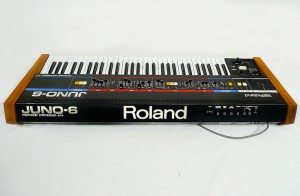
The first in a series of amazingly affordable quality synthesizers from Roland’s amazing Juno family! The Juno-6 is a six voice polyphonic analog synthesizer! It’s a very stable synth thanks to its digitally controlled analog oscillators. The Juno-6 sounds great, however it lacks basic necessities like MIDI control and patch memory storage.
The next generation Juno-60 version added 56 patches of memory storage. Both of these synths sound virtually the same and are considered by many to sound better (punchier) than the popular follow up, the Juno-106. The Juno-6 and 60 are very rich sounding synthesizers and are great analog machines as long as you can overlook the absence of MIDI control. Of course nobody can deny that the wooden side panel look is a true sign of Vintage status!
Time machine: PPG wave 2.2 synthesizer – “Dark Voices”
all sounds self-programmed: PPG wave 2.2 Wavetable Synthesizer from the year 1982
recording: multi-track without midi
fx: a little bit delay and reverb
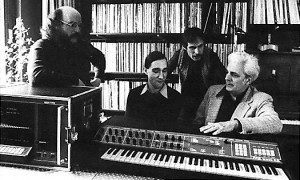
The German made PPG (Palm Products GmbH) Wave 2 series of synthesizers are incredibly great sounding analog/digital hybrid vintage synths. They use digital samples of wavetables and feature analog VCA envelope and VCF (filter) sections for a classic and warm sound. The Wave 2.2 has oscillators that can generate over 2,000 different single-cycle 8-bit digital waveforms! Covered by knobs, the Wave still looks analog and this comprises the “Analog Control Panel”. More complex and new-wave editing of the wavetables and samples is covered by the “Digital Control Panel” where there are several key-pad buttons and an LCD screen. Another familiar treat to analog junkies is the inclusion of an 8-track sequencer which features automation of pitch, loudness, filter cutoff, waveforms and more. A cool feature – its onboard sequencer will also record any filtering and wave changes, in real-time!!
The more commonly encountered Wave 2.3 followed the 2.2 and had enhanced sample-playback capabilities. The sampler was pretty full-featured for its time and included upgraded 12-bit digital waveforms, Fourier analysis and linear playback of samples. The 2.3 model also featured 8-parts multitimbrality and MIDI implementation. The PPG Waves are know to create excellent pads, brass and bass sounds.
In fact it was Tangerine Dream who helped the company and the Wave develop. 1978 saw the development of the PPG Wave Computer 360. But the Wave Computer sounded harsh and tinny. In 1981, the PPG Wave 2 was released which added analog VCF and VCA filter and envelopes to warm the digital sound. The original Wave 2 had 8-voice polyphony, like the 2.2 and 2.3, but it had only one oscillator per voice. The 2.2 offered two oscillators per voice which opened up a whole new realm of sonic possibilities because two separate wavetable sounds could now be combined.
more info: http://www.retrosound.de
Jordan Passmore Demo of the Roland JX-10, Roland SH-2, Akai MPC-60
This is a demonstration of two Roland analog synths, a JX-10 and a SH-2, combined with the sequencer/sampler the MPC-60. The MPC-60 is loaded with Linn LM-1 samples (courtesy of ToneBldr, http://www.drivenmachinedrums.com ) and is also sequencing the JX-10 and SH-2. The SH-2 is doing the bass while the JX-10 is doing the melody; Jordan is playing lines over the melody on the JX-10 occasionally. All sounds are mixed on a StudioMaster mixer and there is an analog delay (Washburn Accellerator) on one send and a EH HolyStain on another.
“The MPC-60 is sort of out of shot so near the end I bring the camera around to show what I’m doing with that.”
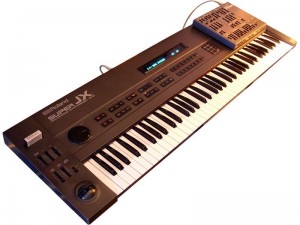
Released in 1985 the JX-10 (Super JX) combines two individual JX-8P’s for an outstandingly warm, rich and analog sound which is still used in many modern studios all over the world. This synth was the first Roland Synth to be fitted with a quality 76 note keyboard with velocity and aftertouch. Two DCO’s per voice, two ADSR envelope generators per voice, and a resonant lowpass & non-resonant highpass filters are only the beginning. It has a 12 voice polyphony for a total of 24 oscillators and it is by far one of the most programmable synths of its time! However, as on the JX-8P, knobs and sliders have been replaced by low-profile buttons and a nice LCD display. Although this may look sleek and elegant, it makes editing a chore. Assign parameters to the alpha dial for tweaking, one at a time, or get the optional PG-800 Programmer to provide traditional, hands-on, dedicated sliders for editing the JX-10’s parameters.
The JX10 has a Chorus effect and a chase-play Delay function. The chase-play function allows programmable delayed repeats of voices by alternating patches of the upper and lower modules. The simple chorus effect is either off, slow or fast. It has two programmable sliders (if you don’t use the PG-800) for some real-time control which can be recorded along with other effects and keyboard modes into one of the 64 Program Patches. This is in addition to its standard 50 preset and 50 user patch memory. A simple sketch-pad 1-track real-time sequencer is also on-board. It stores sequence data directly to an M16C card, or an M64C card for Patch/Tone OR sequence data. The M16C has a capacity of 400 notes, the M64C 1440, according to the manual.
The JX-10 also comes in a rack-mount version known as the MKS-70. It’s worth noting that the JX-10 can not be edited via SysEx, however the MKS-70 can which is one reason many have chosen the rack version of the keyboard. The JX-10 can make bulk dumps of its sounds over sysex, but only with (discontinued) Roland M64C RAM cartridges.
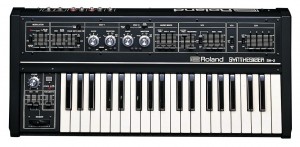
The SH-2 is one of Rolands’ early synthesizers. It is very simple in design, look and function. It sounds much like the SH-101 synth, including the typical SH-style sub-oscillator. But the SH-2 employed 2 oscillators for a much fatter sound. It has the typical Roland SH sound – it’s a monophonic bass synth that’s flexible enough to provoke punchy analog basses, leads and squelchy sounds. The oscillators can be de-tuned as well, another feature the popular SH-101 lacks. But it isn’t very pretty to look at as it shares the same design and layout as the SH09. Still it makes a simple and easily programmable mono-synth that can be used in place of the more common SH-101. However the SH-2 is harder to find and so it usually has a higher price than other SH-type synthesizers from Roland.
Vintage Effects Bundle
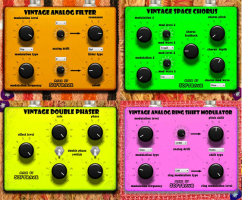
Softrave has released Vintage Effect Pack for Windows, which includes four VST Effects:
- Vintage Analog Filter
Vintage Analog Filter Vst is constructed to emulate analog instability of electric circuits of vintage filters. You can control the level of analog detune with analog drift section. you also have big choice of waves to modulate filter to make psychedelic, cosmic or just disco and house effects. - Vintage Double Phaser
Vintage Double Phaser Vst is providing classical phase shift effect and some extended possibilities. You can create phase shift effect on left and right channel separately that makes strange unique sound. Or just enjoy classic phaser sound. Its good for guitars, pads, drums and percussion lines. This plugin was inspired by The Worm guitar pedal by Electroharmonix. - Vintage Analog Ring Shift Modulator
Vintage Analog Ring Shift Modulator Vst is providing mix of pitch shifting with ring modulation. You can create unusual vibrato effects, distortions or bell like sounds and also weird strange effects. This plugin was inspired by Ring Thing guitar pedal by Electroharmonix. - Vintage Space Chorus
Vintage Space Chorus is intended to create unusual stereo chorus space effects good for rock, electronica, disco and experimental styles of music With this plug you can add some vintage analog feel to boring digital sound.
Price: €31 / $40.
Illuminati secret machines revealed in abandoned underground base in ex-soviet union
Old secret illuminati base discovered underground. This video reveals some of its secrets.
Electric Pianos made with Tronto
A small selection of presets from the ‘vintage’ bank, one of 10 banks supplied with Tronto for Kontakt 5.
This video shows a little of the versatility of Tronto, with interpretations of some classic and much loved electric pianos from the past, with a few twists here and there.
The only external effect used is Echo from Psp audioware. This delay is a favourite of mine, as it’s tape delay characteristics complement Tronsonic’s libraries very well.
http://www.tronsonic.com/#/tronto-for-kontakt-5/4568455166
http://www.pspaudioware.com/plugins/delays/psp_echo/
CRUMAR MULTIMAN String Machine 1975 + Gerd Schulte Compact Phasing A
In the first half of the video ‘AnalogAudio’ plays the Crumar Multiman dry, in the second half with a COMPACT PHASING “A” from Gerd Schulte Audio Elektronik. The Compact Phasing A is a German phaser, which was well known in the seventies (at least in Germany). Many units were sold, but it is rare and sought after today. It was used by Klaus Schulze, Tangerine Dream, Kraftwerk and others.
This Crumar Multiman is the first version (later came the Multiman S versions which are larger). It was produced in Italy. It has a string section, a brass section (with VCF controls and resonance) and a piano section. It is capable of nice layer sounds. A monophonic bass preset can be added.
“Excuse the crackling noises, my Multiman is not 100% intact. Indeed, it is in terrible shape. Some of the keys don’t play notes, instead they produce some crackling noises. But the basic sound is fantastic!”
Polymoog 203a Vintage Analog Synthesizer
Background video description:
Recorded / improvised with my Roland CR-68 (Compu Rhythm) on minimal setting.
From the Polymoog I had the direct output and resonator outputs fed into my Behringer mixer while the VCF output was fed into my Ibanez UE 305 with Analog Chorus,Delay and Compressor all engaged and output back into my cruddy mixer.
I was obviously tweaking the sound in spots… Most notably the VCF Cutoff and sometimes S/H rate etc. Towards the end, or somewhere in the middle I brought down the release for a more plucky sound while the lower half of the Polymoog had a bit more sustain… Unfortunately I recorded this to digital (Tascam DP01FX) It sounded much nicer through my Tascam 688 Cassette 8-track but then I couldn’t transfer it to this media from there. Also, my Polymoog is only offering out Square waves at this time or else it would have sounded even way more complex and OTHERWORLDLY!!!
I have a feeling the Blondie and Gary Numan mostly used just Squarewaves anyway for their string sound… Though ealy 70’s Ultravox relied more heavily on the deeper and fat sounding Polymoog sawtooth waveforms…
DATAMASKIN

