
Time machine: Oberheim OB-X “1979”
All sounds self-programmed: Oberheim OB-X Analog Synthesizer from the year 1979
recording: multi-track without midi, sequenced by the SCI Pro-One step-sequencer over CV/Gate and synced with the TR-808.
drums: Roland TR-808
fx: a little bit delay and reverb
more info: http://www.retrosound.de
About the synth:
The Oberheim OB-X is an analog polyphonic synthesizer first commercially available in June of 1979 . It was the first Oberheim synthesizer that was created with internally pre-wired modules (albeit still mostly discrete circuits) and not with the earlier, unwieldy S.E.M.s (Synthesizer Expander Module). Because of this, it was more functional for live performance, and more portable. It was hurriedly introduced to compete with competitor Sequential Circuits’ Prophet-5, which took the industry by storm during the prior year. While the OB-X had moderate success in the limited numbers produced (aprx. 800 units), the design was quickly updated and streamlined with the OB-Xa; the OB-X being discontinued in 1981.
Originally, the “X” in OB-X, stood as a variable for the number of voice-cards – thus, polyphony – installed. Whereas earlier Oberheim modular systems would require multiple S.E.M.s to achieve polyphony, the OB-X condensed the S.E.M. down onto a single printed circuit board called a “Voice Card”. Using this method, along with the Z-80 microprocessor to program the cards, the OB-X was far less laborious to program than it’s ancestors. It came in four, six, and eight-voice models. The starting price for the base model of only 4 voices of polyphony was a steep US$4,595. Besides the generous polyphony, each OB-X came with a memory capable of holding 32 user-programmable presets, along with polyphonic portamento, and polyphonic sample and hold. Also, a first for Oberheim’s polyphonic range were the “paddle” levers for pitch and modulation. This was Oberheim’s answer to the then standard “wheel” style controls seen on the Sequential Circuits Prophet-5. The OB-X would be used by artists such as Nena, Rush, who used it extensively on “Moving Pictures” and “Signals” Queen, being the bands first Synthesizer to appear on an album Prince, who swore by the Oberheim OB line, and Jean Michel Jarre who used it for it’s massive brass-type sounds. The OB line of Synthesizers developed and evolved even after the OB-Xa with the OB-8, and finally the Matrix series of synthesizers.
SonicProjects have created a VSTi emulation of the OB-X, for Windows and Mac platforms called the OP-X, with near-identical sounds to the hardware version. Widely praised as the most accurate emulation of an Analog Polysynth, SonicProjects include multiple versions of the OP-X including two “Pro” versions.
Bias BS-2 Synth Drum Percussion
Demo of a classic vintage and rare drum synth – Bias BS-2 Drum Percussion: Bias (Ishibashi Japan) Drum Analog Synth Module.
Time machine: MXR 185 Vintage Drum Machine 1983
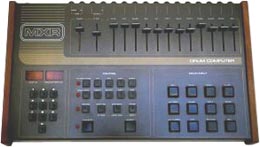
The MXR 185 is a great American drum machine from 1983. It has individual outputs for drumsounds. The crispy 8-bit samples sound great. The built in sequencer has a “tight” groove, it grooves like hell!
Know more about the MXR 185 Drum synth:
MXR were major innovators during the ’70s with their ground breaking effects pedals such as the Phase 100 phase shifter that defined the beautiful, swirling guitar and electric piano sounds of the decade.
They also produced distortion pedals, sustain pedals and more…. products that set the standard for stomp boxes even today.
They also introduced us to the idea of a pitch shifters and harmonisers (not be confused with today’s pitch correction devices).
Their products weren’t cheap but they exuded quality and had a great sound and an MXR Phase 100 pedal is probably now worth more than it originally sold for!
However, as technology progressed, MXR’s fortunes began to dwindle. Looking for ideas to generate revenue, MXR couldn’t resist the lure of the growing (and lucrative) drum machine market. Linn and Emu had been seen to be very successful with their products and, technically, the concept wasn’t exactly rocket science at the time…. a programmable sequencer that issued triggers to fire off crude 8-bit drum samples stored in ROM chips! Nowadays, this might be a course project for a college engineering student! And so in the mid 80s, they released their MXR 185 Drum Computer.
On the surface, it looked great. Twelve ‘real’ drum sounds each with their own pad at an affordable price. None of the pads were velocity sensitive – you needed to use the ACCENT button for dynamics (but this was typical for the time). However, each sound also had its own individual output and level slider. Whereas the Emu Drumulator compromised in these areas, the MXR was more like a Linn in terms of dedicated pads and controls.
The MXR 185 also had some interesting innovations in the user interface.
3 x Exploration of the Simmons SDSV
After months of repair SynthMania are ready to explore the capabilities of the Simmons SDSV. The SDS-5 (or SDS-V) was a really popular system, used by many of the big names in the 80’s. It was ‘module’ based so you could start with 5 modules and expand it to 6 or 7 in total.There was also different types of modules, toms, bass drum, snare and hi hat. Also it had ‘patch memories’, of sorts anyway. These were basically trimmers that were recessed below the panel. You could also use it in a ‘free’ mode where the sound you had was the sound set on the knobs.
After 11 months in the repair shop the Simmons SDSV is fixed. To celebrate the event, I’m testing the SDSV to explore some of the typical Italo sounds of the early / mid ’80s. The SSL Alpha-Link audio interface’s MADI port is also broken at the moment so I’m recording this audio through the computer’s internal sound card… I’ll create a better Simmons demo once I fix the audio interface. This is not a full song, just some noodling on the Simmons and JP-8 to test the SDSV sounds (which are great!)
A moody, slower demo of the Simmons SDSV, the Roland TR-808, and Roland Jupiter-8 using some classic-sounding sounds. The TR-808 drives the Simmons and the JP-8’s arpeggiator, the rest is improvised in real time. The filter of the JP-8 is set at -24dB and tweaked in real time. Again, due to my main audio interface being broken, I’m using the computer’s internal audio card, sorry for the floor noise.
Simmons SDSV, TR-808, Jupiter-8, Minimoog
Chromeo Studio Tour – analog gear guide
In May 2011 FM traveled to Montreal to spend some time in the amazing analogue laden studio of Chromeo. They gave FM a full and detailed tour of almost everything they had.
Exploring the Alesis Andromeda A6
A quick look at the Alesis Andromeda A6.
Filter CV modulation (by a Moog Multi-Pedal) and subtle timbral explorations over a rhythm track made from Moog synths (Voyager, Little Phatty and Slim Phatty).
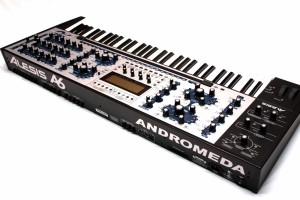
The Andromeda A6 is a true analog synthesizer using two analog oscillators per voice, sub-oscillators, hard and soft sync and more! It features 16-voice polyphony. With the Andromeda, you’ll find a huge range of tonal possibilities: searing leads, warm pads, fat bass lines, extreme sound effects and more. And of course there are plenty of knobs (72) and buttons (144), even an assignable ribbon controller for addictive hands-on real-time control! The large high-resolution LCD display is excellent and shows you actual rather than relative values of parameters. Andromeda will integrate seamlessly into any studio with its total MIDI control and sync, individual voice outputs, stereo outputs and several audio inputs.
Andromeda is completely analog – no emulation! It features two analog filters per voice that sound great! They are a multimode 2-pole and a 4-pole lowpass. External audio can be routed through these filters too (three 1/4″ jacks)! As for modulation, Andromeda has three LFOs, each with six waveforms and they can be synced to MIDI clock. And there are three 7-stage envelopes with very creative and flexible functions. Also onboard is an extensive mod matrix for enormous freedom in configuring Andromeda’s sounds!
No analog synth would be complete without a set of classic effects and features. Andromeda also offers Portamento with nine slopes and legato functions. A built-in arpeggiator and analog-style sequencer are available, with MIDI sync! There are also some high quality digital effects such as reverbs, chorus, echo, distortion and more! Andromeda comes with 256 breathtaking preset patches plus 128 user. A PCMCIA-format memory card slot allows for additional programs and mixes. Andromeda is pure analog bliss, with all the features, stability and widgets of modern digital synths.
Time machine: Roland CR-68 Vintage Analog Drum Machine
The CR-68 is a classic analog Rhythm Machine related to the famous CR-78. The CR-68 has the same sound set and rhythm patterns, but is not programmable and lacks many of the better features found on a CR-78. However the CR-68 does have breaks & fills, an accent that really livens up its beats, and a balance knob that can be used to weird-out the sounds a little bit. A much cheaper alternative to the CR-78 considering it is strictly limited to its preset patterns.
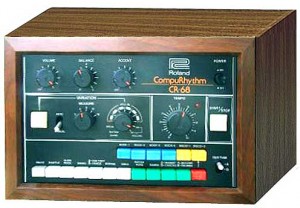
The CR-68 offers up the basic set of rhythms and sounds. There’s 4 Rock, 2 Disco, Waltz, Shuffle, Slow Rock, Swing, Fox Trot, Tango, etc… The sounds are analog and include kick, snare, rim, hi-hat, cymbal, maracas, claves, cowbell and congas. These days the CR-68’s sounds are often sampled instead, after which the machine itself may be kept around for use as a paperweight or book-end.
Futureretro 777, MPC-60 (Oberheim DMX Sampled) Acid Funk Demo by Jordan Passmore
Here is a brief demo of the Futureretro 777 monophonic analog synthesizer/sequencer and the Akai MPC-60 sampler/sequencer. The 777 is running off of it’s internal sequencer and is sync’d via MIDI clock to the MPC-60. The MPC-60 has a sampled set of Oberheim DMX sounds. The delay that the 777 and drums are sent to is the Ibanez DMD2000. All are mixed on my StudioMaster mixer and sent straight to my soundcard (Native Instruments Kore 1).
Young Meets Old: iPad-Synth Magellan ruled boy Korg PK-13
Korgs PK-13 from the mid-1980s is giving some midi to iPad-App Magellan. Magellan is the bold new professional analog modeling synthesizer for the iPad. Not content with just one synth, we gave Magellan TWO independent polyphonic synth engines. Individually or together, they deliver a new powerful warmth to the sound of iOS music.
Complete with a full effects rack, a total of six oscillators, dual filters per engine, multiple unison stages, extensive modulation matrix, dedicated arpeggiators, powerful MIDI capabilities, and a polyphonic step-sequencer – the aural possibilities with Magellan are infinite!
Review Of The Arturia Mini V
In this Video Neil takes a detailed look at the advanced features of the Arturia Mini V, An expanded software emulation of the classic MiniMoog Vintage Synthesizer.
DATAMASKIN

