
Yamaha CS01II Plays BIG MUFF by Depeche Mode – Cubase Screen Capture
Youtube alias peahix has uploaded this DM cover of Big Muff, details below:
I’ve had several skeptics weigh in on my various Depeche Mode covers done all on my Yamaha CS01II synth, so I thought I’d make a screen-cap video showing the Cubase session for my rendition of “Big Muff.” Here’s the mastered version I posted previously: http://www.youtube.com/watch?v=5IiZlvr7fXs
In this version, you can see all my parts, and I solo all the different bits throughout so you can hear how it all comes together. Note that for several sounds there are actually two different tracks that play together to form a composite sound. The CS01II is a pretty limited synth, and in order to more accurately achieve certain sounds, I had to split things into their component parts. The channels that remain muted throughout are just the MIDI parts, which aren’t outputting to anything here, since each MIDI track was recorded one at a time via the CS01II to an audio track. Anyway, hopefully this is useful or interesting to someone!!
Yamaha CSo1 II:
The CS01 is a very old but classic analog monosynth from Yamaha. Although originally designed for use by novice musicians or first time synth-buyers, the CS01 has been recognized by today’s electronic musicians as one fat little bass machine with simple controls. In a nutshell, the CS01 is simple to use and edit but still has some great features for any situation. It’s tiny and portable, it has baby-sized keys and it can run on batteries, and there is a built-in amplifier and speaker which is quite fun.
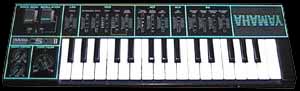
As for sounds and synthesizing, the CS01 is the perfect monosynth for bubbly and growling bass! It features a very nice 12dB resonant VCF filter. In addition to the oscillators’ sine and square type waveforms there is PWM and noise. There are also LFO controls, glissando (like portamento), a typical ADSR envelope generator, pitch & mod wheels and even a breath controller input. A CS01 mkII (pictured below) was later released by Yamaha soon after the original. It featured an improved 24dB resonant VCF (filter) with adjustable slider control over resonance instead of switchable on/off resonance as found on the original. The CS01 mkII is also identifiable by its black case with green letters.
Drum and Bass “Catching Sound Waves” with vintage Instruments
Pearl Drum-X ( Kick, Snare, Tom ), Roland TR-808 ( open/close Hihat ), Roland TR-707 ( Master Clock ), Oberheim OB-1 ( Noise ), OSCar ( Bassline ), OSCar ( Funny Sound ), Roland Juno-60 + RE-201 ( Pad ), Elka Synthex ( Pad + Space Sound ), Minimoog ( Space Sound ), Roland Jupiter-4 ( Space Sound ), Fender Rhodes + Yamaha NE-1 + Electro Harmonix vintage Bass Micro Synthesizer playing ” Catching Sound Waves ” :-))
Creating a remix in no time: Sonote beat re:edit
Based on Yamaha’s innovative sonote technology, sonote beat re:edit lets you create remixes of your beats in next to no time. Extracting characteristic beat slices from an audio loop and swapping them with similar sounds from other audio files, sonote beat re:edit helps you to change the character of your grooves in the most creative and fun way.
More details
www.steinberg.net/sonote
Key features:
- xchange the sounds of your beat with sounds of your own music.
- Create your own sonote database out of your favorite drum sounds and tracks
- Seamless import and export of audio material from and to Cubase
- MIDI support to control nearly all parameters via external devices
- Out-of-the-box factory library included
- Available as download for Windows and Mac OS X Intel
Antique Synthesizer 1970-1979
All you can eat vintage synths on this nice Sunday morning, featured gear listed below:
MOOG Minimoog / ARP Odyssey / KORG MS-20 / E-MU Modular System / MOOG System 55 / Sequential Circuits prophet-5 / Oberheim SEM / Oberheim OB-1 / RML ElectroComp 100 / Roland-SH-2 / KORG 800DV / EMS Synthi AKS / YAMAHA CS10
Yamaha & Steinberg DAW System “NUAGE”
The Nuage integrated audio production system offers top-class hardware and software working in perfect harmony, for unprecedented mixing, editing, or dialog replacement efficiency in audio post production applications. Yamaha control and interface hardware seamlessly integrates with Steinberg Nuendo DAW software in a purpose-built system that offers all-new productivity and flexibility as well as premium audio quality.
Release notes from Yamaha and Steinberg:
Yamaha and Steinberg have joined forces to create an advanced production system – NUAGE – that empowers professionals in the television, advertising, film, and media industries with unprecedented capabilities and efficiency. Yamaha hardware integrates seamlessly with Steinberg software in a cohesive platform that ushers in a new era of post-production productivity.
The numerous hardware and software components that make up a practical post-production system must function as a well-integrated whole in order to achieve professional workflow efficiency and output quality. The Nuage integrated audio production system offers top-class hardware and software working in perfect harmony, for unprecedented mixing, editing, or dialog replacement efficiency in audio post production applications. Yamaha control and interface hardware seamlessly integrates with Steinberg Nuendo DAW software in a purpose-built system that offers all-new productivity and flexibility as well as premium audio quality. For maximum system versatility the dedicated Yamaha control surface and audio interface hardware is modular, and all units communicate with each other and the central computer via a reliable Dante network, so it’s easy to create custom configurations to match any application. Nuendo 6, the latest and most powerful iteration of Steinberg’s acclaimed digital audio workstation software, is at the core of the system with unbeatable DAW features and performance.
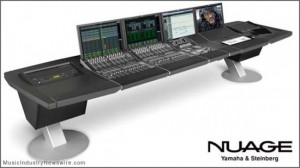
Hardware components available for Nuage systems include the Nuage Fader channel-strip control surface that works with standard LCD monitors to provide smooth visual continuity right into the Nuendo mixing window, the Nuage Master controller unit with everything needed for Nuendo editing in a remarkably efficient arrangement, Nuage Workspace units that aid in creating a unified system layout, three Nuage I/O units that deliver exceptional sonic quality in up to 128 simultaneous channels, and a Dante Accelerator card that gives the computer running the Nuendo DAW extra low latency multi-channel audio data transfer capability. The Nuendo 6 DAW software at the heart of the system is a milestone release that comes with an enviable selection of features not found in any other post-production software.
Kazunori Kobayashi, general manager of the Yamaha Corporation Pro Audio Division, comments: “Nuage is a professional production system that incorporates the most advanced technology and interface design know-how from Yamaha and Steinberg. Yamaha has been manufacturing digital mixers for 25 years, and it is 12 years since Steinberg introduced the first version of the Nuendo DAW. It is a great pleasure to be able to announce such a groundbreaking collaboration at this time, and we are confident that current Nuendo users as well as users who will experience a Nuendo based system for the first time will be more than satisfied with the extraordinary performance and efficiency that Nuage offers.”
“Combining Yamaha’s long-term experience in creating audio hardware with Steinberg’s expertise in software development leads to a system that sets new milestones in terms of operational speed, integration, configurability and design. The Nuage system solution is the quintessence of merging dedicated post-production software and hardware seamlessly together to one complete studio environment. With the Nuage console and Nuendo 6 representing the most sophisticated platform for audio post-production available today, we are delighted to offer existing and new customers a unique approach to achieving higher levels of productivity and quality,” comments Andreas Stelling, Steinberg’s managing director.
NUAGE Products Page:http://www.yamahaproaudio.com/global/en/products/daw_systems/nuage
Nuage and Nuendo – Introduction
Steinberg has announced Nuendo 6, the latest version of its audio post-production software.
Highlights of Nuendo 6:
- New mixing console for enhanced operational speed, including a new channel strip with ‘high-quality’ effects
- Nuendo 6 ADR Taker solution for voice recording and language dubbing
- Fully integrated loudness measurement, featuring EBU-compliant metering plus a large choice of RMS metering scales and a dedicated loudness lane
- Anymix Pro from IOSONO for state-of-the-art surround productions and Voxengo CurveEQ with sound-matching technology
- More professional workflow, with new tools such as MemZap quick-jump tool, Remote Control Editor and Steinberg ASIO Guard with intelligent dropout-prevention techniques
- Professional sound library by the specialists of Pro Sound Effects with more than 1.5 GB of dedicated post-production sounds
In addition, Nuendo 6 represents the core of the Nuage system solution, a top-end post-production platform introduced by Yamaha and Steinberg.
Background video description:
The Nuage integrated audio production system offers top-class hardware and software working in perfect harmony, for unprecedented mixing, editing, or dialog replacement efficiency in audio post production applications.
Yamaha control and interface hardware seamlessly integrates with Steinberg Nuendo DAW software in a purpose-built system that offers all-new productivity and flexibility as well as premium audio quality.
More information: http://www.yamahaproaudio.com
Micromoog & Yamaha CS-5 with Synthrotek Ring Modulator & Analog 8 step Sequencer
http://www.synthrotek.com
A demo of the synthrotek Ring Modulator:
http://www.synthrotek.com/store/-c-42.html
and a micromoog plus a yamaha cs-5 which are both being controlled by our 8-step analog sequencer:
http://www.synthrotek.com/store/-c-48.html?osCsid=ae58d877df51546a0cbe405a364…
“Shake the Disease” cover on a Yamaha DX7 (Martin Gore demo)
Shake the Disease (Martin Gore demo) cover.
“I noticed he recorded it mainly with a Yamaha DX7. In fact, he used six cartridge preset sounds (that I switched live). So I decided to recreate it. None of the backtrack sounds were recorded with MIDI or other clock resources.”
All sounds (*unless stated): Yamaha DX7.
Bassline synth: Roland Promars MRS-2
Drumbox: Boss DR55 (sampled)
Backtrack recorded on a Revox B77 MkII.
Composed by Martin L. Gore
Yamaha Synth MX61 & MX49 Introduction
MX Serie Synthesizer Introduction with Adrian Zalten: MX61 & MX49
Differentiated only by keyboard size, each of these 61-part multitimbral keyboards contains over 1000 of Yamaha’s flagship MOTIF sounds, effects and an ‘easy’ split/layer/performance mode that enables you to quickly come up with custom tones.
What’s more, the MXs are designed to integrate tightly with your DAW: audio can be piped directly over USB, and you can switch to a DAW Remote mode that enables you to use the hands-on controls to adjust parameters in your software.
You can also use the Ms as an audio interface, though disappointingly, the only input comes in the form of an aux mini-jack. Another thing that’s lacking at present is the option to use the MX’s synth as a VST instrument (complete with software editor) though we’re told that this is on the way.
The MX49 and 61 both ship with a copy of Cubase AI, plus Steinberg’s Prologue synth and Yamaha’s own YC-3B virtual organ. As such, anyone who buys one is getting a full music production starter kit.
Perhaps the most striking thing about these keyboards, though is their price: the MX49 has a target price of £499 and the MX61 should be available for £649. Both models will be shipping in December.
Yamaha MX49 and MX61 specs
- 166MB of internal Wave ROM
- More than 1000 Voices taken directly from MOTIF
- USB Audio/MIDI interface built in
- VCM Effects
- Auxiliary input and WAV/MIDI file playback
- One touch Layer and Split function
- 128 note Polyphony / 16 part multitimbral
- 999 arpeggio patterns
- Advanced synth editor
- Remote Mode for DAW control
- Bundled with Cubase AI, YC-3B organ emulator, Steinberg Prologue analog synth
- Lightweight design: (MX49: 4kg, MX61: 5kg)
First video of the new Yamaha synths – MX49 and MX61
Motif Sounds for Inspiration,
Xtensive Controller Integration.
It doesn’t get better than this.
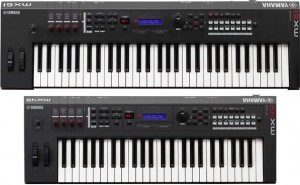
The MX series synthesizers feature carefully selected sounds taken from the Yamaha MOTIF XS. That powerful sonic palette is packed into sleek packages (available in 49- and 61-note versions) that fit today’s on-the-go life style. But the MX Series aren’t just synthesizers; they are designed to bridge the gap between hardware and software. By adding extensive audio and MIDI USB connectivity, advanced DAW and VST controller features and a suite of powerful music production software, the MX integrate hardware reliability with controller flexibility to give you the best of both worlds at a ground breaking level of affordability.
The new MX series combines Motif XS sounds, USB Audio/MIDI connectivity and advanced DAW/VST controller
features at a ground breaking level of affordability.
– Over 1000 sounds from the MOTIF series
– Equipped with VCM effects
– Easy Split /Layer Performance Mode for Instant Inspiration
– 16-Part Multi timbral and 128-note polyphony
– Extensive Hands-On controls for VSTs and DAWs
– Bi-directional USB Audio/MID interfacing
– A complete suite of music production software included
– A lightweight design with a quality Yamaha keyboard
– Complete analog and digital connectivity
DATAMASKIN

