
Sneak preview: HandySynth from Icebreaker Audio
HandySynth
HandySynth is a sample based re-creation of a custom circuit-bent Yamaha HandySound HS-200 for Native Instruments Kontakt 4 or 5.
- All instrument sounds chromatically sampled at 24-bit 48kHz
- 8 circuit-bent sound variations
- Convolution based emulation of the original speaker at various microphone positions
- Authentic emulation of the HandySound volume envelopes and tuning via custom scripts
- Additional Effects: Distortion, Filter and Spring Reverb
- Download also includes a copy of C-Bent Kit for Battery
Coming February 3rd from Icebreaker Audio
PortaSynth and Calc-U-Synth – new for Native Instruments’ Kontakt 5 platform
Icebreaker Audio has released the PortaSynth and Calc-U-Synth instruments for Native Instruments’ Kontakt 5 platform.
PortaSynth is an emulation of a circuit-bent Yamaha PortaSound PSS130 from 1987. It also includes PortaDrums – a drum machine based on the percussion samples from the same instrument.
Calc-U-Synth is a full emulation of the Casio VL-Tone’s programmable synth engine for Kontakt. It features faithful emulations of all of the VL-Tone’s parameters.
Both PortaSynth and Calc-U-Synth are included in the ToyBreaker Bundle, which also includes HandySynth – a sample based emulation of a circuit bent Yamaha HandySound. Not only does this bundle save you around 25% of the total price of buying the three products separately, but as an added bonus, ToyBreaker Bundle owners also get an exclusive battery kit of drum samples taken from several toy keyboards from the 80s.
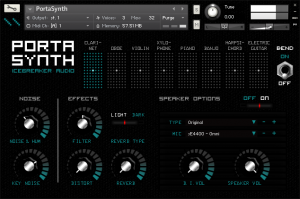
PortaSynth features:
- All instrument sounds sampled chromatically at 24bit, 48kHz quality.
- Bent sound counterparts for each of the sampled sounds.
- Advanced speaker options.
- Distortion, filter and spring reverb effects.
- Key-Click and Background Noise controls.
- Also includes the PortaDrum drum machine.
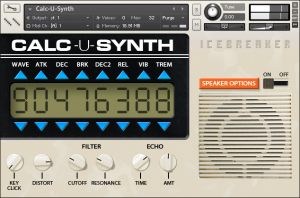
Calc-U-Synth features:
- A full emulation of the Casio VL-Tone’s programmable synth engine.
- All waveforms sampled chromatically at 24bit, 48kHz quality.
- Additional filter, distortion and echo effects.
- Advanced speaker options, and key-click noise control.
Prices:
- PortaSynth: £7.50 (€9 / $12 approx.).
- Calc-U-Synth: £4.50 (€5.5 / $7 approx.).
- The ToyBreaker Bundle: £12.50 (€15.5 / $20 approx.) – a 25% saving over buying the three products separately.
Upgrade Prices: HandySynth Owners can upgrade to the ToyBreaker Bundle for £9 (€11 / $14) before the 1st September, 2012.
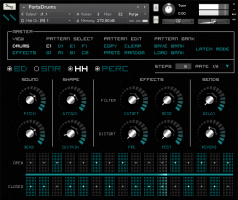
All products are available now from the Icebreaker Audio website.
iYM2151 iPad App Simulator of YAMAHA YM2151 FM Synthesizer
Detune has released iYM2151, a new iPad music app that they describe as ‘the world’s first FM synthesis music workstation’.
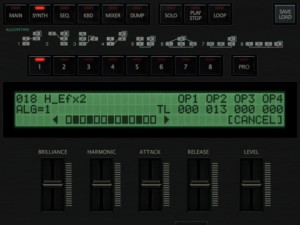
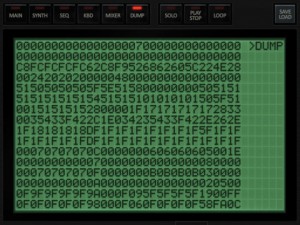
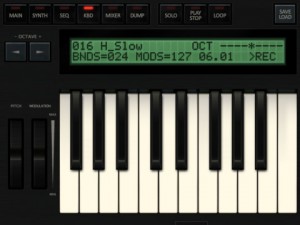
Here’s what they have to say about iYM2151:
YM2151, aka OPM, is a single-chip FM synthesis implementation, an eight-channel four-operator sound chip. it was used in many 80′s arcade games and home computers.
iYM2151 is the The world’s first FM synthesis music workstation app, using YM2151 simulator engine for iApp.
iYM2151 not only tries to recreate the 80′s FM sound, but it also recreates the experience of working with an 80′s FM interface.
Features:
- uses YM2151 simulator engine for iApp
- 4 operators per 8 Algorithms
- 8 voices
- 3 software LFOs
- max 99 scenes (1scene with 64 steps)
- easy FM edit mode
- MML mode : programable huge FM parameters in every steps
- DUMP mode : realtime all FM operator parameters viewer
- song data file sharing and mail attachment
- 80′s design user interface
Time machine: YAMAHA CS-10 Analog Synthesizer 1977
The YAMAHA CS-10 came out 1977. It is a monophonic synthesizer equipped with 1 VCO, 1 multimode resonant filter (highpass, lowpass, bandpass, but self oscillating of the filter is not possible – why?), 1 LFO, 1 noise generator, 2 envelopes. It also has an external signal input. This is great for processing signals – a bit like Korg MS-20 (I did this with a Roland TR-606 in the video). The LFO is very fast. It has CV and trigger inputs/outputs.
A nice little synth with some nice sounds!
“I played the CS-10 along with a Roland DEP-5 (delay) and a Lexicon MPX-500 (reverb).”
Video: Having a bit of improv with some new kit
Here’s a nice new video from Cranda11, check it out:
Having a bit of improv with some new kit. The bassline is done with the original MeeBlip; there are four two-measure MIDI clips in Ableton, and I’m randomly switching amongst them using follow actions. All drum and percussion sounds were created on a Yamaha TX81Z, then imported to and edited in the Maschine software.
Gear used: MeeBlip, MeeBlipSE, Native Instruments Maschine Mikro, SammichFM, DSI TETR4, Eventide Space, Eventide TimeFactor. Recorded with Ableton Live in one pass of live improv.
Yamaha DX7 – the 32 classic factory patches
The 32 classic factory patches of the Yamaha DX7.

One of the most popular digital synths ever was the DX7 from Yamaha, released in 1983. It featured a whole new type of synthesis called FM (Frequency Modulation). It certainly is not analog and it is difficult to program but can result in some excellent sounds! It is difficult because it is non-analog and thus, a whole new set of parameters are available for tweaking, many of which seemed counter-intuitive and unfamiliar. And programming had to be accomplished via membrane buttons, one data slider and a small LCD screen.
Still the sounds it shipped with and that many users did manage to create were more complex and unique than anything before it. Percussive and metallic but thick as analog at times, the DX-7 was known for generating unique sounds still popular to this day. The DX-7 was also a truly affordable programmable synth when it was first released. Almost every keyboardist bought one at the time making the DX-7 one of the best selling synths of all time! It also came with MIDI which was brand new at the time – Sequential had already released the first MIDI synth, the Prophet 600. Roland had just released the JX-3P with very basic MIDI implementation, and wouldn’t get around to adding full MIDI for another year with the Juno-106, and it would be three years before Roland can counter the popularity of the DX7 with a digital synth of their own, the D-50.
Time Machine: Yamaha DX7 II + Roland VP330 “Choral”
(c) 2012 vintage synth demo track by RetroSound
lead sound, fx and female voice : Yamaha DX7 II FD
analog strings and human voice choir: Roland VP330 Vocoder Plus
recording: multi-track without midi
fx: a bit delay
drums: Roland TR-808
more info: http://www.retrosound.de and
http://www.facebook.com/pages/RetroSound-Marko-Ettlich/265713782347
Synth jam – Benge in the studio
Benge Studios in action. Featuring Moog Modular, ARP 2500, Roland Juno 60, Yamaha CS80
See http://myblogitsfullofstars.blogspot.co.uk/ for more info
Play Hatsune Miku Songs Live! With The Yamaha Vocaloid Keyboard
Play Hatsune Miku Songs Live! With The Yamaha Vocaloid Keyboard
The keyboard is made possible by the relative simplicity of Japanese phonology, with only fifty or so possible syllables in the language altogether. Syllables are selected by simultaneously pressing a Roman alphabet key with a D-pad-shape modifier for one of the five Japanese vowels — so, for example the “K” key with an “A” directional press would result in a “KA” consonant. This is all done with the left hand, with the right hand controlling each syllable’s pitch via a standard keyboard layout, and there’s an LED display to confirm character input. The interface seems simple and logical for Japanese speakers, though it will take some practice to get right — Yamaha says that several players so far have been able to play nursery rhymes after around three hours with the device.
DigInfo TV – http://diginfo.tv
17/3/2012 interaction 2012
Yamaha
VOCALOID Keyboard
The keyboard is still in development with no solid plans for a commercial release, and the prototype still looks pretty rough from a design standpoint. The company says it’s more likely that it would provide the sound chip inside for other companies to use in their own hardware. However, if a product ever sees the light of day it could well be the next step along the way to Vocaloid domination of J-pop.
Yamaha launches the all new CL-series for digital mixing
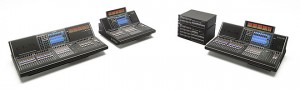
25 years after first setting the standards in digital mixing, Yamaha has taken digital consoles to another evolutionary level with the launch of the three-model CL series at ProLight + Sound 2012.
Retaining essential features and functionality that have become standards over the past quarter of a century, the CL series of digital mixing consoles offers an evolved experience in accessible mixing. Combined with sonic purity and advanced sound shaping capabilities, the new range gives the most imaginative artists and engineers unprecedented creative freedom.
Yamaha CL series:
Combining a tactile, ergonomic user interface with elegant and contemporary design, the CL series comprises three models – the CL1, CL3 and CL5. Ranging in mix capacity from 48 to 72 mono plus eight stereo inputs, all models feature 16 DCAs, 24 mix and eight matrix busses, plus stereo and mono output busses.
User interface
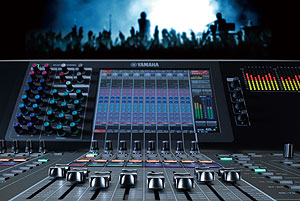
At the heart of the CL series is Yamaha’s acclaimed Centralogic user interface, ensuring that the consoles will be immediately familiar to many thousands of live sound engineers.
It has evolved considerably on the new consoles, incorporating a new generation, highly responsive colour touch screen and an array of user definable rotary encoders and buttons. Newly designed faders offer optimum feel, visibility and accuracy and are freely configurable to allow control of any combination of inputs, outputs or the 16 DCA faders. The control surface also provides editable, backlit channel name displays above each fader, with assignable colour bars. The CL1 and CL3 also feature the option of an external meter bridge.
Audio quality
Audio quality and character were top priorities in the development of the new consoles. In addition to featuring newly-designed mic preamps and delays on every input channel and output port, the range debuts a prestigious line up of studio quality processing.
The Effects Rack provides the equivalent of eight SPX2000 effects processors, along with a range of VCM EQs and dynamics, while two further virtual racks provide access to up to 32 channels of graphic EQs.
However, probably the most exciting sonic innovation is the introduction of the Premium Rack concept. Developed by Yamaha’s Dr K (Toshi Kunimoto) and his team, the Premium Rack provides a range of extremely high quality, dynamic processors and EQs. Yamaha is particularly proud and pleased to have collaborated closely with Rupert Neve to incorporate the highly acclaimed Portico 5033 EQ and 5043 Compressor as key elements in this new concept. These processors are included as standard in the CL series, eliminating the need for any plug-in management.
“For the first time we have the capability of bringing Rupert Neve sound into the live audio field, entirely due to Yamaha VCM technology. I believe that it is indistinguishable from the original analogue sound,” says Neve.
Scalable solution
A key factor in making the CL series so flexible is the pair of accompanying I/O racks, the Rio3224-R and Rio1608-D, and the fact that consoles are the first to feature built-in Dante networking as a standard feature.
A scalable system is easily constructed by simultaneously attaching up to eight I/O racks via Dante, providing up to 256 input sources. Pairs of CL series consoles can also be cascaded to handle larger mixing requirements.
Connection of basic systems is easy, using the console’s auto-configuration facility. Two or more consoles can share the inputs from one set of I/O racks without fear of unexpected level changes due to the inclusion of Auto Gain Compensation within the I/O racks themselves. With the new Dante 32-bit mode of operation, gain compensation can be provided without audibly affecting the dynamic range.
“We are extremely excited to be collaborating with Yamaha on the extraordinary new CL series and I/O racks,” notes Audinate CEO Lee Ellison. “Dante provides a flexible, low latency, highly scalable, plug and play networking solution to connect Yamaha networked systems, Dante Virtual Soundcards or any other Dante networked device. We believe the combination of technologies integrated in this new platform will provide an unsurpassed digital experience.”
The Rio3224 also includes four stereo AES-EBU outputs, keeping signals in the digital domain right through to the amplifier. The new consoles feature three MY card slots on the rear panel, maintaining compatibility with every existing audio format as well as newer cards like the MY8-Lake speaker processing card and the MY16-Dugan auto mixing card.
The three card slots also allow for additional i/o alongside the consoles’ onboard eight mic inputs and eight line outputs.
Software control
CL Editor is a new standalone online / offline editor which runs on both Macs and Windows PCs. Featuring all the functionality that users will be familiar with from other Yamaha Editor software, it does not require Yamaha Studio Manager as a host.
Further new software applications include a new version of StageMix for iPad, which offers comprehensive wireless remote control and has been expanded to include new features such as channel naming, DCA fader control and tap tempo. Crucially, both CL Editor and StageMix can be run simultaneously, allowing very flexible options for engineers, sound designers and system technicians alike.
Meanwhile, Yamaha’s new File Converter software has been upgraded to allow straightforward exchange of console files between the CL series, PM5D, M7CL and LS9.
Recording
Every CL console customer will receive a copy of the new Steinberg Nuendo Live recording software, which has been designed specifically for live recording applications. Available from July, it includes unique features not found in any other live recording software and will be tightly integrated with CL consoles to provide optimum ease of use.
When combined with Audinate’s Dante Virtual Soundcard (also included with every CL console) engineers can easily use the Dante network to record up to 64 tracks of audio to either a Mac or Windows PC.
“Nuendo Live is not only ultra stable and easy to use, but it integrates seamlessly with the latest generation of Yamaha live consoles,” says Steinberg Managing Director, Andreas Stelling. “This is another successful example of the strong ongoing relationship between Yamaha and Steinberg.”
In addition, basic stereo recordings can be done via a convenient two track USB recording and playback function.
Setting the standards
Having worked very closely with engineers and rental companies for a quarter of a century, Yamaha knows that the key requirements from digital consoles are flexibility, audio quality, ease of use and, of course, the company’s well known standards of reliability.
With the advent of the CL Series, the company is confident these products strike the perfect balance between innovative functionality and sound investment potential.
“The CL series ideally answers today’s needs using today’s technology” says Kazunori Kobayashi, General Manager of Yamaha’s Pro Audio Division. “The collaboration between Yamaha, Rupert Neve Designs, Audinate and Steinberg has made it possible to deliver a sublime balance of sound, performance, and features that results in uncompromised overall mixing capability and quality. After a quarter century of evolution, the CL series represents a momentous new chapter in the history of Yamaha digital mixing.”
The CL5 and Rio3224-D are scheduled to be released in the spring of 2012, with the CL1, CL3 and Rio1608-D available in the summer.
DATAMASKIN

