
Behind the Props
This official video is pretty glossy, but it does offer some interesting insight into Propellerhead Software and the origins of ReBirth, Reason & Record.
Seeing the precursors to ReBirth is especially interesting.
The second half of the video turns into a fairly standard promo for Reason 5 and Record 1.5.
Via ST
Multi-user sound sculpture – Sonomateria
SONOMATERIA is a multi-user sound sculpture, installation, tangible sound interface and intersensory composition. The work aims to explore the mutual reinforcing effect that the manipulation of tactile and auditory perceptions can have on each other in the context of art and design.
SONOMATERIA takes the form of a tangible interface that allows spectators to manipulate digital sound via tactile interaction with a selection of physical objects made of 16 distinct materials: Polystyrene, Coal, Cork, Wood, Industrial Rubber, Clay, Sponge, Stone (Granite), Coal, Wax, Synthetic Leather, Vinyl, Iron, Gaffer tape, and Plasticine. It is a tactile composition interconnected with a dynamic sound palette, inviting multiple spectators to navigate through, re-arrange, deform and manipulate a pre-existing sound composition.
The interface responds with tactile and sound feedback, attempting to position the spectator in a loop of intersensory synesthesia. The work draws upon and extends surrealist cut-up techniques popularized in the late 1950s by writer Willam S. Burroughs. The cut-up technique is an aleatory literary technique in which a text (or multiple texts) is cut up into smaller portion at random, and rearranged to create a new text. In SONOMATERIA, this technique is extended from the literary domain to the musical domain, and instead of words, big portions of sound are cut down to small fragments. The audience is invited to interact with the fragments via a tangible interface that invokes tactile sensations, and thereby access an intersensory composition coded into a hybrid of touch and sound.
Steinberg has released version 5.5 of Cubase

Steinberg has released version 5.5 of Cubase / Cubase Studio, a free update of its music production systems featuring new mixing features, new video engine, instrument updates, workflow improvements and optimized performance for multi-core processors.
The 5.5 update ensures an improved low-latency performance on systems with four or more CPU cores, while the included version increments of two Cubase 5 features, LoopMash and the REVerence convolution reverb, reduce CPU usage considerably. The native x64 version of Cubase and Cubase Studio features an enhanced VST Bridge to improve compatibility with the majority of bridged 32-bit VST2.4 plug-ins within a native 64-bit production environment.
Enhancements for both mixing and video work have been realized with additional automation functionality in the automation panel as well as expanding the Quick Control system to Group, FX, Input and Output channels. An entirely new video engine offers full HD support in Cubase 5.5 as well as scalable performance and video playback capability via FireWire for the PC platform.
Version 5.5 also introduces enhancements to the range of onboard beat production, witnessing refinements in hitpoint detection within the Sample Editor, the introduction of a local timeline for the AudioWarp definition mode plus extended Export/Import functionality for Groove Agent ONE including 19 exclusive new drum kits made up of over 800 finest vintage drum machine samples.
To further speed up workflow in the Cubase environment, the MediaBay interface has been redesigned to provide improved usability, with an integrated virtual keyboard and memo recorder. On top of the many small enhancements, the Channel Batch Export tool has been improved, and the Infoline and the toolbars of all editors have been consolidated for improved legibility and faster access.
Cubase 5.5 complements Cubase 5 and Cubase Studio 5 to the fullest, delivering performance optimization, additional features and useful enhancements throughout.
The 5.5 update is now available to download from the Steinberg website at www.steinberg.net.
More Information: Steinberg / Cubase
Depeche Mode becomes a musical

A musical featuring Depeche Mode songs is set to open early next year. Called “Playing The Angel” (taken from the name of their eponymous 2005 album), the ‘jukebox musical’ will run at the MITP theatre in Valletta, Malta and will feature a storyline which some media have already branded as being ‘controversial’. Writer Adrian Buckle (see photo) explains: “It is a story of two boys growing up, coming of age and discovering love. They are abused, used, taken advantage of. It’s their sad way of discovering life.”
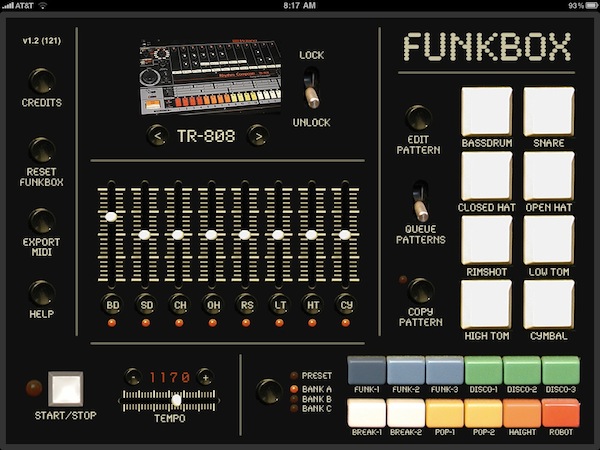
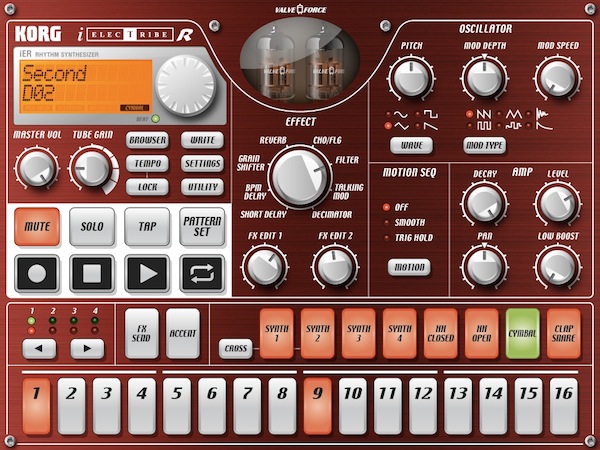
Two of the most popular instruments for iPad…
…right now
Funkbox on the iPhone is ok but I never really used it past a novelty show off item. On the iPad I can sit comfortably and knock out loops with pleasure. The iElectribe really knocks you out. It feels like hardware.
Three freeware virtual synthesizer plug-ins by Chris Roberson
Roberson Audio has launched a new website.
The website offers three freeware virtual synthesizer plug-ins by Chris Roberson.
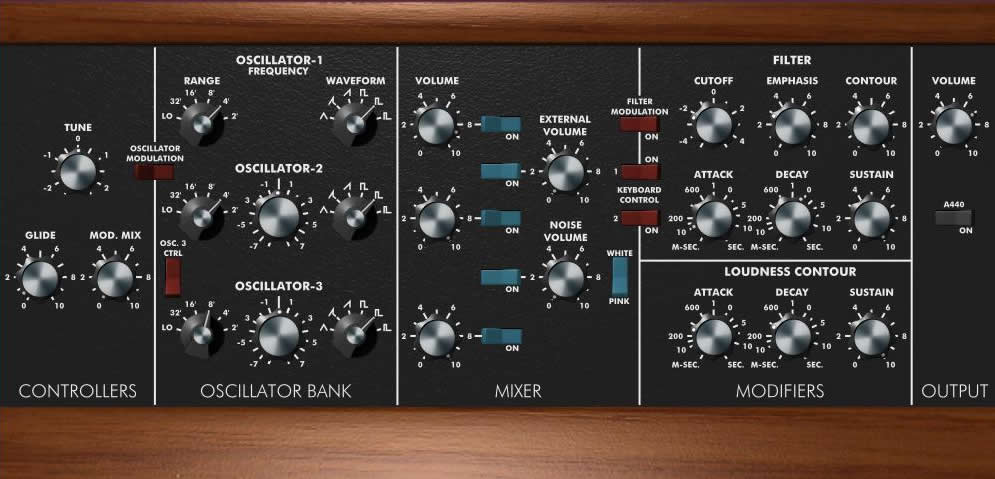
Roberson Audio Synthesizers: RA Mowg, Oddy-Free, and Prophanity
Roberson Audio Synthesizers
- RA Mowg, a Minimoog Model D clone. From the deep, full-bodied filters, to the mellow analog-style oscillators, to the distortive drive from feedback-looping the output, this instrument can give you the feeling of playing a Minimoog without spending a small fortune to do so.
- Oddy-Free, an emulation of an Arp Odyssey MkII. Much attention to detail was given in the layout of the signal path to have it behave as accurately as possible. It does have just a touch more umph than most originals would – this particular emulation was based on the “illegal” filter versions based on Moog’s -24dB Low-Pass filter, so it sounds quite a bit smoother and richer but at the same it can produce the harsh metallic tones known from the Odyssey.
- Prophanity, a Prophet 5 clone. There isn’t a terrible lot to say for the synth, other than one major bug with the unison section. You may notice it isn’t present, and that has been done on purpose. It is a goal for a future release to re-include a unison feature.
Roberson Audio’s synthesizers are available to download as freeware VST instrument plug-ins for Windows PC.
More information: Roberson Audio
Summer NAMM: Zoom Announces the H1 Digital Recorder
Reaper: split the audio into various bands and process each independently
Thanks to AGZ for providing this tutorial

The source audio track is sent (master send disabled) to 6 other tracks, each with a ReaFIR plugin to define the bands. Subs, Lows, Low Mids, High Mids, Highs and Ultra Highs. After that is a simple compressor for each band. You can insert any other plugins you want for each band: Saturation, stereo width etc. You may find this to be a good starting point for mastering.
Here’s the Project File: http://dl.dropbox.com/u/1053122/multiband%20template.RPP
Free sets for Ableton Live

Ableton & Minus have released ten Ableton Live sets that are available as a free download:
The Live Sets were made exclusively for Ableton by ten artists from the Minus roster. Each Set comes with a companion Lesson that reveals insights into the artist’s musical vision and offers valuable production tips.
Includes material from: Click Box, Hobo, Heartthrob & Troy Pierce, Magda, Marc Houle, Fabrizio Maurizi, Barem, Ambivalent, JPLS and Gaiser.
This Live Pack requires Live 8.1.3 or higher. To install the Pack, download it, unzip it and double-click the .alp file. You’ll then be asked where to save the contents of the Pack.
Note: This Live Pack will work in Live Intro or Live Lite, but the Sets will be read-only.
Link:
Morbius demonstrates pattern bussing with Moog-style modular step sequencers.
This is NOT a music-video. It’s a patching demonstration ONLY.
After more requests for additional info, I’ve made ‘another’ “Pattern Bussing” demo. (Sorry- no hi-def or someone to operate the cam for close-ups). I suggest that you simply watch the sequencer lamps and listen to the pattern changes, to get an idea of what this technique can do for you, either LIVE ‘on-the-fly’, or in the studio.
This patch allows you to change the sequenced patterns heard to many different-sounding patterns, and even changing the time-signatures (and back again) WITHOUT loosing either the ‘pulse-sync’ between the two Q960’s, or the ‘time-signature sync’, musically speaking… like- changing from a 4/4, to a 6/4, to a 3/4, to a 2/4, and back to any one, including the original 4/4. You can make it sound like you have a large number of ‘DIFFERENT’ patterns (and you could use these different patterns in different songs, or sections of songs)… and all, “ad-Lib”, improvised, on-the-fly, or any way you want.
None of the patching needs to be done DURING the performance… so everything can be preset and tuned, and you can use a written chart for specific changes you may want at specific places in the music.
Yeah… digital sequencers have some advantages, without any doubt. But- none will let you control, and actually ‘play the instrument’, like this. If you wanted to change the usual patterns played, in an improvisational way, live on stage… a digital will be extremely limiting, only allowing what has been preloaded. With this analog technique, you decide and alter any part, in any way, at any time, backwards, half back & half forward… your creativity is the only limitation.
After many months of experimenting, I found that using only FOUR return buses back to the Master sequencer are needed, even though, from one through eight are possible.
This is not a Moog Modular, but rather a Synthesizers.com Analog Modular system, and I’m using the Q960 Sequencers (2) (clones of Moog’s 960). There are several ways and modules which work well for switching the buses. The Q963 is ideal, and to do this, you’ll need two Q963’s, ‘daisy-chained’ in series, BOTH connected to the ‘SLAVE’ Q960.
Other modules that either WILL work, or will LIKELY work (and this would be for using FOUR buses, as I do here): a ‘patchable’ A/B trigger Bus; two Q149 Signal Selectors; two Q113 Mixers (or four Q112 Mixers); two Q962 Sequential Switches (although there are advantages, there CAN be some unexpected results when used manually); four Multiples (using the switch between the upper and middle jack groups; or- just build your own on a ‘blank-panel’.
DATAMASKIN

