
Getting deep in to the power of LFO
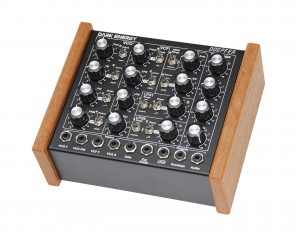
Dark Energy, a monophonic desktop synthesizer conversant in Volts, MIDI and USB. With a single oscillator, low-pass filter and ADSR envelope plus two LFOs, its feature set looks fairly basic, but to encourage modular fraternisation, it adds a cluster of patch connections. The Dark Energy has three internal sources of modulation: two LFOs and an ADSR envelope. The LFOs offer just triangular or rectangular waveforms and each has a red/green LED, the colours shifting to track the phase of modulation. Low, medium and high frequency ranges may be selected, the latter hoisting LFO frequency to around 5kHz. Modulation at audio rates is your ticket to pseudo-ring-mod atonality, whilst the slowest (“up to a minute”) LFO speed is ideal for those slothful moments. The envelope is entirely conventional, with just one slight twist. It has three operational ranges scoped for precise, short envelopes, envelopes suitable for solos or general performance, and long drone-type settings. Droners everywhere take note: the maximum attack time is almost a minute.
In this video:
Controlling Analogue Solutions Telemark’s filter with Doepfer Dark Energy LFO. Dark Energy has an incredibly high LFO rate and can make for some interesting sounds when paired with the Telemark.
Gear used:
Analogue Solutions Telemark
Doepfer Dark Energy
Vermona DRM1 MkIII
Analog gestural interface controlling a Bugbrand Modular
The Bugbrand Modular is an interesting synth mostly consisting of a huge number of banana jacks. Banana jacks are only used in a handful of other modular systems – notably Serge, Modcan and Fenix, plus in the control signals of Buchla. There are are certain electronic and aesthetic differences between each system, but that does not completely rule out cross-patching between systems. Differences in signal levels (and banana socket colour schemes!) should be considered and amplification / attenuation / offsetting may be necessary to achieve best results. A common ground connection must also be made between different systems – the BugBrand system has a black banana socket ground terminal on the power supply.
Read more about Bugbrand here >>

In this video:
This is a live performance by Palle Dahlstedt on a custom built instrument, using a simple pencil drawing as a gestural interface for controlling complex analog synthesis (on a Bugbrand Modular). The instrument works by creating a voltage potential field in the graphite/pencil markings on the paper using custom movable electrodes made from coins. Then, various control voltages are extracted from other points on the paper, controlling various aspects of the synthesized sound.
A big thanks to Tom Bugs for very valuable electronics advice!
The sound is recorded directly from the BugBrand Modular (with a slight reverb), and from contact mics on the pencil sharpener. There is no normal microphone, which explains the slightly awkward silence in the beginning, while I’m drawing.
Recorded at the second performance (of two), May 6th, 2011, Gothenburg, Sweden. Concert arranged by Levande Musik (www.levandemusik.org)
This work is part of the research project Creative Performance at University of Gothenburg, funded by the Swedish Research Council.
The future of the NES synth
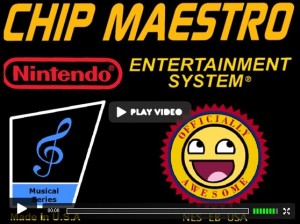
Here is what the author has to say about it:
I am prototyping, designing and assembling a special cartridge called Chip Maestro which can be used in any Nintendo Entertainment System. This cartridge will accept a MIDI input from any instrument, and by passing the MIDI notes through the NES, the cartridge will make the NES synthesize 8-bits of awesome in true NES squarewavey goodness. See the video for more details!
Most chiptune artists today use ‘software synths’ to try and recreate the sound we grew to love. By providing artists with a low-cost and easy to use hardware solution, they can use a real NES to compose their music, and even play it live on stage! And if you don’t have a MIDI instrument, don’t worry; you can use your PC with an inexpensive USB-MIDI converter, or create your own instrument using Arduinos or other microcontrollers that can output MIDI, so you can turn anything into an 8-bit instrument!
Getting this cartridge into the hands of musicians takes a bit of funding. All the money raised will go towards finishing the prototype, a thorough debugging, and beginning production. This entire project will be showcased on Kickstarter as well as my site, and every backer will get backdoor access to my build logs. And, best of all, it will all be open source! Yes, even though there is money involved, I am still putting all my schematics and code on the internet! This way people can improve on my design, and remix it into their works. These remixes come back to me, and I can improve the original product based on those works. It’s an endless cycle of creativity, and I wouldn’t have it any other way.
Background on the NES:
The Nintendo Entertainment System (also called NES or Nintendo) is an 8-bit video game console that was released by Nintendo in North America during 1985, in Europe during 1986 and Australia in 1987. In most of Asia, including Japan (where it was first launched in 1983), China, Vietnam, Singapore, Middle East and Hong Kong, it was released as the Family Computer . In South Korea, it was known as the Hyundai Comboy and was distributed by Hyundai Electronics. In Russia, an unlicensed clone was manufactured called Dendy (Де́нди). A clone that was popular in Eastern Europe in the 1990s was the Super Design Ending-Man BS-500 AS, also known as Terminator. Similarly in India, clones were popular by the names of Little Master and Wiz Kid, in Poland there also was a clone produced, called Pegasus. in Argentina, the clone was called Family Game. It was succeeded by the Super Nintendo Entertainment System.
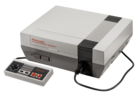
As the best-selling gaming console of its time, the NES helped revitalize the US video game industry following the video game crash of 1983, and set the standard for subsequent consoles of its generation. With the NES, Nintendo introduced a now-standard business model of licensing third-party developers, authorizing them to produce and distribute software for Nintendo’s platform.In 2009, the Nintendo Entertainment System was named the single greatest video game console in history by IGN, out of a field of 25. 2010 marked the system’s 25th anniversary, which was officially celebrated by Nintendo of America’s magazine Nintendo Power in issue #260 (November 2010) with a special 26-page tribute section. Other video game publications also featured articles looking back at 25 years of the NES, and its impact in the video game console market.
Technical details:
I am exploiting the 2a03 chip inside the NES by keeping it in an infinite loop, and injected note addresses and data using opcodes derived from NES note tables. The internal circuitry inside the cartridge translates MIDI note data into NES note opcodes, and sends that to the 2a03 APU, which synthesizes the notes on the appropriate channel. Full technical details will be up in a week, and all backers will receive a link to a secret page with all the details!
Shared by Kickstarter
It’s all about Moog

The guys at Moog Music have launched an all-new Website. Moog’s online home is even more musical than ever. The updated site is a true online destination for Moog-heads and synth aficionados of every stripe. Among other highlights, visitors to www.moogmusic.com will see:
– The Moog Sound Lab, which drops known and unknown bands in a studio full of Moog gear to see what sounds they can come up with. The bi-weekly series has debuted featuring the Dandy Warhols, re-inventing their song “Green” from their 1997 album “Come Down”.
– The new LEGACY section, which features a short but highly informative documentary on the Minimoog. Follow the life of the Minimoog Synthesizer from its inception through its prolific contributions to poplular music throughout the last 4 decades. In this first installment documenting the journey of the Minimoog synth through the 1970’s, we explore the musicians and the people that were instrumental in bringing the instrument to prominence. We also sit with one of Moog Music’s earliest engineers, Bill Hemsath, who recalls the process of the Minimoog’s birth and sheds some light on what sets the Moog synthesizer apart from other analog synths.
Gear and products news abound. For more of all things Moog, it’s definitely worth a visit.
Coming up close with the Nord Lead 2X
Its warm analog sound coupled with cutting-edge digital technology moved the Nord Lead into a “leading” position in the synthesizer community. Musicians from all over the world loved its simplicity, intuitive design, and its musicality and expression offered with the virtual analog concept.

The Nord Lead 2 improved upon the original Nord Lead, including expanded polyphony. A decade later, the Nord Lead, and its descendant the Nord Lead 2, are still among the most popular synths ever built. Used worldwide on stage and in studios, the Nord Lead series has contributed to the signature sounds of some of the most popular musicians and producers known today … and we want to keep it that way!
The Nord Lead 2X has the same characteristic sound and functions as the Nord Lead 2, except for some very nice improvements:
- X-tra polyphony: The Nord Lead 2X comes with 20 voices polyphony – very useful when creating layered sounds, “power pads”, awesome leads and booming basses. 20 voices are also very beneficial in sequencing situations when you use more than one sound at a time.
- X-tra memory: The Nord Lead 2X comes with a large internal memory holding 4 x 99 user Programs, 100 user Performances and 4 x 10 user Percussion Kits plus 6 x 99 factory Programs and 3 x 100 factory Performances! The Nord Lead 2X is 100% patch compatible with the Nord Lead 2 which means that you can transfer sounds directly between the models via MIDI.
- X-tra high resolution: The awesome sound in the Nord Lead 2X is refined even further thanks to the brand new, crystal clear 24-bit DACs running at 96kHz.

In this video:
This demo were created using only the Nord Lead 2X. All Sounds come from it. Even the drum kits. Eq’s, Reverbs,Delays and Compressors were used to make this Track as you hear.
Photography and Video by Ares Kalogeropoulos
Duel: Spiritual vs. Vibrant
Partitura 001 from Abstract Birds on Vimeo.
Missing SMS – the old SEGA Master System, then here´s a chip treat for you
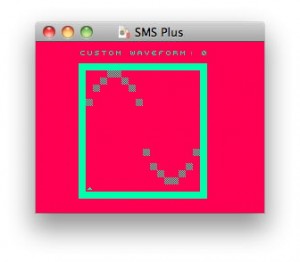
CWP for SEGA Master System / SEGA Game Gear is a simple tool for playing custom waveforms in real time using the control pad. Works in an emulator and on hardware.
The Master System (マスターシステム, Masutā Shisutemu) (abbreviated to SMS) is a third-generation video game console that was manufactured and released by Sega in 1985 in Japan (as the Sega Mark III), 1986 in North America and 1987 in Europe.
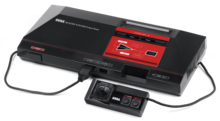
The original SMS could play both cartridges and the credit card-sized “Sega Cards,” which retailed for cheaper prices than carts but had less code. The SMS also featured accessories such as a light gun and 3D glasses which were designed to work with a range of specially coded games. The Master System was released as a direct competitor to the Nintendo Entertainment System in the third videogame generation The SMS was technically superior to the NES, which predated its release significantly, but failed to overturn Nintendo’s significant market share advantage in Japan and North America. In the European, Oceanic, and Brazilian markets, this console launched Sega onto a competitive level comparable to Nintendo, due to its wider availability. It enjoyed over a decade of life in those territories. Due to strong international support, the Master System became the second best selling Sega console. With 13 million units sold worldwide, only the Mega Drive sold more. The console was redesigned several times both for marketing purposes and to add features, most notably in Brazil. The later Sega Game Gear is effectively a hand-held Master System, with a few enhancements. In 2009, the Master System was named the 20th best video game console of all time (out of 25) by the video gaming website IGN.
Features:
– 8 customisable waveforms
– Handy pre-loaded waveforms including sine, triangle and everyone’s favourite, square
Controls:
– Directional pad up / down / left / right: trigger a waveform
– Button 1 and directional pad up / down: change currently-selected sample
– Button 1 and directional pad left / right: change current cursor position / sample
– Button 2 and directional pad left / right: change currently-selected waveform
Credits:
– Thanks to Maxim for his Hello World tutorial / source code, which can be found here: http://www.smspower.org/maxim/HowToProgram
Download:
– ROM: http://milkcrate.com.au/_other/chipmusic_software/sms/CWP_20110508.sms
– Source Code: http://milkcrate.com.au/_other/chipmusic_software/sms/CWP_20110508.asm
Dave Gahan of Depeche Mode covers “New Rose” by The Damned
http://youtu.be/2ThkrXpGI5Y
Recorded at the MusiCares benefit concert at Club Nokia in downtown Los Angeles on May 6th, 2011.
This was the seventh annual MusiCares benefit concert. Depeche Mode lead singer Dave Gahan and Vans Warped Tour founder Kevin Lyman were both honored at the event.
Gahan was honored with the Stevie Ray Vaughan Award for his dedication and support of the MusiCares MAP Fund, and for his commitment to helping other addicts with the addiction and recovery process. Lyman received the MusiCares’ From the Heart Award for his unconditional friendship and dedication to the mission and goals of the organization.
All proceeds from the event went to the MusiCares MAP Fund, which provides members of the music community access to addiction recovery treatment regardless of their financial situation.
You can read more about MusiCares here: http://www.grammy.org/musicares
New stuff from Jean Michel Jarre – Essentials and Rarities
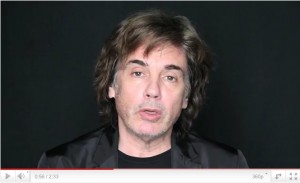
Essentials & Rarities, JM Jarre’s next project will be released on the 30th of May 2011. Here is a video presentation
Max for Live: Mark Egloff’s APC Step Sequencer
A mild-mannered logistics expert working for Ableton by day, Mark Egloff is also a hobby musician and remixer, who always preferred the direct control and tactile feel of hardware drum sequencers over their software equivalents. Working with Akai’s Shane Hazleton, Mark created a patch that can be used for hours of beat making without touching the keyboard or mouse.
Download the APC Step Sequencer for free here: http://www.ableton.com/pages/max_for_live/apc_step_sequencer
Also, through April, take advantage of deep discounts on Max for Live with Suite 8: http://www.ableton.com/maximized
DATAMASKIN

