
New video with Miss FD – “Moment Of Fade”
“Moment of Fade”, the second video from Miss FD’s most recent studio album “Love Never Dies”, continues the artist’s journey through a world of riddles without solutions.
This lush gothic tale was filmed by Adam Alvarez (who also directed the video for FD’s playful Halloween treat “Love Magick”) on various locations in Miami, Florida. The contrasting images of light and darkness capture the emotional heart of both the song and the album, as FD roams a lonely domain in search of the key to a happier reality that remains out of reach.
DOWNLOAD THE MP3: http://tinyurl.com/moment-of-fade
(c) Quantum Release Records 2011
Artist: Miss FD
www.MissFD.com
Directed by Adam Alvarez
www.adamalvarez.info
Production Assistants:
Jason Bowman
Matt Johnson
From the album Love Never Dies.
Lyrics posted on www.MissFD.com/lyrics.php
Navi Retlav releases Missing Pieces – Octopulsethor Refill
Navi Retlav has released Missing Pieces – Octopulsethor, the second piece from the Missing Pieces Refills collection.
Features:
- Total 666 sound patches for Reason 6 or above.
- 256 Thor patches in 4 categories – Pad, Bass, Synth, FX
- 256 Single sound Combinator patches with Pulveriser, The Echo, Aligator, KongFX, and Line6 amp effects.
- 94 “Tripulsethor” Triple sound combinator patches.
- 60 “Octapulsethor” combinator patches with eight thors, in double 4-way cross-fade and selective frequency filters system.
- 35 Combinator skins in ART and reason clip colors style.
- Reason Demo Songs
Pricing and Availability:
$36
More information:
Nebula Space Reverb VST from Minimal System Instruments
Minimal System Instruments has released Nebula (Space Reverb), a VST plug-in for Windows:
Reverb is one of the most commonly used effects in music production and every producer should have an array of various reverb effects at their disposal. Developed over the last 9 months Nebula is a true labour of love for Minimal System Instruments and we are confident this is reflected in the quality of the plugin both in terms of sound and control and also visually. Nebula can be used to create standard reverb effects but it really excels when used to create stunning atmospheric sounds from something as simple as a single drum hit. When used with more complex loops and sounds the possibilities are endless.
Techno Producer ‘Psionzfikshun’ was a BETA tester throughout the whole development process and here is what he had to say about Nebula:
“Being involved in the testing of Nebula from the beginning has been a real privilege, this was a constantly evolving product and was very exciting to work on. Nebula sounds great, it can be used on drums to add space and character or it can transform any sound into a lush soundscape. I also love how the sound morphs when automating the parameters. I now use Nebula on every track”
Nebula has been tested and works in Cubase, Sonar, Ableton Live, FL Studio, Reaper, Energy XT and works without issue. It is recommended that you always try out the demo before purchases to ensure that the plugin is compatible with your system.
Nebula costs £19.99 and is available now from www.minimalsystem.com
Phaedra iPad Sequencer First Look…
Last week we got a teaser of the upcoming Phaedra iPad sequencer, now the developers gives us some more details:
This is a quick overview of the highlights of Phaedra, the “analog” style four-channel MIDI sequencer for iPads, coming soon from NaughtyPanther.
In this video, Phaedra is driving a DSI TETR4, a Doepfer modular synth, a Korg Monotribe, and an Eventide Space and TimeWorks. No DAW is used in the sequencing. Everything is being clocked from Phaedra.
Micro Patch Synth: patching and arpeggiator demo
“In this video I demonstrate how to patch the keyboard to VCO1.
I then play each arpeggiator pattern in sequence.
NOTE: The software still requires a fair amount of work to reduce the noise and buzzing from the waveform synthesis.”
DXi FM synthesizer version 3.1.0 on iPad
DXi is a FM synthesizer application inspired by 80’s most popular synthesizer. Enjoy making music and creating sound by FM synthesis engine easily.
The movie show you the new great features about DXi version 3.1.0.
Please visit the URL for more information: http://itunes.apple.com/app/dxi-fm-synthesizer/id370138065?mt=8
FM synthesizer is still popular among many people by its unique tone. We carefully selected parameters from original synthesizer so you will be enjoy editing tone with them easily. You need to know some technique to tweak the tone, but you will be able to get DXi’s special tone and effects while having some fun!
Creating sound effects is another idea to enjoy DXi.
We loaded 16 step loop sequencer as a bonus feature!
If you remember the days of FM synthesizers, try creating the tone you remember from them.
If you have no experience with any FM synthesizer, we are sure you will be enjoying the unique tone world!
* 4 operators FM synthesizer
* Anti-ailiased oscillator
* 8 algorithms
* Envelope, frequency (Ratio or Fixed) can be set each operators.
* Feedback control on operator number 4.
* 2 master effects (LPF with Resonance and Delay)
* Import/Export function to save the tone you created. (URL schema text string format)
* Audio recording function. And you can transport recorded audio file, .wav, onto Mac/PC via iTunes file sharing.
* Clipboard audio sharing support. You can export recorded waveform to other application via clipboard. It’s compatible with Intua’s clipboard.
* Supports external MIDI keyboards via Core MIDI USB adapters. iPad users can use Camera Connection Kit. And iPhone/iPod touch users can use Yamaha i-MX1.
About the original – Yamaha DX7:
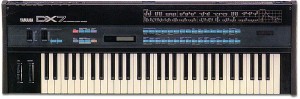
One of the most popular digital synths ever was the DX7 from Yamaha, released in 1983. It featured a whole new type of synthesis called FM (Frequency Modulation). It certainly is not analog and it is difficult to program but can result in some excellent sounds! It is difficult because it is non-analog and thus, a whole new set of parameters are available for tweaking, many of which seemed counter-intuitive and unfamiliar. And programming had to be accomplished via membrane buttons, one data slider and a small LCD screen.
Still the sounds it shipped with and that many users did manage to create were more complex and unique than anything before it. Percussive and metallic but thick as analog at times, the DX-7 was known for generating unique sounds still popular to this day. The DX-7 was also a truly affordable programmable synth when it was first released. Almost every keyboardist bought one at the time making the DX-7 one of the best selling synths of all time! It also came with MIDI which was brand new at the time – Sequential had already released the first MIDI synth, the Prophet 600. Roland had just released the JX-3P with very basic MIDI implementation, and wouldn’t get around to adding full MIDI for another year with the Juno-106, and it would be three years before Roland can counter the popularity of the DX7 with a digital synth of their own, the D-50.
Prototype #1
A prototype app made a few months ago. Still debating if it should be developed further and released.
What do you think, leave your comments 
Qonquer Death – Tradition // Animoog Xenon Ipad
Music: Qonquer Death
Synths: Xenon Groove Synth, Animoog
Drums: Xenon Groove Synth
Art: J. Wecker
www.godmadeusfonky.com
God Made Us Fonky Records ©
Taking a closer look at the Moog Modular IP (Vintage 1969)
Background data:
Just messing around with my 1969 RA Moog modular. Added annotations to describe the different settings I adjust during demo. The IP is all original from Aug 1969 and still plays great. I did the restorations and tune-up and kept the Moog as original as possible. This Moog has 3-901 osc., a 904a VCF, 2-902 VCA’s, 2-911 EG’s, 2-CP3 mixers, 903 noise, 907 FFB, 905 reverb, 991 filter/attenuator, CP7 routing panel, and added a 912 env. follower. Added to the blank panels a Q960 and 2 Q961 sequencer and switches from Synthesizers.com.
Demo of the unique Chamberlin Rhythmate
Demonstration of a very unique and rare object – the first ever drum machine

The Chamberlin Rhythmate has the distinction of being the first drum machine ever produced. Only around ten were made by Harry Chamberlin from his Upland, California garage back in 1949. Some have said that the Wurlitzer Sideman was the first drum machine, but Chamberlin’s invention preceded it by ten years.
The Rhythmate uses a 1″ magnetic tape loop which is read by a tape head that can be moved up or down to play back 14 separate drum patterns. The tempo is adjusted by moving a spindle up or down which affects the speed of the tape moving across the head. The Rhythmate has a built-in amplifier and 12″ speaker.
In 1951, Harry Chamberlin used his idea of magnetic tape playback (samples) to create the Chamberlin Model 200 keyboard. The Model 300/350, 400, 500 and 600/660 models followed.
In the mid 1960’s, Harry’s concept was used by Mellotronics to create their now famous line of Mellotron keyboards. Mellotronics did not ask Mr. Chamberlin for permission to use his idea and he was not at all happy about it. But they agreed to pay Harry $30,000 in compensation, which was quite a bit of money in 1966.
DATAMASKIN

