
DEPECHE MODE – SEE YOU
HIGH QUALITY 1982 PERFORMANCE (ROLAND JUPITER 8, MOOG)
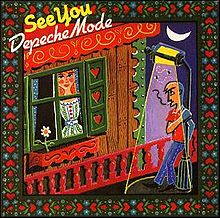
“See You” is the fourth UK single by Depeche Mode and the first written by Martin Gore. The single was released on 29 January 1982 and was later included on the band’s second album A Broken Frame. The single launched a small world tour, with extra band member Alan Wilder, although he did not contribute to the song or the album. There are two versions of “See You” — the single version, and an extended version with a longer intro. This became the album version.
The B-side to “See You” is “Now, This Is Fun”. The extended version has a bigger bridge in the middle and a longer ending, with David Gahan sometimes shouting “This is funny!” instead of “This is real fun!”.
The video for “See You” was directed by Julien Temple. It was also the first video with Alan Wilder. He can be seen briefly playing the keyboards, and he also appears in several photo booth strips. At the beginning of the video there is a speakerphone, much like the one on the cover of Music for the Masses, released five years later. The band did not like the video, and it did not show up on the 1985 video compilation Some Great Videos, which included the band’s videos up to 1985 except the A Broken Frame singles and “Get the Balance Right”.
4ms – PEG Quadratic Beats
Patch using two 4ms Pingable Envelope Generators. This was an experiment to see what rhythmic possibilities are possible using only two PEGs synced to the same LFO clock. This same clock also was controlling one MakeNoise Brains, and two pressure points. The output of the Pressures Points was CV controlling the PEG’s divided time divisions making some cool repeating glitchy effects.
Note: no drum machines or computers used here 
Polivoks Clone
Polivoks VCF Clone:
Circuit uses LM4250 Programmable OP Amps. Runs on 12VDC, has a single output and a LFO rather then CV control. Controls include: Resonance ( “Q”), FM Range for the LFO, Signal Cutoff and LFO Frequency. Input audio signal is from a modified APC.
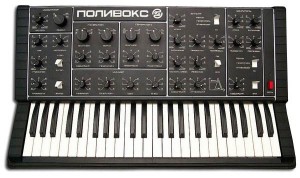
The Polivoks is the most popular vintage Russian synth made in the early 80’s and it was among the first synthesizers produced in the USSR. It’s purely analog with two voices of polyphony, two oscillators each with triangle, square, saw, two types of pulse waveforms and one noise generator, the levels of which are controlled via the internal mixer. Although the oscillators can become unstable and difficult to tune, the Polivoks is well suited for making screeching sounds and thunderous bass. You can also connect an external audio input for processing through the Polivoks’ switchable dual-mode band pass/low pass filter and LFO sections. The LFO, or “Modulator” offers triangle, square, random and noise waveshapes and can be applied to the oscillator level and pitch or the filter cutoff. There are also two ADSR envelopes for contouring the oscillators and filters.
Polivoks had been produced since 1982 by the Formanta electronic factory (one of the biggest at the time); it was sold exclusively in the USSR. Polivoks has its own unique electronic components including a reliable keyboard (49 notes F to E) made with magnetically controlled contacts. Its synthesis modules consist of independent circuit boards, which is convenient for maintenance and repair. In addition, Polivoks is housed in an original rugged aluminum body of uncommon design with handy controls.
Discover the full potential of Reaktor

macProVideo.com has released Native Instruments 203 Reaktor: Revealed. Here’s what they have to say about it in their own words…
You asked for it, and we “reakted”! Learn how to design and build your own awesome synths with Native Instruments Reaktor by expert sound designer and controllerist, Brian Cass…
Imagine having all the tools you need to build your own synthesizer. That’s what Reaktor’s all about! Join sound design and synthesis maestro Brian Cass as he reveals the inner world of this amazing instrument from Native Instruments. And along the way you’ll learn everything you need to know to begin designing and building your own, unique virtual synths and sound modules.
This tutorial starts out with an intro section that gives you a deep understanding on how Reaktor is put together and how you iinteract with its interface. Next you’ll learn all about it’s amazing tone generators, filters, envelope generators and other modules that you can use to build you own custom synth.
Throughout this tutorial adventure Brian leads you on a synth design/sound design journey showing you all along the way how and why Reaktor’s programable objects are connected together giving you deep understanding of programming and synthesis all at the same time! By the time you get to end of this 35 video tutorial you’ll be ready to take on the synth world with your newfound Reaktor skills!
After watching this tutorial, checkout our ever-expanding library of Native Instruments tutorials below and forever-expand your NI sound experience!
Pricing and Availability:
$25/mth USD subscription.
$23.60 USD download.
More information:
Padshop – new VST Granular Synthesizer from Steinberg
Coming straight from the Steinberg sound lab, Padshop is a state-of-the-art granular synthesizer that provides out-of-this-world atmospheres and far-out effects — and a user interface that’s a breeze to work with.
Granular synthesis is one of the most fascinating fields of experimental sound design, but the conversions for programming sounds based on granular synthesis algorithms have always been too complex for every-day sound design or too shallow for serious in-depth sound manipulation.
With Padshop, Steinberg offers a granular synthesizer that raises the standard in terms of handling, flexibility, musicality and sound.
Top features:
• Advanced granular synthesis engine with 2 independent layers and individual oscillator, edit and FX sections
• Up to 8 grain streams per oscillator for impressively rich and spacious structures
• Intuitive user interface for effective usability and direct accessibility
• More than 400 presets dedicated to atmospheric pads and evolving textures
• SoftGrain Wave ROM with hundreds of sounds for custom presets
The Padshop VST Granular Synthesizer will soon be available as a download product from the Steinberg Online Shop. So, fasten your safety strap and get ready to expand your universe with this high-class virtual synth.
Find out more and listen to audio demos on www.steinberg.net
Features at a glance
- Advanced granular synthesis engine with 2 independent layers, each with individual oscillator, edit and FX sections
- Up to 8 grain streams per oscillator for impressively rich and spacious structures
- Intuitive user interface for effective usability and direct accessibility
- More than 400 presets dedicated to atmospheric pads and evolving textures
- SoftGrain Wave ROM with hundreds of sounds for custom presets and individual tweaks
- 10-stage Modulation Matrix with Note Expression support for unlimited flexibility
- 12 different high-quality filter types for each layer
- Step Modulator for rhythmic triggering of oscillators, filters, amp and pan
- 2 LFOs and ADSR for filters and amp envelopes
- Mono and Poly Mode with Legato and Glide
- FX Section with high-class modulation and delay effects
- VST 3 compatible host application support
The Fundamentals of Synthesizer Programming Pt. 2
Moog Music Inc. is proud to present Dr. Joseph Akins’ five part series on the fundamentals of synthesizer programming. Dr. Akins is an associate professor at Middle Tennessee State University and strives to teach his students a complete understanding of synthesizers and computers as tools for modern music production. In this five part series Dr. Akins uses a Voyager to teach the process through which a synthesizer’s sound is generated and the techniques needed to program your own sounds and sonic experiments. In part two of this five part series Dr. Akins goes over operation of a synthesizer’s two main sound sources the oscillators and the noise generator
Live DSI Tempest Improvization – Sound Design and BeatFlipping
Nice new demo of the Tempest in action:
My name is James Jaret Kojac / Syndicate Synthetique. I’m a Sound Designer and one of my latest projects has been working with DSI on the Tempest Drum Machine.
This video is primarily a showcase of what my friends and I have been calling “beat flipping” on the DSI “Tempest”. Beat Flipping is essentially an exercise in live improvisation to see how far one can take the same 4bar pattern on one device.
All Patches/Sounds and patterns are all designed from zero’d out custom patch initializations and designed by myself for DSI and/or Myself.
This video is 100% Live Tempest. It was recorded into an MBox2 into Reaper at 48/24 .wav with no pre- or post-processing except normalization.
In this video I demonstrate use of polyphonic synthesis, reverse, beat roll, pad pressure modulation routing and obviously a bunch more. As time goes on and I add them, the timed comments should go over a few things as I do them.
Enjoy! More to come…
– SynSynth
btw… the rest of the session can be found here: http://soundcloud.com/syndicate-synthetique/ss-tmpst-dubwelt-live-gearwelt
Sinevibes Deep – video demonstration
http://youtu.be/Rz_E_srKQM0
Sinevibes Deep is an animated filter AudioUnit plugin, shown here working on synth, bass and drum beat sounds. Full information about Deep: http://www.sinevibes.com/deep
Deep is an AudioUnit plugin for creating rhythmic filter effects. Its flexible envelope sequencer runs precisely synchronized to your DAW and modulates an ultra-steep, -48 dB/octave low-pass filter with a dense yet delicate sound. Multiple shaping and timing options, as well as an intuitive, high-contrast interface, make Deep a universal and fun-to-use tool – no matter which music style you work with.
What can it do?
- Apply complex filtering patterns onto any instrument parts.
- Re-process and mangle beat loops with perfectly matched timing.
- Transform static, lifeless sounds into spectrally and rhythmically rich new material.
Compatibility
Deep works with Logic, GarageBand, Live, Maschine, Studio One, ReNoise, Reaper, Bidule and other Mac software that supports AudioUnit instrument plugins. It requires OS X Leopard, Snow Leopard or Lion.
FX Drooms for Ableton Live
Cluster Sound has announced FX Drooms, a massive collection of FX layered percussion kits specifically designed for Ableton Live and for a wide range of electronic music styles.
This Live Ready Instrument provides 5400 WAV samples, 312 percussion clips and 312 instrument racks organized into 13 categories : Congas, Bongos, Djembe, Metals, Woods, Toms, Mixed, Ethnics, Snares, Kicks, Shakers, Low Percs and Clanks.
Sample FX Layering : In FX Drooms, each of the dry percussion samples has been processed with 24 esoteric reverb and sound effect templates obtained by stressing DSP, hardware and convolution sources. Thanks to our Sample FX Layering technique you will be able to mix these external effect signals to the dry samples and manage them via dedicated controls : FX Amount, Decay Time, Pre Delay, Low Cut, Hi Cut, Pitch, Shaper, OSC Volume.
Mixed with the solid dry sources, the included FX templates give the library a distinctive glommy psycho (acoustic) athmosphere characterized by incredible hi end and definition. In addition to the dry percussions and the Sample FX Layers the included instruments implement also several sound-specific send effects created by using Ableton Live plugins.
- Live Clips
- Live Instruments
- Live Ready Pack
- WAV
- 5400 WAV samples
- 312 Percussion Clips
- 312 Percussion Racks
- 24 Sample FX Layers
FX Drooms is available to purchase for 24.95 EUR.
MATH THE BAND “Four To Six” music video
Apart from a rather ugly introduction scene, this is quite a nice chip influenced video, enjoy
Directed by Jonathan Yi and Sam Goetz.
MATH THE BAND will be touring in support of Andrew WK’s “I Get Wet Tour” all across America this March and April. More info about the band can be found at facebook.com/maththeband
Cast: Chris Cipriano, Jeff Williams, Kevin Steinhauser, Justine Mainville, Joe Gannon, James Gannon, Mary Perrino, Peter Brown
Production Company: Decoupage Productions
Producers: Tara Power and Joselyn Allen
Assistant Director: Michael Haertlein
Production Assistants: Mike Goetz and Kengo Hioki
DATAMASKIN

