
iDensity 1.2 – feature overview
iDensity for iPad brings all the powerful Density/Pulsaret (Mac/Win standalone) Granular Synthesis tools to the world’s most popular tablet. http://www.densitygs.com
iDensity 1.2
– Background Audio
– FX chain: Echo, Ring Modulation, Parametric and High Shelf filters, Reverb and Dynamic Compressor
– Independent Y scrubbing and X scrubbing at the same time for grains density/length
– Time limit of samples removed ( you could load files as big as your free iPad RAM )
– New wavePad pinch gesture ZOOM for long samples
– Sliders and Knobs could switch to Default/Last values
– Fine increment/decrement mode in Sliders and Knobs behavior
– New Rewind button in toolbar for quick jump at the start time position
– Preferences: waveform color and resolution are customizable
– Preferences: Y and second finger step resolution are customizable
– Preferences and last UI state is stored
– Auto load audio after recorded ( on/off )
– Stereo Input audio recorder (if device is stereo)
– Sound File and Snapshots rename
– Quick Help embedded
– Some bugs fixed
Neo MasteringQ – new effect plug-in for Windows
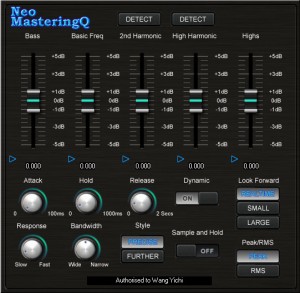
Sound Magic has announced Neo MasteringQ, an effect plug-in for Windows.
Based on Sound Magic’s Neo EQ technology, Neo MasteringQ is a revolutionary concept in equalizer technology.Totally different from traditional EQ, Neo MasteringQ is able to automatically detect and lock in the most audible/sensitive frequency. This makes the whole EQ process much easier than traditional EQ methods – much more efficient and effective than traditional parametric EQ. In addition, Neo MasteringQ also has many special “weapons” designed for mastering EQ processing.
Mastering Engineers often think it would be perfect if an EQ curve could change as the RMS or peak level changes. With a lot of time and a super precise frequency control, this could be done within the traditional realm. However, with Neo MasteringQ, this process is a whole lot easier. Neo MasteringQ provides a 16 Stage, 32 User Preset Changing Curve for each slider. You can achieve a different boost or cut amount as your dynamics change, giving you meticulous timbre control which will add great depth to your music.
Neo MasteringQ features
- Innovative pitch detection algorithm special for mastering and multi-instrument mixing, can lock up the right frequency even when there was a lot instruments mixes together.
- 4 pitch detecters focus on bass, basic frequency and harmonic.
- Innovative Auto Distortion Correction Peaking Filter Technology brings lowest distortion rate ever.
- Artificial Intelligence Assisted Bandwidth control based on the behavior modeling on over 70 mastering engineers, included frequency furthering.
- Sample and hold function enables users to analyze an audio signal first, then hold its harmonic information and apply to another audio track.
- Different plug-in version to fit for usage on M/S, Sidechain, Mono.
- Up to 32Bit/384KHz resolution.
Neo MasteringQ for Windows (VST) is available to purchase for 69 EUR. A bundle with Neo EQ is 99 EUR.
The Hatchet – a new software synth for Ableton Live

Sonic Faction has introduced The Hatchet – a new software synth for Ableton Live, based on the legendary Arp Axxesynthesizer.
The Hatchet comes with a Max for Live step sequencer patch for Launchpad.
Features:
- Multi-sampled ‘analog instrument’ for Ableton Live
- Oscillator blend, Analog detune, ‘Vintage filter’
- Original Portamento, S&H presets, Inifinte sound design possibilities
- Built in FX Racks: Distortion, Waveshaper, Freq Shifter, Pumper, Delay
- Includes custom made Max4Live Melodic Step Sequencer for Launchpad
The Hatchet is available now for $19.99 at the Sonic Faction site.
JOHN FOXX And The Maths / UNDERPASS – Live 25th Feb. 2012 Aarschot Belgium
OHN FOXX And The Maths – UNDERPASS – Live 25th Feb. 2012 Aarschot Belgium
Peter Vogel and Thomas Dolby on the Impact of the Fairlight CMI
A one hour interview focusing on the classic Fairlight CMI
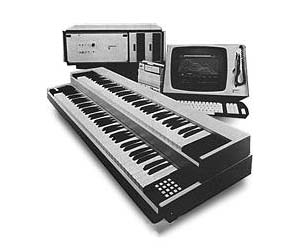
The Australian Fairlight Computer Music Instrument (CMI) is a vintage but state-of-the-art Synthesizer/Sampler workstation. An incredible sampler with 28 megabytes or more of memory! One or two full 73 note velocity sensitive keyboards! Complete synthesis and editing of digitally sampled sounds. Three different on-board SMPTE Sequencers and storage to various disk mediums. The processor itself is housed in a 24″ module. It was also the first digital sampler to hit the market back in 1979 and has endured throughout the eighties and nineties.
From 1979 to 1985 several versions of the Fairlight were produced, with the Series III being the last of them. Each new series added updates to the Fairlight as technology developed through the early eighties. The Fairlight 1 and 2 had only 16 kByte of Memory per voice, and only eight voices but expanded to several megabytes and double the polyphony by the Fairlight III. The IIx was the first Fairlight to offer MIDI. The Series III added aftertouch capability to the keyboard. They all had pitch/mod wheels, an 82-key alphanumeric keyboard, 15 function keys, a Graphics Tablet for drawing sounds and a Video Monitor for seeing what you’re doing while editing.
The sampler is the heart of the Fairlight. It’s a 16-bit resolution digital sampler with variable sample-rates up to 100kHz! Original Fairlight models used two standard 8 bit 6800 processors, updated to the more powerful 16 bit 68000 chips in later versions (the IIx had updated 6809 processors, which is what designated it a IIx over a II, and raised the sampling resolution to 32kHz, from the I & II’s 24kHz). In the Fairlight III, sample memory (RAM) comes in 28MB chunks per 16 voices of polyphony – wow! That’s plenty of room for creating stereo or mono samples. Edit them using various hi-tech functions and at a ‘microscopic’ level using the large Monitor screen. Samples can be looped, mixed and re-sampled with processing for sweetening. As for synthesis, create your own waveforms by sampling and applying Fast Fourier Transform and Waveform editing functions. Storing samples and synthesized waveforms can be done to Hard Disk or 8″ floppy disks.
As for sequencing, there are three sophisticated methods. There’s CAPS (Composer, Arranger, Performer Sequencer), an 80-track polyphonic sequencer. The complicated MCL (Music Composition Language) is like a text-based step time sequencer. And finally the Rhythm Sequencer which functions like a classic drum-machine style sequencer. All sequencer’s are SMPTE syncable.
The Fairlight is a horribly expensive Music Production Center and is rivalled only by the NED Synclavier. Although current samplers, sequencers and synths can blow away the Fairlight at a fraction of the cost – the Fairlight is an historical, prized piece of Vintage Digital Synthesizer and Sampler technology. It still holds up today, over twenty years later and is still a high quality and professional instrument. The facilities provided by it benefit hardcore synth programmers, wealthy musicians, sound designers, film composers and wealthy Vintage Synth collectors.
C64 Fastfingers Lead Synthesizer Lightshow&Drums !
“This is a video using the Fastfingers Lead Synthesizer software for Commodore 64 and my drumming. I added a new Lightshow feature to Fastfingers, which changes the color of the screen in time with the music.
All of the sounds are C64 Fastfingers sounds except for my drumming.”
Jean-Michel Jarre Megamix Arte Digisequencer in Berlin
Enjoy
“Jean-Michel Jarre
interviewé à Berlin par Arte pendant la tournée Europe en Concert – Chronologie
démonstration du Digisequencer, Roland JD800, DJ70, Synthi AKS, Rack Mini-Moog et démonstration du bouton on-off de l’AX1
clip Chronologie 5
avec Patrick Rondat, Guy Delacroix, Dominique Mahut, Laurent Faucheux, Francis Rimbert, Sylvain Durand et Dominique Perrier
24 11 1993”
Cubase 6.5 with two new software synthesizers, new effects and other enhancements
Steinberg has released Cubase 6.5, an update that adds two new software synthesizers, new effects and other enhancements.
Here’s what’s new in Cubase 6.5:
- Two new synths: The brand-new Padshop granular synth and the Retrologue virtual analog synth provide more than 700 extraordinary presets.
- Supersonic sidekicks: Check out the DJ-EQ and MorphFilter effects and VST Amp Rack 1.5 with new stomp boxes and signature presets made by world-class guitarists.
- New comping and audio quantizing tools give you the results you want in a more intuitive and faster way.
- Intercommunication 2.0: Export your mixes directly to SoundCloud, save up to 60% disk space while recording with the new FLAC support and connect ReWire client applications to Cubase in a pure 64-bit environment.
Pricing:
- Updates to Cubase 6.5 and Cubase Artist 6.5 are available for 49.99 EUR.
- Customers who have activated Cubase / Cubase Artist 6 after January 1, 2012 are eligible for a free update.
- The Cubase 6.5 and Cubase Artist 6.5 full retail versions are available for 599 EUR (Cubase 6.5) / 299 EUR (Cubase Artist 6.5). All prices incl. German VAT.
Retrologue features two oscillators, each with a maximum of eight widely detunable voices, one sub and one noise oscillator, alongside 300 presets and sounds.
Padshop features two individual layers in granular textures that are mixed and processed with a dozen high-quality filters, modulation and delay effects. Each layer consists of two LFOs, two ADSR envelopes and one oscillator together with new control parameters for generating up to eight grain-streams, plus 400 quality onboard presets for immediate inspiration.
Benge (working with John Foxx) has a new Buchla album out
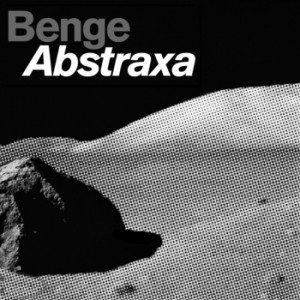
Listen to it here:
“Abstraxa – exploring the outer reaches, using the Buchla Electronic Music Box
The six compositions featured on Abstraxa were realised on a Buchla modular synthesiser. Donald Buchla began makng electronic musical instruments in 1963, developing the first Buchla 100 series systems in conjunction with the San Francisco Tape Music Center. These first inventions coincided with the development of Robert Moog’s 900 Series modular systems over on the west coast of america, and as such belong to the very first generation of commercially available synthesisers. One intersting aspect is that Don Buchla is still developing and manufacturing his modular systems, using the same module format (now 200e series) that he introduced 50 years ago. The current 200e modules utilise a combination of analogue and digital components
The Buchla has a very unique way of producing sound, using electronic voltages to control the sound sources (oscillators and noise generators), sound modifiers (gates, filters, phase shifters, modulators, etc) and event timing generators (sequencers, random sources, pulse generators, etc). Systems can be built up from the available modules to suit the needs of the composer. The power of the system lies in the inter-modulation capabilities. This means that extremely deep patches can be set up with a myriad of connections interacting together in complex ways to produce evolving and self-generating soundscapes. It is anagolous to working with a living organism as opposed to a static machine, a brain rather than a computer
The pieces presented here were recorded to tape using overdubbing in places. Additional reverberation and delay lines were also incorporated into the system. See below for a full module list
Buchla 200e Electronic Music Box:
225e Midi Decoder (digital interface and preset manager)
227e System Interface (various audio mixing and panning functions)
251e Quad Sequential Voltage Source
255 CV Processor (octal slew and voltage source)
261e Complex Waveform Generator (dual digital VCO)
266e Source of Uncertainty (complex random and noise functions)
281e Quad Function Generator (quad LFO / envelope)
291e Triple Morphing Filter (three bandpass filters / VCAs plus sequencer)
292e Quad Dynamics Manager (four Vactrol lowpass gates)
077 (Eardrill) Pendulum / Ratchet (complex triggers and clock dividers)
254v (Verbos) Quad Voltage Processor
258v (Verbos) Dual Oscillator (clone of the 1970s Buchla analog VCO)
Boss DD3 Delay Unit (mono)
Ace Tone MP4 Spring Reverb (mono)
Track Listing:
1 – Alpha (4.55)
2 – Beta (4.22)
3 – Gamma (5.04)
4 – Delta (4.20)
5 – Epsilon (5.19)
6 – Zeta (Abstraxa) (6.21)
Total Duration (30.19)
Recorded at Benge Studios, London, February 2012
All Music and Design by Benge (c)2012 Ben Edwards (Benge)
All Rights Reserved
Cover picture adapted from NASA Images lunar photograph
www.bengestudios.com
www.expandingrecords.com
DATAMASKIN

