
New musical interface: PocoPoco Studio Live
Pocopoco is a new musical interface that users can control by pushing, holding and turning – very intuitive and tactile actions.
“To create Pocopoco we developed original solenoid units with built-in sensors and assembled 16 of them in a box-shaped container to serve as a universal input/output device.
Through the use of their up and down movement we have created a new form of musical expression. The resulting device is a versatile interface whose physical movement is appealing to both performers and audiences.”
http://ideea.jp/index.php?p=pocopoco&lang=ja
Facts behind the curtain – abstract links of the buildings
Gated communities are accepted fictional living forms of the big cities. Most of the families want to live in a secure and well-prepared constructions with active social possibilities. The construction have also been designed for new communication ways and privacy limits of the visitors. Technologies and eco-friendly approaches in daily architectural visions direct urban planners to add really simple and effective designs on whole area. Taking all this into consideration; gated communities convert all this parameters into a reliable social networks with a specific design path.
NARKULE (narkule.com.tr/) is located at the top of Narcity, which is designed by Nevzat Sayın (nsmh.com/). Their first public housing project has a major public building now. Story of our performance is built on facts behind the curtain, such as energy of life and abstract links of the buildings. We covered walls / stage floor / stage background to project our visuals on it. NARKULE, its trade center and C Block of Narcity built by architects as a 1/50 models. We synchronized and projected our visuals on independently mapped 5 different surfaces at the same time.
Art Direction & Visuals:
Deniz Kader – Candaş Şişman
Music & Sound Design:
Görkem Şen
Project Management:
Erdem Dilbaz
Project Co-ordinator:
Elif Demirci
Modelling: Canan Erten, Alper Yıldırım, Elif Karaköse
Archive: Mert Şahbaz (photo), Volkan Çağalı (video)
Special Thanks to: Berna Erkartal, Cihan Kandaz, Pınar Karaduman, The Seed
Special Hates to: Dataton Watchout Systems.
Resonator Neuronium Performance
First Performance with Resonator Neuronium by Jürgen Michaelis and audio controlled visuals by Peggy Syllop
in the Glaslager of Berlinische Galerie during rebuild for the contemporary museum of art photography and architecture.
December 2002, Berlin
Introducing the RetroCade Synth
Here are the details:
The RetroCade Synth is a combination of the Papilio FPGA board, the RetroCade MegaWing, and a control dashboard that runs on a computer*. This exciting new hardware synthesizer is built on Gadget Factory’s own Papilio platform, and is designed with both hardware hackers and musicians in mind. Musicians will love the ease of use and extreme retro glitchiness that the Retrocade has to offer. Hackers will love that it is open-source, and is designed to be HACKED. Either way, you’re in luck. You will find no better, more flexible synthesizer at this price point anywhere else!
The RetroCade Synth boasts the capability to play the built-in Commodore 64 SID chip, the Yamaha YM-2149 chip, .mod files, and MIDI files – all at the same time! The RetroCade Synth can be played via any external MIDI control interface or via your favorite audio/ sequencing software. We have built a custom VST software dashboard which gives you visual control over all the various parameters the synth has to offer, and it is included at all hardware tiers here on Kickstarter.
Papilio FPGA
- Xilinx Spartan FPGA (Spartan 3E 500K or Spartan 6 LX9)
- High Speed USB port for programming and communication
- ZPUino Soft Processor
- YM2149
- MOS 6581 (I.E. C64 SID)
RetroCade MegaWing
- 2 – ¼” Stereo Audio Jacks with 18 bit Delta Sigma DAC
- MIDI – In, Out, Through
- uSD Card for MOD, MIDI, YM, SID, and config files
- MicroJoystick – 4 directions, Select
- 2×16 LCD Display
- 16 Analog inputs for sliders and knobs
- 16 Digital inputs for switches and peripherals
Control Dashboard
- Control all of the features of the audio chips from a computer.
- Made with SynthMaker for easy customization
- VST plugin or standalone executable
Octatrack tutorial – The audio editor and loop slicing
The audio editor is a powerful sample editing tool. This video introduces some of the available operations and also demonstrates how to slice a loop.
Tic Tac Beatz Electro – Electro music sequencer for iPad
Tic Tac Beats Electro is half drum machine, half music sequencer, designed specifically for electro style music.

Features:
- 4 Dedicated drum tracks,
- 1 Dedicated bass track, 1 synth track,
- 1 chord(pad or hit) track and an effect track
- 1 LFO modulates pitch on three tracks(V1.1)
- LFO syncs to beat, can adjust depth, speed and trigger for envelope effect.
- Adjust the note of each step on each track covering 2 octaves
- Adjust the sound on each step on the effect track
- 6 Pattern locations that store everything
- A “STEP” offset button for a skip effect
- Mute tracks, BPM and volume control
Tic Tac Beatz Electro is available now for $2.99 in the App Store.
EMS Polysynthi – “Sounds from the Outer Space”
This is one of the few and working EMS Polysynthi, produced between the ’78 and 79 in ONLY 29 exemplars. As far I know the last Peter Zinovieff work.
Space look… totally amazing, its sound is magic!
It’s fully polyphonic with built in analog delay and chorus (both CV/keyboard touch controllable) Two cv-lfo’s with many combinations, modulable also from keyboard aftertouch, filter is very very nice selectable from 2 to 4 poles, envelope follower for external signals and many other features.
For me is one of the best polyphonic synthesizers ever made with unique sound and an incredible look.
This is a small space sounds demo with both the enevelopes auto triggered from one cvlfo.
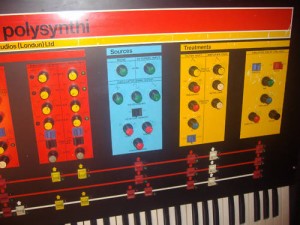
The EMS POLYSYNTHI
Made in 1979 by the legendary EMS, alledgedly no more then 29 were ever produced. Size-wise, it’s bloody massive, and it really looks the business, despite its multicoloured, toytown style exterior. It houses the first ever (only?) velocity sensitive, aftertouch responsive 100% POLYPHONIC keyboard – if you’ve enough fingers and toes, you can play every single one of its 49 notes at the same time. The keyboard has a totally unique velocity sensitivity and aftertouch implementation – the entire keyboard itself moves as one mechanical piece. And, it has to be said, the Polysynthi also has one of the most difficult to fathom control surfaces ever to appear on any synthesizer!
It uses a switchable bus matrix system to determine, amongst other things, the signal and modulation sources, which can also be variably assigned to velocity and/or aftertouch. This switchable bus system on the Polysynthi is quite frankly bonkers. Furthermore, it has a somewhat standard set of synthesizing functions, but it does have some additional useful abilities too. The two ADSRs onboard are also routable and patchable through the bus system, though take some getting used to, and there’s an external audio input, routable through the filter section and modulation matrix, as well as a fantastic analogue delay line. This delay was the original design for what became the ElectroHarmonix Memory Man, and produces very peculiar and interesting effects indeed, especially with higher feedback settings – you seriously have to watch out for your bass bins when using it.
Closer look at the 16 Step Sequencer Vari-Clock Quantizer
This is a demonstration of the features of the new Vari-Clock Quantizer for the MFOS 16 Step Sequencer.
“You can make one yourself but it’s a very challenging project and I don’t recommend it for people just getting started. Seasoned synth-diyers will have no problem with this project. PC boards will be available in a few weeks if you’re interested (sometime in June 2012).”
Here is a link to the project:
http://www.musicfromouterspace.com/index.php?MAINTAB=SYNTHDIY&PROJARG=SEQ…
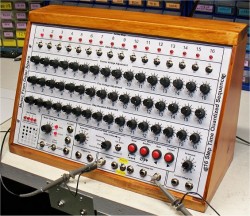
Features:
- Each step’s duration can be set independently.
- Each step’s duration is settable from 1 to 16 clock cycles.
- Main clock adjustment affects all steps equally.
- Clock selection: Quantized or Normal
- Two gate/trigger modes: Single per step and Multi per step.
- External clock supported.
- Clock out supported.
Rhythm Studio gets a powerful update

Pulse Code has announced an update Rhythm Studio, its virtual studio for the iOS:
The fourth update includes the addition of a powerful three operator FM (frequency modulation) synthesizer, the FM-3.
The FM-3 has been designed to allow maximum results with minimal effort. The complexities of FM synthesis have been simplified to allow you to create great sounds right from the start.
In addition, we are adding a help link within the app to a full set of online tutorial videos. The video tutorials touch on all the major aspects of Rhythm Studio. From navigating the song browser and its options to interacting with all of the virtual synthesizers and other audio gear in the workspace, the video tutorials will help you learn Rhythm Studio faster.
Rhythm Studio is $4.99 in the App Store.
Droning Machine
The Freqbox is a very underrated device.
This is very simple programming, just some slight modulation of the waveshape, to an overdriven 101 LPF. Then a random sequence with most of the pots totally CCW seemed to simulate a two person morse code conversation using the Ringmod as a pitch source.
Oscs sent to a synthesiers.com VCA and to the MF 104z Delay prior to going to the board.
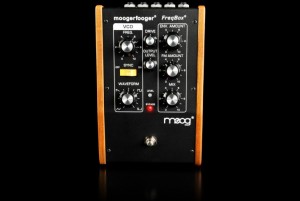
The MF-107 FreqBox is different from other effects – the effected sound is not a processed version of your input signal, but the sound of the input signal modulating an internal oscillator. It contains a VCO with continuously variable waveshape, and the capacity to modulate that Oscillator in the following ways:
– the VCO can be hard synced by the input signal
– The VCO can be frequency modulated (FM) by the input signal
– The VCO frequency can be modulated by an envelope follower which tracks the dynamics of the input signal
– The Amplitude of the VCO also tracks the dynamics of the input signal
Hard sync is a classic analog synthesis technique where the start of an oscillator’s cycle can be reset by another. The oscillator being synced takes on the frequency characteristics of the other oscillator, and when its frequency is swept, it reinforces the harmonics of the fundamental frequency. In the case of the FreqBox, the input signal is used to reset the FreqBox’s VCO.
FM is a technique used to get really rich sounds from simple waveforms. The type of FM used in the FreqBox is linear FM. Sounds range from gong or bell-like tones to sizzly sweeps.
The FreqBox, like all moogerfoogers, works with any instrument to line-level input. In addition to the panel controls there are control inputs for use with expression pedals or control voltages and control outputs for interconnecting moogerfoogers like you would a modular synth.
The demo was recorded with an electric guitar, the FreqBox, a Moog EP-1 expression pedal, and recording software on a laptop. That’s it!
The FreqBox can provide some really unusual processing to all types of signals – guitars, synths, drum sounds, vocals or wind instruments allowing you to enter previously unexplored sonic territory.
DATAMASKIN

