
Variations II of Variations II
Variations II of Variations II : May 14 – 18 2012
Installation at Integrated Media Studio Valencia CA
by Jinku
Variations II of Variations II is a kinetic sculpture inspired by John Cage’s Variations series. Cage’s Variations II is a graphical composition that generates musical events using measurements of distance between dots and lines on a piece of paper.
In my realization of Variations II, the instructions for the piece determine the behavior of rotating panels and images synchronized to be projected onto the sculpture. Motors drive the rotation of the panels, and are used as a sound source for the audio portion of this piece.
My next goal for this project is a live interactive audiovisual performance. The performers will function as a variable in a feedback loop between performer, sculpture and score.
work in progress
C/C++, Arduino, MaxMSP/Jitter,Stepper Motor
Synesthesia
Time for another fascinating expreimental video – called syn·es·the·sia syn·aes·the·sia (sĭn’ĭs-thē’zhə)
A condition in which one type of stimulation evokes the sensation of another, as when the hearing of a sound produces the visualization of a color. A sensation felt in one part of the body as a result of stimulus applied to another, as in referred pain. The description of one kind of sense impression by using words that normally describe another.
Awesome fan video: Brian Eno – Kings Lead Hat
Video from the 1977 album, Before and After Science, By Brian Eno.
Polydor Records
Glitch Factory: APC40 Performance Template
http://youtu.be/8LVm_F_mRI
A collaboration between Australian producers Mr Bill and Will Marshall, this is a stems-based template for the Akai APC40, designed to help producers get started performing their own material live on stage.
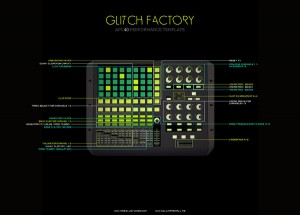
“We’ve built some awesome performance FX, as well as writing a custom script for the APC40 to streamline your live sets. Included in the template are four tracks worth of stems, to help get you started.”
More info here – http://willmarshall.me/products/glitch-factory
MINITAUR + ABLETON LIVE: Minitaur Editor Librarian
In the final part of this three part series, Moog Product Development Specialist, Amos Gaynes shows you how to use the under the hood features of the Minitaur Editor Librarian. Learn how to utilize even more features of your Minitaur for a totally custom experience.
Learn more about the Minitaur at:
www.moogmusic.com/products/taurus/minitaur
Be sure to register your Minitaur to receive your free copy of the Minitaur Editor Librarian at:
www.moogmusic.com/register
Experimental stuff: The Infinite Music Machine
An immersive digital journey into the analog world of Juju & Jordash.
On the 24th of February 2012 at Berlin’s Feed Soundspace, Juju and Jordash gave a live improvised performance, accompanied by artist Paul Skawinski’s liquid projections. The application takes their muliple layers of analog recordings and randomly combines them to produce an infinite music machine. An experiment on continuing randomness in the analog and digital domains.
Features
– Randomly auto generates music derived from Juju & Jordash’s live performance.
– Liquid visuals by Paul Skawinski.
– Randomize the audio and visuals using the randomize button.
– Set the length of time the machine generates audio and visuals: one minute to ∞
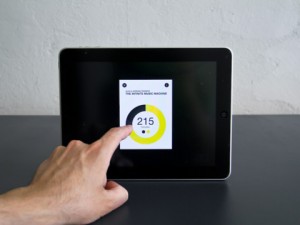
Free DJ app for iPad
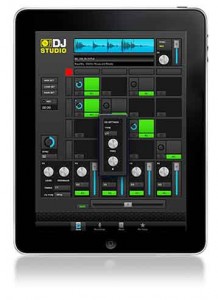
Rocudo has released DJ Studio, a free app for the iPad which they say is built to help you find and release your Inner DJ.
A spokesperson told Sonic State, “The idea is simple: we built a powerful DJ App which requires no skill to use and we packed it full of great Loops & Samples from top Artists & DJs. Then we folded in some advanced features and premium content options which you can unlock at your own pace.”
Features
- Browse builit-in library of Loop & Samples and drop onto your 4×4 Deck
- Tap Pads to play – auto-sync means you’re always on the Beat
- Manipulate Level, Mute and FX Send for each Pad
- Mixer provides Level/Mute, EQ and FX Send on 4 independent channels
- Delay FX Unit provided will autoset its parameters to match Tempo
- Save your Sets and Record your Live Performances
- Absolutely no experience required
Pricing and Availability:
Free
More information:
Time machine: SOLTON PROGRAMMER 24 Drum Machine Arranger 1985
Time for another retro machine to be featured, this time it is the classic Solton drum machine:
The Solton Programmer 24 is a programmable drum machine with 8-bit samples and integrated arranger, which uses analog sounds (bass, solo synth). It also has a polyphonic string-ensemble and polyphonic organ.
You can program your grooves with bass line and solo synth! It was produced in Italy in 1985 by Ketron. It has a tight timing, single outputs and MIDI. All you hear in this video is a Solton Programmer 24.
The Solton Programmer is heard on the Italo-Disco single “Fotonovela” from Ivan. A great little box for eighties music!
Make Noise DPO Dual Prismatic Oscillator. Wave forms and simple sequence
“Here’s a demo for the Wigglers out there who demand it. The new Make Noise Dual Prismatic Oscillator.
Disclaimer: I’m functioning on about three hours restless sleep. UPS man knocked on my door surprisingly early and well… I couldn’t bring myself to go back to bed.
What we have here is a quick demo showing the raw wave forms from both sections of the DPO. Then some tweaking of the knobs and the modes. Then I use the Make Noise Pressure Points/Brains combo to construct a very simple sequence. Only other modules in use are the Make Noise Optomix (Low Pass Gate) and a mixer. There is some wave folding and FM modulation going on during the sequence. I hope it’s pretty self-explanatory. I will be doing a proper tutorial when I’ve had time to spend with the DPO and hopefully borrow a nice HD camera. Until then enjoy!”

New series – Legends of electronic music
Created in 1963, Tod Dockstader’s Water Music appears on Starkland’s first CD (Quatermass ST-201). Sound sources include: water, toy gong-rattles, finger bells, sheet metal, test generators, water glasses, Coke bottle, metal garbage can, a nail.
Wired Magazine has started a new series on their online website called “Legends of Electronic Music”, well worth checking out, here’s how they describe it:
Wired’s new series Legends of Electronic Music explores the history of electronic music through in-depth interviews with some of the field’s pioneers. The series kicks off with a rare interview with trailblazing American electronic composer Tod Dockstader.
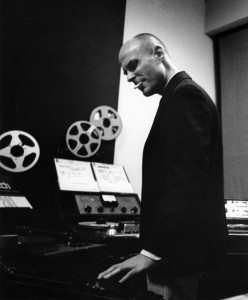
In the 1940s, before magnetic tape was widely available in the United States, electronic music pioneer Tod Dockstader made low-fi recordings on steel wire.
“I loved the idea of the wire singing,” Dockstader said in a recent interview with Wired. As a high school student in the ’40s, he used the end of a lit cigarette to make splices in the thin wire, in a painstaking and risky process.
“You had to tie the wire, which was very fine, in a perfect square knot,” he explained. He would hold the wire up to his nose, with the cigarette perched in his mouth. A single wrong move and the edit could be destroyed.
“I became very adept at editing,” he said. “I really liked editing; I understood it. To me, it was really basic stuff. You could make decisions — take things out, put things in. I liked that you were building something.”
Born in 1932, Dockstader was part of the first wave of electronic musicians, who, before the advent of synthesizers in the early 1960s, worked with whatever hardware they could find: reel-to-reel tape machines, sine wave generators and a wild array of homemade circuits and military surplus gear. In the process, they created a universe of electronic music that still sounds unique and prescient today.
The wire recorder Dockstader used to create electronic music was a piece of used military equipment. “A lot of this [electronic music] happened because, after the war, a lot of the stuff was available,” Dockstader said. “Normally a person, a civilian … wouldn’t be able to get that tube, this device or that device. That fascinated me.”
In the late 1950s, Dockstader worked as a sound engineer at Gotham Recording Studios in New York. At night, he worked on his own music, which eventually led to a series of impressive albums of electronic music, including Apocalypse (1961), Quatermass (1963) and Omniphony (1966).
“I was always working at night — deep night,” Dockstader said. “And I’d be very careful. If they found me in a studio — just me — I would have lost my job.”
DATAMASKIN

