
Applied synthesis and more from the Moogfoundation
When you have the ability to control multiple resonances, you can create “formants.” Formants are the acoustic resonances of the human voice. Marc creates a patch which uses multiple resonances to generate a human-voice-sounding sound.
Inspired by Leon Theremin’s incredible device, Maurice Martenot set about creating a device of his own. His Ondes Martenot became an important stepping stone in the development of synthesizers, as well as an inspiring musical instrument for composers. Marc describes the history and effect of the creation of this device.
Many more new videos from the Moogfoundation can be found on their channel >>
Moog Sub Phatty Demo with Jake Widgeon
Jake Widgeon from Moog Music demonstrates the Moog Sub Phatty analog synthesizer at Kraft Music.
Checking out the vintage Oberheim Matrix-1000 synth
A voyage into the heart of the Oberheim Matrix-1000 analog synthesizer from the year 1987.
Exploration by Marko Ettlich (RetroSound)
6 voices
2 oscillators per voice saw, triangle, square variable pulse width, fm
resonant filter 24dB/oct lowpass filter
2 LFOs
1000 sounds
used by Apollo 440, Moby, Fatboy Slim, Depeche Mode, Pet Shop Boys, Faithless and many more

The analog Matrix 1000 is essentially 1,000 Matrix 6 patches in a single-space compact rackmount MIDI module. It has the same synth architecture as the Matrix 6. Each of its 6 voices have two DCO’s (digitally controlled analog oscillator), a low pass filter, 2 VCA’s, 3 envelope gens, 2 LFO’s, and 2 ramp gens. The sounds are plentiful and good enough, however sounds can only be edited via MIDI, so you’ll need an external MIDI editor (such as MOTU’s Unisyn) or Access’ Matrix Programmer to edit parameters. You can also load sounds from the Matrix 6 via SysEx or software.
The Matrix 1000 provides an excellent source of pads, textures and ambient sounds. It has 195 “keyboard” sounds, 118 “strings”, 130 “woodwinds & perc”, 239 “synthesizer”, 119 “bass”, 74 “lead” and 125 “effects”. For the price, there is no better way to find genuine analog Oberheim Matrix sounds in a compact and very in-expensive rack module that is loaded with more sounds than you’ll ever need! The older versions of the Matrix 1000 have a black front-panel. The newer models in the ’90’s have a cream colored face-plate.
Time machine: Yamaha RX8 Drum Machine
Yamaha RX8 drum machine. Yamaha launched the RX8 in 1989 as a replacement for the RX7 and to be Yamaha’s first drum machine using 16 bit PCM samples. In the late eighties there were several successful 16 bit drum machines available, the Alesis HR16 and HR16B as well as the Roland R8 and R5 to name a few, but the RX8 was still able to carve out a niche in the market of the time.
“Shaped like a plastic doorstop. Not one of the best drum machines ever but still has its charms. Not as boring as the RX17 and RX21. Clearly a budget drum machine, it boasted 16 bit samples and it would have gone head to head with the Alesis HR16, which had better samples.”
The Fastest Way to Clean Up Your Mixes
Two Minute Ableton Live Tip – The Fastest Way to Clean Up Your Mixes is to cut unnecessary frequencies. Each track in a song takes up a certain amount of “frequency real estate.” Often you’ll have tracks that don’t need much information in the upper frequencies (think bass drums) or in the lowest frequencies (think cymbals or vocals). You can quickly clean up your mixes by cutting any unnecessary frequencies out.
Visit AfroDJMac’s site for more stuff like this, including Live Instrument downloads, tutorials and music! http://www.afrodjmac.com
Heat Synthesizer for Android – browsing some presets and editing
Heat – Music Synthesizer App for Android, available in the Google Play Store:
https://play.google.com/store/apps/de…
A virtual analogue subtractive synthesizer with online Preset Browser, everyone can share sounds directly from within the app. The synthesizer has full VST integration, use the Heat Android App as a controller for your VST plugin, design patches while on the way and use them later in a VST sequencer of your choice.
Everything you hear is recorded straight from the line out of a Google Nexus 7 Android 4.2 tablet.
For more info visit http://heatvst.com
- Design sounds while on the way, store sounds on your local Android Device or use the Collaborative Preset Manager to store your sounds online, making them available to everyone.
- Control the VST plugin from your Android device in realtime
- See parameter automations from your sequencer in realtime on your Android device
- Use the Collaborative Preset Manager on your Android Device to select from a big variety of sounds, made from other users all over the world. Select sounds on your Android Device, while connected, they are immediately loaded by your VST plugin.
- Use the integrated keyboard of your Android Device to send midi events to your sequencer
Yazoo singer Alison Moyet’s new video ‘Changeling’
Get the lyrics to Changeling, the first song premièred from Alison Moyet’s new album, the minutes and download the track for free via http://alisonmoyet.com
PixiVisor: Using the Korg Monotron As Video Filter
Using the Korg Monotron (Pocket Synth) As Analog Video Filter.
PixiVisor is a revolutionary tool for audio-visual experiments. It is based on the video signal transmission over audio (you can listen to the sound of your image).
More info: http://warmplace.ru/soft/pixivisor
Music: http://soundcloud.com/nightradio/anal…
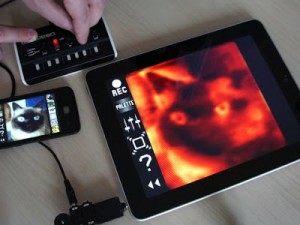
PixiVisor is a revolutionary tool for audio-visual experiments. Simple and fun, cross-platform application with unlimited potential for creativity!
It consists of two parts: Transmitter and Receiver.
* Transmitter converts the video (static 64×64 image or 10FPS animation) to sound, pixel by pixel (progressive scan). This lets you listen to the sound of your image. But the main function of the Transmitter is to transmit the signal to the receiving devices.
* Receiver converts the sound (from microphone or Line-in input) back to video. You can set the color palette for this video, and record it to animated GIF file.
Key features:
* file formats supported by Transmitter: JPEG, PNG, GIF (static and animated);
* real-time video export to animated GIF;
* 64 predefined color palettes;
* iTunes File Sharing;
* Wi-Fi Export/Import (in the File menu of the Transmitter);
* it also available for Android, Windows, Linux and OSX;
* more functions in the next PixiVisor updates…
Examples of use:
* wireless Lo-Fi video transmission over audio;
* video signal transmission through audio cable; you can then modify that signal by some mixers or audio FX processors;
* VJing;
* sound visualization;
* save any sound to animated GIF;
* hide some images and animation in your music;
* searching for hidden messages in the ambient noise; EVP;
* something else; reveal it first!
Official PixiVisor homepage + test broadcasts + more videos:
http://warmplace.ru/soft/pixivisor
Reaktor Tutorial: x0x Kicks
This tutorial looks at building Kick drums based off the classic TR-808 and TR-909. The tutorial goes over how to calculate Freq and Q (Quality Factor) from reading schematics. The video also shows how to modify the Core static BP filter to use Q values instead of Resonance. To see how to do the same thing for BandWidth (BW), see our previous video on Vocoders vimeo.com/59133221
The video also points out the excellent tutorials for building a TR-909 Kick at nireaktor.com/reaktor-tutorials/how-to-make-a-909-kick-in-reaktor/
Logic Tutorial: How to Create Rave Stabs Using ES2 Synth
More info: http://bit.ly/VAhK6k
Dubspot instructor and course designer Matt Shadetek returns with another episode of Secret Knowledge, a Logic Pro video tutorial series full of production tips, techniques and advice for Logic users. In this installment, Shadetek shows how to create rave stabs by layering multiple detuned saw waves, using Logic’s ES2 virtual analog synthesizer.
The sound we’re going to create here has been in use for years in many styles of electronic dance music, but somehow people keep returning to it: the rave stab. Rave stabs are made by layering a pair of highly detuned saw waves with one another and then using something to animate the pitch and cause it to bend. In this example we’ll do this with the ES2 synth in Logic and an envelope but there are many ways to create this type of sound. All you need is a synthesizer that can layer saw waves and create pitch movement. For extra credit I’ve set up the envelope modulating the pitch to be velocity-sensitive, so when this patch is played from a controller we get some additional variation depending on how the instrument is played. – Matt Shadetek
DATAMASKIN

