
Four Analog Promenades : 3-Dredging the time
Four Analog Promenades: This is the third video from Frederic Gerchambeau featuring analog synths
Korg MS-20 + Analogue Solutions Telemark + Plogue Bidule + Audacity
1 and 4 are played by hands, 2 and 3 are played by the machines.
Every videos have been made on the august 25th 2012 in Nantes, France.
1-Dreamlike prayer
2-Drifting logic
3-Dredging the time
4-Driven by the sun
Doepfer A155 Analog/Trigger Sequencer- Frequency Modulation Tutorial
A demonstration of Frequency modulation of a sequence on the Doepfer A 155 Analog/Trigger Sequencer with low rate cv signals and audio rate signals. Sound and Description by Raul Pena.
MacBeth Micromac and Touch keyboards
Yet another promising video with updates from MacBeth, details below:
Life’s not all grim! Touch keyboards are real fun and they make you think in a completely different way about keyboard playing- odd at first- but the technique starts to change and grow. Here is me playing the MacBeth micromac-r unit and the olde ‘vaporware’ protoype unit with the mere 1 octave prototype job. To your right the planned three octave controller- now with now stylus, earthing yourself to ground or anything like that-0 it’s now ‘touch capacitative’ and pure analogue!
Sunday morning modular noises
Up early this (in Northern Europe) very windy Sunday morning – then go ahead and enjoy some modular synth noises from Lyonel Bauchet:
Twisted Waveform Generator + Harmonic Oscillator mastered by Complex Waveform Generator via Spectral Processors, through Time Machine and Frequency Shifter Twins.
Inside a VSTi – how its made
Have you ever seen inside a VST plugin – how its made? Ourafilmes is, probably, the first to show you!
Here´s a nice video that take you inside the SB-2 monster synth and shows its main features!
This synth is now free and is included in the Ourafilmes Facebook Pack – available in www.facebook.com/ourafilmes
Electric Pianos made with Tronto
A small selection of presets from the ‘vintage’ bank, one of 10 banks supplied with Tronto for Kontakt 5.
This video shows a little of the versatility of Tronto, with interpretations of some classic and much loved electric pianos from the past, with a few twists here and there.
The only external effect used is Echo from Psp audioware. This delay is a favourite of mine, as it’s tape delay characteristics complement Tronsonic’s libraries very well.
http://www.tronsonic.com/#/tronto-for-kontakt-5/4568455166
http://www.pspaudioware.com/plugins/delays/psp_echo/
Taking a closer look on the Roland Juno 6 synth
“The Juno 6/60 is a popular synth that is the subject of a lot of discussion, and much of it is negative. I am a huge fan of the Juno 6/60 and think it gets and unfair amount of criticism, primarily behind the veil of the internet. This demo showcases its amazing sound and some of it’s capabilities.”
Below is the link to the original uncompressed demo:
http://soundcloud.com/briancastro/roland-juno-6
The first in a series of amazingly affordable quality synthesizers from Roland’s amazing Juno family! The Juno-6 is a six voice polyphonic analog synthesizer! It’s a very stable synth thanks to its digitally controlled analog oscillators. The Juno-6 sounds great, however it lacks basic necessities like MIDI control and patch memory storage.
The next generation Juno-60 version added 56 patches of memory storage. Both of these synths sound virtually the same and are considered by many to sound better (punchier) than the popular follow up, the Juno-106. The Juno-6 and 60 are very rich sounding synthesizers and are great analog machines as long as you can overlook the absence of MIDI control. Of course nobody can deny that the wooden side panel look is a true sign of Vintage status!
Tutorial: Wave Arts “Dialog” – Introduction to vocal processing
Jonas “Missing Identity” Hagenvald explains the new plugin “Dialog” from Wave Arts and enhances a vocal from the singer Lulablue.
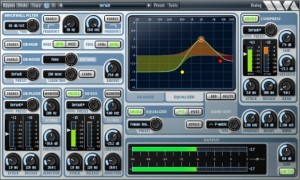
Dialog combines in one plug-in all the processing needed to clean up, adjust, and sweeten recordings of the spoken voice. It is perfect for voice-over, film/tv recordings on location or sound stage, and broadcast.
Dialog includes brickwall filters, de-hum and de-buzz processing, broadband noise reduction, de-ploding, de-essing, 10-band equalization, compression, and limiting. Separate presets for each section allow you to get results fast.
The brickwall filters have variable rolloff slopes and can be used to cutoff low or high frequency ranges. The de-hum processor uses notch filters to eliminate 10 harmonics of either 50 Hz or 60 Hz hum. The de-buzz processor squelches nasty line frequency buzzes. The de-noise processor is the stellar sounding MR Noise algorithm with a simplified interface. De-plode and de-ess are custom processors; use de-plode to tame plosive sounds and use de-ess to adjust the amount of sibiliants. The EQ section is the powerful and easy to use TrackPlug equalizer, with 10 bands of equalization, 11 different filter types to choose from, and a variety of presets. The compressor is the TrackPlug Vintage compressor, with presets tailored to voice processing.
CRUMAR MULTIMAN String Machine 1975 + Gerd Schulte Compact Phasing A
In the first half of the video ‘AnalogAudio’ plays the Crumar Multiman dry, in the second half with a COMPACT PHASING “A” from Gerd Schulte Audio Elektronik. The Compact Phasing A is a German phaser, which was well known in the seventies (at least in Germany). Many units were sold, but it is rare and sought after today. It was used by Klaus Schulze, Tangerine Dream, Kraftwerk and others.
This Crumar Multiman is the first version (later came the Multiman S versions which are larger). It was produced in Italy. It has a string section, a brass section (with VCF controls and resonance) and a piano section. It is capable of nice layer sounds. A monophonic bass preset can be added.
“Excuse the crackling noises, my Multiman is not 100% intact. Indeed, it is in terrible shape. Some of the keys don’t play notes, instead they produce some crackling noises. But the basic sound is fantastic!”
Directly from the labs – Steim synth
A research piece from STEIM exploring analog synths:
Here’s the first video of the research I’m doing at STEIM in Amsterdam. this is a simple analog synthesizer which can be patched and modified using a breadboard interface. The visuals are made by setting my oscilloscope to XY plot mode. The X axis is a triangle wave. The Y axis is a ring modulated signal between the same triangle wave and another triangle wave. There are 5 oscillators total which are all inter-modulated. There’s also a sample&hold in the mix which gives the visuals a stepped appearance which you can see once in a while.
DATAMASKIN

