
Analog Ribbon Synth
The Analog Ribbon Synth controlled via CV with two modules:
– Sample & Hold
– Noise Generator / Random Gate Generator
The Noise Generator module is connected to Sample & Hold and then to CV input (Ribbon Synth).
Envelope Generator is controlled by Random Gate Generator.
Analog Jam and Synth Spotting
Quick little jam featuring two analog synths and a drum machine.
Hardware:
Moog Minimoog Voyager Old School
Korg MS-20
Jomox XBase 888
Time for battle – Korg Monotron vs. WerkBench!
WerkBench for iPad is a perfect companion for this quirky analog synth. All sounds came from the Monotron and were recorded into WerkBench in real-time. WerkBench is available in the app store: bit.ly/L6jhd9
http://www.bolasol.com/werkbench
http://www.facebook.com/werkbench
NOVA DRONE sound and light synth
The Nova Drone is an open source, analog experimental sound and light synth from casperelectronics.
It it can be used to create effects ranging from slowly fading drones to chaotic harmonic sequences.
The Nova Drones offers 9 potentiometers, 9 switches, 6 oscillators, 3 oscillator sync inputs and an epic 15 voltage outputs as well as 3 high current outputs for controlling external LEDs. All of the ins and outs have been routed to a prototyping breadboard at the bottom of the unit which allows for liberal experimentation and development of custom circuits. The prototyping area is especially useful for syncing the oscillators of 2 or more Nova Drones together.
*************FUNCTIONALITY****************
The NovaDrone has three separate channels which generate sound and control the brightness of the three colors in a tri color LED.
The sound and light come from the SAME electrical signal. You are literally seeing what you hear.
Each channel has:
a TONE pitch knob,
an LFO rate knob and switch,
a VOLUME knob,
2 SYNC switches and an external SYNC input.
The LFO for each channel modulates the LED brightness and audio wave shape. This uses pulse width modulation, or PWM.
The rate of the LFO can be adjusted (using a knob and switch) from around .008 Hz (around 1 cycle every 2 minutes) to 750Hz (750 cycles per second).
The TONE pitch of each channel can be adjusted from 24Hz to 750Hz. It can also be hard synced to the other channels in order to create harmonic overtones. Interesting (crazy) sync feedback loops can be created by syncing one channel to another and then back to the first (for example). This kind of configuration generates bizarre textures and sequences.
Very interesting effects are achieved by syncing the tone oscillator of one channel to the PWM output of another channel. This results in a modulating harmonic sequence.
The VOLUME adjustment controls both the amplitude of sound and brightness of the LED.
*************HARDWARE****************
Each channel has the following features:
ADJUSTABLE CONTROLS
-volume
-TONE pitch
-LFO rate
SWITCHES
-sync 1
-sync 2
INPUTS
– ext sync 3
OUTPUTS
-TONE square wave
-TONE triangle wave
-LFO square wave
-LFO triangle wave
-PWM square wave
-High current LED out for off board LEDs.
For more info including ordering info and complete schematics email pete[at]casperelectronics[dot]com or go to
casperelectronics.com
Pure Analog with the Oberheim OBXa + Roland SH-101
Background details:
I made this track in the mid 80’s with the Oberheim OBXa on a 4-track analog tape recorder Tascam 144.
Everything was played by hand, without a sequencer or MIDI.
The remastering is made with SONAR 8.0
This piece was also featured on our national radio called BRT-2 in 1987 in a special program “maneuvers in het donker” for home made electronic synthesizer music
Voyager – new analogue synth ReFill based on the sounds of the famous Minimoog Voyager
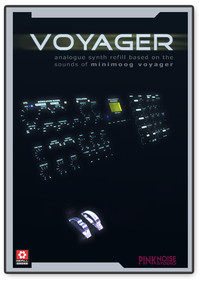
ReasonBanks has announced the release of Voyager, an analogue synth ReFill based on the sounds of the famous Minimoog Voyager synthesizer.
VOYAGER refill provides vivid, dynamic and rich-sounding real analogue leads, bass, polyphonic keys and pads, giving you a new powerful synth in your Reason rack.
Our concept has never targeted the development of the 100% perfect software emulation of Minimoog: it is practically not possible. A sample library is a bit similar to the photo album: they contain series of snapshots. It will sound but never work as the original hardware. Bearing this constraint in mind, we wanted to create a synth in Reason that sounds like a real Moog, but acts like Reason’s instruments.
Voyager features
- 1.78 GB multi-samples (over 2400 wav files) in 24 bit wav format.
- All samples are perfectly looped and contain the unity note info for quick and proper automapping.
- 124 REX loops: melodic bass, arp & noise sequences for KLP (keyboard loop player).
- 339 NN-19 patches, 412 NN-XT patches, 128 Combinator presets.
- Refill size: 1.22 GB (24 bit).
The ReFill is available to purchase for the introductory price of 28.80 EUR through June 2012 (regular 36 EUR). Requires Reason 6 or above.
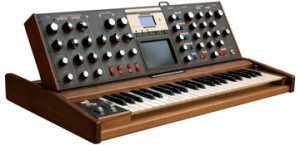
The Minimoog Voyager is a true analog monophonic synthesizer (probably the most expensive one of its kind) and is based entirely on the original classic Minimoog Model D, which was on the production line of Moog Music, Inc. from 1970 to 1982. It’s cased in a beautiful, solid hardwood cabinet with a multi-position hinged control panel.
Just like the original, the Voyager has three analog wide-range voltage controlled oscillators, one noise source, as well as one audio preamplifier for externally-applied audio signals.
Two resonant Moog-style filters are on-board and function in dual lowpass or lowpass/highpass modes and can be modulated by one of the two ADSR envelopes, the LFO, or external control.
Minimoog Voyager is a first class synth; every bit as elegant in look as sound and quality. It is highly streamlined and offers all the functionalities of a modern day (mono)synth with the classic, warm, unforgettable Moog sound.
Richard Devine – The Analog Voodoo Effect
Richard Devine is an Atlanta-based electronic musician and sound designer. He is recognized for producing a layered and heavily processed sound, combining influences from hip-hop, to old and modern electronic music. Richard Devine has released records through such esteemed labels as Schematic and Warp Records, and is the creative force behind his own sound design company, Devine Sound. Though he has contributed sound design to a number of hardware and software manufacturers, he recently released his first official sample library through Sony Creative Software. Devine has also scored commercials for the likes of Nike and Touchstone Pictures.
Since the late-90s, Richard Devine’s sound has been synonymous with taking cutting-edge computer-based DSP (digital signal processing) to its limits. In recent years, however, Devine has also become a convert to the unlimited sonic capabilities and hands-on “analog voodoo effect” of the Eurorack modular format. I Dream of Wires spoke to Devine at NAMM 2012, which he attends annually. Judging by the studio footage on his Vimeo channel, and his wild enthusiasm on the subject, Devine is a bonafide Eurorack obsessive!
All music and sound in this video is by Richard Devine. Additional studio footage supplied by Richard Devine.
For more info on Richard Devine
richard-devine.com
devinesound.net
soundcloud.com/richarddevine
vimeo.com/channels/richarddevine
I DREAM OF WIRES is a forthcoming documentary film about the history and resurgence of modular synthesizers. The film is currently in production. This is the 6th in a series of extended interviews, which will be produced and released in various formats throughout the production, and following the release, of the film. I DREAM OF WIRES extended interview segments are sponsored by MATRIXSYNTH (m.matrixsynth.com).
Synth Magic Polychrome basic demo of some of the sounds
Instrument based on the Farfisa Polychrome-Lots of extra features added such as LFO’s on all sections, full effects section,autopanners, velocity to vibrato,filter, tremolo etc.
Available at www.synthmagic.co.uk
Instrument based on the rare Farfisa Polychrome analogue synthesiser for Native Instruments kontakt 4.2.4 or higher(including Kontakt 5). Custom designed GUI to allow for easy tweeking of sounds. Over 200 presets included and thanks to the custom designed user interface it is childs play to design your own sounds. Many existing users say our instruments sound and feel like your playing with real hardware. Easily create the fantastic sounds of this beautiful classic synthesiser. Lots of extra features added such as extra LFO’s,independent autopanners for each synth section,lots of effects and a master effects plus lots of expression controls for aftertouch,modwheel etc.
ARP Omni-2 – the classic Joy Division keyboard
“When I was a teenager in the mid-1980s, like many of my teenager friends I was very fascinated by Joy Division, in particular by their album “Closer”. I remember that in those days I used to put Closer on the turntable, turn off the lights in my room, and fall asleep to the music. The music from Closer was very beautiful and hypnotic, and left a big impression on me. In particular I loved the synth strings used in that album. It was the ARP Omni-2, also used in other songs by the band. A great album, a great performance by the band, a masterful production by Martin Hannett, and a big influence for my music since those days..”
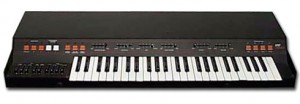
The Omni is an analog synth with preset Orchestral String sounds. It has polyphonic Violin and Viola waveforms as well as monophonic Bass and Cello waveforms. It is split into 3 sections: Strings, Synthesizer, and Bass synth – all simultaneously available. It has traditional and simple VCA, VCF, and LFO controls for contouring your sounds as well as a nice chorus that really thickens up the string sound. It has no program memory.
ARP later released the Omni Mk 2. It was basically the same machine as its predecessor, except for a few minor enhancements and a cosmetic Orange & Black color-scheme upgrade. And it did have a much more advanced triggering system for the VCF and VCA for more expressive results.
Polivoks – The best soviet synthesizer
The Polivoks is the most popular vintage Russian synth made in the early 80’s and it was among the first synthesizers produced in the USSR. It’s purely analog with two voices of polyphony, two oscillators each with triangle, square, saw, two types of pulse waveforms and one noise generator, the levels of which are controlled via the internal mixer. Although the oscillators can become unstable and difficult to tune, the Polivoks is well suited for making screeching sounds and thunderous bass. You can also connect an external audio input for processing through the Polivoks’ switchable dual-mode band pass/low pass filter and LFO sections. The LFO, or “Modulator” offers triangle, square, random and noise waveshapes and can be applied to the oscillator level and pitch or the filter cutoff. There are also two ADSR envelopes for contouring the oscillators and filters.
Polivoks had been produced since 1982 by the Formanta electronic factory (one of the biggest at the time); it was sold exclusively in the USSR. Polivoks has its own unique electronic components including a reliable keyboard (49 notes F to E) made with magnetically controlled contacts. Its synthesis modules consist of independent circuit boards, which is convenient for maintenance and repair. In addition, Polivoks is housed in an original rugged aluminum body of uncommon design with handy controls.
DATAMASKIN

