
Analogue Solutions VOSTOK MATRIXSYNTH v2 – Modular Suitcase Synth Demo
Here’s an extended look at the Analogue Solutions Vostok MATRIXSYNTH synthesizer.
This demo features a variety of sound types and sequences (traditional and non-traditional) demonstrating the Vostok’s sound palette and variety of timbres. All sounds, with exception of the obvious acoustic drums (used for context), are created on the Vostok using either traditional patching or the pin matrix — or a combination of both.
Sounds are being driven by either the on-board sequencer, MIDI sync (via GATE to CLOCK), or direct MIDI connection to a controller keyboard.
Emphasis for this video was more traditional synth sounds (basses, leads, sequences) as there are plenty of non-traditional (fx, ambient, noise) sound demonstrations on YouTube. The filter section at the heart of the Vostok was also a focal point of this video and is tweaked extensively for the various sound types.
Also, see the Telemetry (mini Vostok) in action at the following link:
http://www.youtube.com/watch?v=rvo5x5G4YJg
KEY FEATURES OF VOSTOK Pure analogue voice circuitry. Suitcase style design. 22×22 matrix pin panel. Rugged Steel construction. Quality chrome catches and cool steel spring handle. Stuffed full of electronics. No front panel space is wasted. Joystick, retro-VU meter, MIDI, jack socket patch points, more, more, more!
Atonal Oscillations with the Moog Voyager and MF-102 Ring Modulator
Demonstration using the Moog MF-102 Ring Modulator as an extra “atonal” oscillator for the Moog Voyager
Introducing the Orphion
Orphion is a dynamic velocity touch playable sounds and manipulation app
The Orphion is a new percussion instrument, which will be ported to the iPad / iPhone. The video shows a prototype in which the iPad is used only as a remote control of a laptop, but the whole should be converted into a native app, so everyone can download in the App Store.
In order to provide potential developers with an advance can I need this budget.
_______________________
UPDATE:
Hi! The App is allready finished by now: You can get it on the app store here:
http://itunes.apple.com/en/app/orphion/id495465097
KORG Kaossilator 2 & mini KAOSS PAD 2
Live from the floor of NAMM 2012, an overview on the new KORG Kaossilator 2 and mini KAOSS PAD 2! Also check out the Kaossilator 2 preview at http://www.youtube.com/watch?v=FmQeP3y1F2w and the mini KAOSS PAD 2 preview at http://www.youtube.com/watch?v=OeArHaC0e9U
Live from NAMM: Moog Minitaur Analog Bass Synth demo
Moog launch new Minitaur Analog Bass Synth at NAMM 2012.
Minitaur is a powerful, compact Analog Bass Synthesizer that features a classic one knob per function design. It is the first instrument in the Taurus family that does not have foot pedals. At only 8.5″ x 5.25″ and less than 3lbs, the Minitaur puts legendary analog Moog bass into a package designed to fit seamlessly into today’s performance and production environments. There are no confusing or convoluted menus to dig through. Plug in a MIDI controller or hook it up to your computer and start playing immediately.
OP-1 as Control Surface for Reason
Teenage Engineering OP-1 meets Propellerheads Reason in a very short demo of the OP-1 / Reason control surface functionality.
Working with Reason 6.0.2, OP-1 OS #12234 and newer.
http://www.teenageengineering.com/
http://www.propellerheads.se/
NAMM: Video feat MacBeth’s MICROMAC 1 – TEST 1
Here are the details:
Hi there- this is the first *test* of the macbeth micromac- measuring just over a mere 8″ wide- it whacks a punch! This is the first demo that I’ve done of this 3 Oscillator pure analogue synthesizer and on this video- I’m getting to try out a couple of things. Oscillators 1 and 3 have direct outputs to left and right- the filter section has Oscillators, 1, 2 snd 3 pitched 1 octave apart, and a fifth! I guess then I lose the plot and try other things! Anyway- I put up because some folks have wanted to hear it! The micromac is a project that started well over a year ago….and now it is complete! I’m using the all analogue Vortex keyboard to play this thing!
NAMM teasers from Eowave – featuring the Domino Filter and Reaktor
Here is a quick look at the Eowave Domino, focusing on the sound of the filter, using the sawtooth oscillator
Eowave Domino’s LFO sync’d to MIDI clock. This video shows LFO waveforms: triangle, ramp up, ramp down, square and random. You can have fun manipulating the LFO speed setting while sync’d to MIDI clock. The LFO is modulating the 24db/oct filter and the pulse width of the square waveform oscillator in this video.
Using the audio input to route a drum beat from a Reaktor Ensemble Krypt, through the Domino’s 24 db/octave filter. Domino’s LFO is tempo sync’d to Reaktor’s MIDI clock, and is modulating the filter cutoff.
NAMM teaser – Pittsburgh Modular Filter Demo
Teaser demo of the upcoming Pittsburgh Modular Filter. More info is available at www.PittsburghModular.com
More info:
The Filter is a voltage controlled, analog, state variable filter designed by Pittsburgh native and electronics experimenter Michael Johnsen. The state variable topology was chosen because it allowed us to produce a very smooth and natural sounding filter, in addition to offering several other modes of operation, each with a unique sound and energy all their own.
There Is No Sweet Spot
This Filter defines the sound of Pittsburgh Modular. It offers a warm, organic sweep through the full frequency range. The lowpass filter is gummy and relaxed while the highpass is clean and defined. The goal was to produce a filter that did not have a sweet spot; where the every turn of the frequency knob produced something interesting.
View the Filter product page.
Doepfer A-122 VCF3 Demonstration
Short Doepfer A-122 Demo by NetPierre
Starts with a sequenced bassline, generated by my Doepfer MAQ16/3 and Doepfer VCO A-110 (saw wave)
Slow LFO sinewave A-147 into QCV input
ADSR into VC2 input
Drums provided by an Elektron Machinedrum
More info on the A-100 and related stuff at http://PatchPierre.blogspot.com
Module A-122 (VCF 3) is a voltage-controlled low-pass filter, which filters out the higher parts of the sound spectrum, and lets lower frequencies pass through.
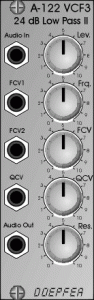
The cut-off frequency determines the point at which filtering takes effect. You can control this manually, or by voltage control (filter modulation, for instance by an LFO). Two CV inputs are available.
The cut-off slope is -24 dB/octave. The circuitry uses a Curtis chip, and is very similar to the classic Oberheim filter sound. Because of its different circuitry and controls, the A-122 has a considerably different sound to the A-120 ‘Moog-like’ filter, especially in the way the resonance behaves.
Voltage controlled resonance: on the VCF 3, resonance can be controlled not just manually, but by voltages as well, right up to self-oscillation. In this case, the filter behaves like a sine wave oscillator.
DATAMASKIN

