
How to make your Moog Voyager sound FAT, overloaded, unstable, about to lose it…etc
This is a simple “overload” trick that’s been posted on the Moog Music Forum for some time now (http://forum.moogmusic.com/viewtopic.php?f=2&t=14154), and the author of this video found it to be really helpful. you totally dont need a distortion pedal if you have a Moog Voyager. The whole thing IS a distortion pedal.
Pictures of the first production Boomstar synthesizer
Studio Electronics has released these photos of the first production Boomstar synthesizer – a Boomstar 4075. Earlier this year, Studio Electronics announced a new line of four Boomstar synthesizers, each with a different style of filter:
- 4075-classic Arp 2600
- 5089-classic Moog 24db ladder
- SEM-classic Oberheim 12db
- 303-classic Roland TB.
The Boomstar synths are priced at $799.
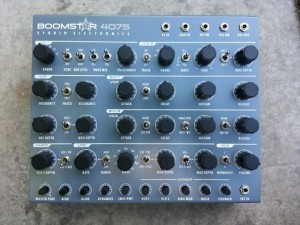
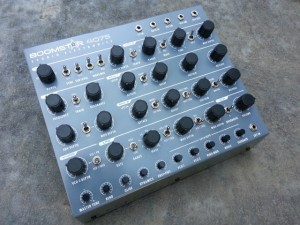
Official Description:
Back to the raw power and purity of non-programmable* discrete analog––where STUDIO ELECTRONICS started in 1985. The snap and punch of hardware envelopes drive the BOOMSTAR’s brilliant voltage controlled circuits with unparalleled sonic integrity and versatility. BOOMSTAR is the ultimate desktop analog synthesizer for those who remember and desire still, the electronic Analog sound that changed the world and for seekers who have yet to discover that magic and delight… in their time.
This new blazing brainchild of STUDIO ELECTRONICS represents the design collective ethos of circuit and software “Saseong” Tim Caswell, tactile layout and lead feature specialist Greg St. Regis, graphic and sound consultant Marc St. Regis, art design wizard of vector truth, John Greczula, cool-headed concept leader Geoff Farr and our relentless and wise feature and functionality consultant, Drew Neumann.
Four Models/Filter types: 4075-classic Arp 2600, 5089-classic Moog 24db ladder, SEM-classic Oberheim 12db, 303-classic Roland TB.
This All-American-Made music machine’s discrete voltage controlled analogoscillators, hand matched transistors in its filters and amplifiers and STUDIO ELECTRONICS’ typically expressive programming feature realizes its name: Earth Grounding Subs to Deep Field Shimmers… BOOMSTAR!
The Foundation Of Synthesis: Control Voltage
Additional videos for this title: http://j.mp/SZauJ3
The Foundation Of Synthesis 104: Control Voltage by The Bob Moog Foundation
Video 1 of 22 for The Foundation Of Synthesis 104: Control Voltage
Marc Dotylead educator for The Bob Moog Foundationis back with a series of tutorials in this course on Voltage Control.
But what is Voltage Control and how do you use it in the world of hardware synths? Well, here’s the story: In the early days of sound synthesis, if you wanted your sounds to change or evolve in any way whatsoever, you had to do it manually. Need the pitch to go up? Grab the the oscillator knob and turn it! Want the volume to change? Again, grab the volume knob! What about sequencing a series of notes? Well, before voltage control, you had to record every pitch onto magnetic tape and cut them all together in the order and rhythm that you wanted. It was hard work to create electronic music way back when!
Voltage control forever changed all that! And in this course Marc Doty shows how different hardware synth designers harness the power of VCs to transform and supercharge electronic music composition. Taken one step further you’ll see how Voltage Control was the mother of MIDI… and we all know how powerful MIDI is!
Bob Moog was an early pioneer and inventor of voltage-controlled analog synthesizers. He revolutionized the music industry and his ideas, inventions and musical instruments have dominated the sound of music for more than 30 years. Aside from being an innovator, Dr. Bob was an outspoken advocate of education. The Bob Moog Foundation, created by his daughter, Michelle Moog-Kousa, continues his legacy with Dr. Bob’s SoundSchool, the preservation of his inventions and the development of the Moogseumthe only museum of its kind dedicated to the advancement of sonic education. We hope you will help support the BMF’s efforts by watching these courses with the knowledge that a large portion of the proceeds go to support their awesome efforts!
So sit back, hit the play button, and proceed on your journey into the Foundation of Synthesis with Marc Doty, and the Bob Moog Foundation. Be sure to watch all 6 of the BMF’s courses on filters, modulation, oscillators, sound design and more!
More info on this title: http://j.mp/SZauJ3
Glow in the Dark Etherwave Theremin
It’s almost Halloween again, time to drink witches brew with creatures of the night and let the unearthly sounds of the Theremin float through the ether. In celebration of the holiday Moog has created a glow in the dark version of their Etherwave Theremin. Play at night and let the unearthly glow guide your hand. Only 200 exist so act quickly.
For more info and available dealers go to:
http://www.moogmusic.com/products/etherwave-theremins/etherwave-theremin-stan…
Alesis and Moog – Analog Collage
A collage of video clips of the Alesis Andromeda A6; Moog Voyager, Little Phatty and Slim Phatty and Ableton’s Operator softsynth. Filter CV modulation by a Moog Multi-Pedal. Step sequencing by Koushion iPad app fed into Ableton Live.
Learn more at www.experimentalsynth.com
Flute Sounds | Moog Little Phatty: Subtractive Synthesis
In this video Arjen Schat demonstrates how to create flute sounds with the Moog Little Phatty. He starts from the calibration patch (CA CALIBRATION) as usual and create a flute sound as he goes.
Vocodrone
Featured instruments in this video:
Alesis Metavox & 3630
Buchla 292e
Line6 FilterPro
Moog CP251 FreqBox MP 201
Oberheim Sem
Roland SVC-350
Logic Ultrabeat Drum
ERUPTION: Moog Voyager 10dencies
10 Moogist Tricks on the Moog Voyager
Tim Tsang, demonstrates that with some modulation, you can turn you keyboard shredding into something much better. Expect explosive flurries of atonal melodic flourishes and timbral mayhem. Using a Moog Voyager, he modulates those pitches into some musical insanity. In short:
- Shred.
- Add pitch randomization with sample and hold (a lot of it).
- Filter the result.
- Hold that key trigger so you can use your fingers for something else. (Here, the Voyager’s X/Y pad.
- Route mod wheel to LFO.
- Route LFO to pitch, add more triggering, timbral modification like FM …and go all wobbly.
Thomas Dolby – Mulu the Rain Forest
• The song “Mulu the Rainforest” from Thomas Dolby’s classic album “The Flat Earth”.
• Shot and Directed by Chad Johnson in August 2012
• © Lost Toy People / Chad Johnson 2012
• Shot with a GoPro attached to the XP2 quadcopter: http://xproheli.com/affiliate/25/quadcopter/xp2-rc-aerial-video-quadcopter
• This video was shot in the Rockefeller Forest in the Giant Redwoods of Northern California.
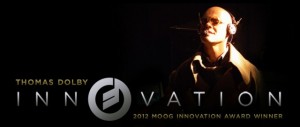
We are also happy to share that Thomas Dolby has won the Moog Innovation Award award this year. Past winners were DEVO in 2010 and Brian Eno in 2011.
Dolby is a self made man, synth pioneer, and mad scientist. Like Bob Moog, Thomas Dolby’s quest for knowledge and desire to sculpt the world around him led him to the world of electronics, where he designed his own synths, founded his own software company, and charged head long through the world of pop music and into America’s consciousness. To say he was blinded by science would be doing him a disservice, for science has been his guiding light, and technology his namesake. For expanding the sonic boundaries of the new wave movement and for fearlessly embracing the future, Moog is proud to present Thomas Dolby with a custom Minimoog Voyager XL, in honor of being the 2012 Moog Innovation Award winner.
Bass Sounds | Moog Little Phatty: Subtractive Synthesis
In this video Arjen Schatt demonstrates how to create bass sounds with the Moog Little Phatty. He starts from the calibration patch (CA CALIBRATION) as usual and create a bass sound as I go.
DATAMASKIN

