
Tres – new monosynth Rack Extension for Reason
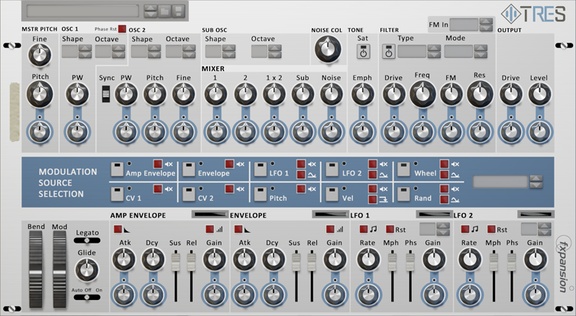
FXpansion has announced the release of Tres, a monosynth Rack Extension for Reason powered by DCAM analogue circuit-modelling technology.
Tres features our powerful TransMod modulation system and a wide variety of timbral flexibility and tone sculpting – a deep two-oscillator synth capable of deep basses, biting leads, strange drones, warped percussion and twisted SFX.
Tres’ modelled VCOs can interact at audio rate to produce complex tones; a filtered noise generator and sub-oscillator round out the oscillator section. A keytracking, time-variant shelf-EQ allows you to emphasize or cut higher harmonics before a switchable multimode filter with huge resonance, self-oscillation, FM, adjustable drive and 3 distinct classic synth filter models. Tres’ final output VCA provides a non-linear analogue drive stage for a variety of tonal colours from warm and smooth to gritty and aggressive.
Most of Tres’ parameters can be modulated simultaneously by any of 10 available modulation sources including Tres’ built-in dual envelopes and LFOs and external CV sources from elsewhere in your Reason project. You can also route external sources for audio-rate filter FM and use Tres’ built-in envelopes and LFOs to modulate other devices within your session.
Tres comes with a comprehensive library of over 200 unprocessed and Combinator patches, developed in conjunction with Nucleus Sound Lab.
Tres is available to purchase for $49 USD / 39 EUR inc. VAT where applicable.
The Chiller – free synthesizer ensemble for Native Instruments Reaktor
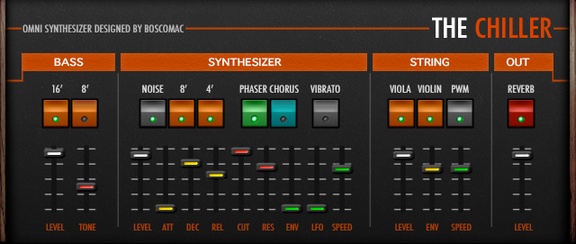
Boscomac has introduced The Chiller, a free synthesizer ensemble for Native Instruments Reaktor.
THE CHILLER is an omni-synthesizer which includes a bass section, synth section and a string section. Inspired by the ARP Omni, it is very easy to use and offers a synthetic orchestra on hand.
The instrument delivers a sound cold, reminiscent of the eighties and the new wave. The bass section is monophonic (active from C0 to C4) and other sections cover the entire keyboard. All sections can be played together.
In the autumn, let’s play with the chiller.
The Chiller is a free download. Donations are appreciated.
Demo of the ROLAND JUPITER-6
The Jupiter-6 is an incredible analog synth. All of the Jupiters have a sound that was unlike any other synthesizer and the Jup 6 is no exception. This sound is due in part to classic analog Roland technology in its filters, modulation capabilities and a thick cluster of 12 analog oscillators at 2 per voice. Easy and intuitive programming via front panel sliders, knobs and buttons for all your tweaking needs.
The Jup 6 is a scaled down version of the Jup 8 in terms of programming and polyphony. However the Jup 6 has some major improvements of its own such as newly added MIDI control and better tuning stability! While the Jup 6 does have MIDI, the implementation is very rudimentary and hard to control. The Jup 6 was one of the very first (along with the Sequential Prophet 600) synths to use the then new MIDI protocol, and the implementation on the Jup 6 is far from complete.
Synthcom Systems, Inc. offers the Europa firmware upgrade for the Jupiter-6 which gives it an up-to-date and comprehensive MIDI implementation. All parameters are controllable via Continuous Controller or SysEx. Europa also features an extensive arpeggiator which will sync to MIDI clock with programmable clock divisors and rhythms, and has about 50 more playback variations than the JP-6’s original Up, Down, Up/Down, and Down/Up. A Europacized Jupiter-6 is a thoroughly modern synth with a classic sound.
The Jupiter-6 is an excellent for ambient drones, pads, blips, buzzes and leads.
Video details:
What kind of music gear do you have?
” musictrack gear ” is now ready to open !!
http://gear.musictrack.jp/news
DEMO by Katsunori UJIIE.
Sonic Potions LXR build and jam with Shruthi-1
Time lapse build of the Sonic-Potions LXR digital drum synthesizer and some messing around with it for the first time. All sounds come from the LXR and the Shruthi-1. The Shruthi is slaved to the LXR and is just playing the equivalent midi notes as the drum sounds. The LXR is being run through a hardwire RV-7 pedal (seen directly north of the LXR). I am sure that this is only scratching the surface of the LXR’s capabilities.
Performance on the PPG wave 2.2 – “Electroplankton”
Vintage synthesizer demo track by RetroSound
“Electroplankton”
all synthesizer sounds: PPG wave 2.2 Synthesizer (1982)
I use the internal arpeggiator for the main sequence.
recording: multi-tracking without midi
fx: reverb and delay
Download free artist sound banks for your NORD Lead 4
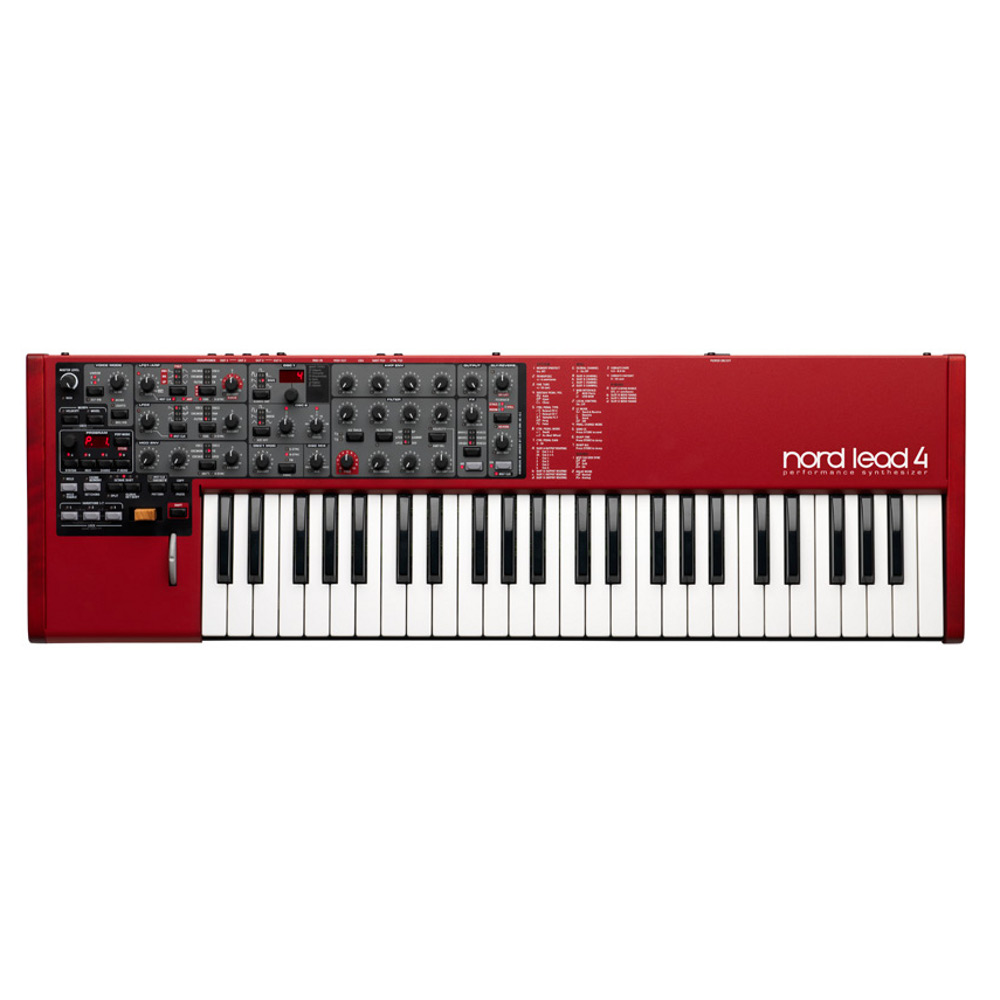
Nord has announced six new artist sound banks for the new Lead 4 and Lead 4R are now available for free download. They tell us that six very different sound designers have created a wide range of new sounds covering everything from classic analogue vintage leads and pads, FM pianos, evil distorted rave basses and complex performance patches with multilayered synchronized arpeggiating monsters and much more.
The sound creators are ASL SoundLab, Federico Solazzo, Åke Danielson, Palle Dahlstedt, Kristofer Ulfves and Ulf “Vinyl” Stenberg.
The sounds are compatible with the Nord Lead 4 and the Nord Lead 4R and are transferred using the Nord Sound Manager.
Free download from the Nord Lead 4 Program Library
iTuttle: New synth for iPad
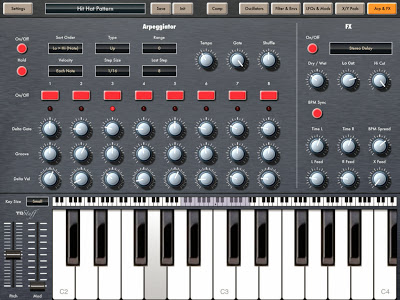
A new synth for your iPad arrives. Here’s what iTuttle is all about:
iTuttle is an Awesome Fat & Warm Subtractive Monophonic Synthesizer. Fat by Design with its 9 oscillators section, all waveforms (but Sinus with oscillators) use generalized PWM (called “Ratio”), so you can tune/modulate the waveform of each oscillator / LFO. Its huge modulations capabilities lets you create a very large sound styles. The arpeggiator includes an 8 steps sequencer and lets you mute, change the gate duration, the groove and the velocity of each step. In addition, you can use the global Shuffle to humanize your arpeggios.
Specifications :
- 9 Oscillators section organized on 3 Oscillator Modes (8 waveforms)
- White Noise
- Full Stereo path (from Oscillators Section to FX)
- 24dB/oct Filter (Low Pass, Band Pass & Hi Pass)
- 3 Envelopes
- 2 LFOs (11 waveforms with Generalized PWM, even with Sinus/Cosinus)
- 2 X/Y Pads
- 8 Modulation Slots (20 Sources and 67 Destinations !!!)
- Arpeggiator with Shuffle/Groove and Step Controls
- Stereo Delay with delay time modulation capability
- Full MIDI implementation
- Background Audio
- Korg WIST support
- User Bank sharing with Mail/Safari
The app is priced at $9.99
Introducing the Well-Sequenced Synthesizer
The Well-Sequenced Synthesizer is a series of sequencers that are designed to be physical interfaces to play with traditional music theory. The sequencers were created by Luisa Pereira, a research fellow at NYU?s Interactive Telecommunications Program. The Counterpointer, below, is a cross between an electronic arpeggiator and a baroque music rule book. It takes a melody input and responds with voices that follow the rules of counterpoint.
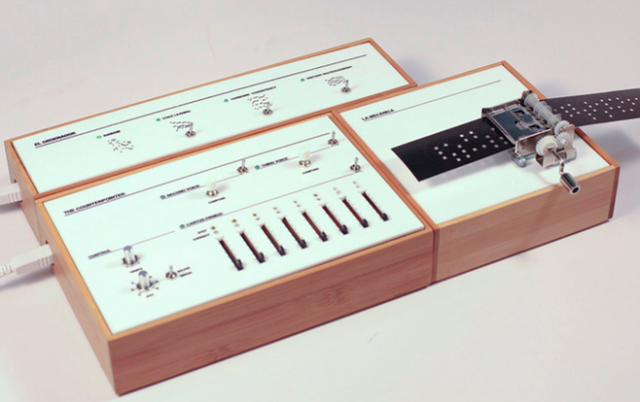
El Ordenador carves chaos into order by applying constraints to randomly generated chord progressions, inspired by the features of tonality described by Dmitri Tymoczko in A Geometry of Music
Oberheim Drumulator Synthesizer Review (Waldorf Micro Q + Novation X-Station 25)
This is an in-your-face review of the Oberheim Drumulator Audio Synthesizer (Waldorf Micro Q + Novation X-Station 25).
This was the first Gluten Free iPad Synthesizer App from 1977.
Roland JD-800 – the 64 classic factory patches
The JD-800 is Roland’s answer to half a decade of hard-to-program synthesizers. Covered in sliders that act as dedicated editors just like a classic analog synth, the JD-800 is an extremely programmable and hands-on digital synthesizer. It is also an interesting and great sounding digital synth with incredible flexibility and control. Internal ROM based waveforms are combined to build your sounds. The sounds are based on Roland’s D-50, but updated for the nineties with multimode filters – uncommon but welcome at the time.
The JD-800 came in a tough metal case capped off on the sides with large plastic covers. Programming may be a little too flexible for some users, but once you know what you’re doing with it, almost any sound you can dream up can be dialed in and stored.
DATAMASKIN

