
Generalmusic S2R – Performance demo
Demos of a few of the Generalmusic S2R built-in Performance patches.
Italian company Generalmusic (also called GEM) was known for producing home organs and semi-professional accompaniment keyboards. But they also made a few attempts at producing professional music workstations. The first of them was the S-Series, introduced in 1992. GEM called it the “Music Processor” because of its many advanced functions, including a powerful sequencer, the ability to read and edit samples, excellent real-time controllers, and many others.
In 1993, GEM upgraded the S-Series with the so-called “Turbo kit” which allowed for many new functions and doubled the polyphony. The Turbo kit was also sold separately as an upgrade for the original models. GEM also released a rack version, called the S2R, with the Turbo upgrade already installed.
There were two original models, with only one difference between them: S2 and S3. The S2 has a 61-note keyboard and the S3 has a 76-note keyboard. Both keyboard models have excellent semi-weighted keys with touch/release velocity, polyphonic aftertouch and metal contacts. On the front panel, there are also seven programmable sliders, seven programmable buttons and Pitch and Modulation wheels. All functions are logically and clearly displayed on a large graphical LCD with light blue neon back-lighting. Thanks to the excellent hardware and also thanks to two MIDI I/O’s, the S2/S3 is an ideal master keyboard for the home studio.
The new Waldorf Rocket desktop synth

Waldorf has announced a new desktop synth – the Rocket.
No one expected this Rocket launch, which is in clear violation of several UN resolutions and basic laws of physics. Unlike conventional missiles, this one comes in a square shape and will be sold world-wide in complete ignorance of German governments exports restrictions.
It’s incredible sound is a powerful weapon of mass destruction, and never before has this been achieved with such an enormous fun factor. It features an analog multimode VCF with lowpass, bandpass, and highpass, resonance up to self oscillation and beyond, a powerful monophonic oscillator section with Ultra High Density Sawtooth and unison for chord play.
Furthermore equipped with a powerful Arpeggiator and a destructive Booster circuit, this Rocket is technologically way ahead of all current defense systems.
Rocket is an ideal fun sound design machine, which in combination with its extremely attractive price, will appeal to any sound designer and musician interested in quality sounds. It works as a stand-alone instrument or in any imaginable music production environment. But its most important feature is of course its sound: a real Waldorf synthesizer, powerful, direct and with a lot of love for the details.
And of course, this Rocket is 100% Made in Germany – With Love!
Specs
- Analog multimode-filter (VCF) with Low Pass / Band Pass / High Pass
- VCF-input
- Highly flexible oscillator-section with pulse width modulation and hard sync
- Up to 8 oscillators in unison for chords or Ultra High Density Sawtooth
- Low Frequency Oscillator (LFO) for modulation
- Envelopes for VCA, VCF and Sync
- Booster circuit to generate aggressive sounds
- Arpeggiator with different rhythmic patterns
- Glide
- USB powered
- MIDI in and out
- Extensive control panel with high-end pots and switches
- Control via MIDI and USB
- MIDI clock sync
- Line output
- Loud headphone output
- Launch key for easy pre listening
Checking out the vintage Oberheim Matrix-1000 synth
A voyage into the heart of the Oberheim Matrix-1000 analog synthesizer from the year 1987.
Exploration by Marko Ettlich (RetroSound)
6 voices
2 oscillators per voice saw, triangle, square variable pulse width, fm
resonant filter 24dB/oct lowpass filter
2 LFOs
1000 sounds
used by Apollo 440, Moby, Fatboy Slim, Depeche Mode, Pet Shop Boys, Faithless and many more
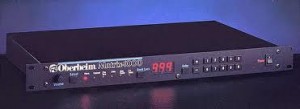
The analog Matrix 1000 is essentially 1,000 Matrix 6 patches in a single-space compact rackmount MIDI module. It has the same synth architecture as the Matrix 6. Each of its 6 voices have two DCO’s (digitally controlled analog oscillator), a low pass filter, 2 VCA’s, 3 envelope gens, 2 LFO’s, and 2 ramp gens. The sounds are plentiful and good enough, however sounds can only be edited via MIDI, so you’ll need an external MIDI editor (such as MOTU’s Unisyn) or Access’ Matrix Programmer to edit parameters. You can also load sounds from the Matrix 6 via SysEx or software.
The Matrix 1000 provides an excellent source of pads, textures and ambient sounds. It has 195 “keyboard” sounds, 118 “strings”, 130 “woodwinds & perc”, 239 “synthesizer”, 119 “bass”, 74 “lead” and 125 “effects”. For the price, there is no better way to find genuine analog Oberheim Matrix sounds in a compact and very in-expensive rack module that is loaded with more sounds than you’ll ever need! The older versions of the Matrix 1000 have a black front-panel. The newer models in the ’90’s have a cream colored face-plate.
Heat Synthesizer for Android – browsing some presets and editing
Heat – Music Synthesizer App for Android, available in the Google Play Store:
https://play.google.com/store/apps/de…
A virtual analogue subtractive synthesizer with online Preset Browser, everyone can share sounds directly from within the app. The synthesizer has full VST integration, use the Heat Android App as a controller for your VST plugin, design patches while on the way and use them later in a VST sequencer of your choice.
Everything you hear is recorded straight from the line out of a Google Nexus 7 Android 4.2 tablet.
For more info visit http://heatvst.com
- Design sounds while on the way, store sounds on your local Android Device or use the Collaborative Preset Manager to store your sounds online, making them available to everyone.
- Control the VST plugin from your Android device in realtime
- See parameter automations from your sequencer in realtime on your Android device
- Use the Collaborative Preset Manager on your Android Device to select from a big variety of sounds, made from other users all over the world. Select sounds on your Android Device, while connected, they are immediately loaded by your VST plugin.
- Use the integrated keyboard of your Android Device to send midi events to your sequencer
1st Techno jam session with a finished Home-made Synth
Background video description:
1st jam with my finished DIY synthesizer.
The additional sounds are generated by another device.
See my other videos for earlier versions of this synth.
—————————————-
https://sites.google.com/site/synthaq…
Subtractor Basics – Micro Tutorial for Reason DAW
Subtractor, the original Reason synth, still packs a punch! In this tutorial we’ll learn the basics of this virtual analog classic by creating a synth bass from scratch. Regardless if you own Reason, Reason Essentials or if you’re just trying out the demo, this should get you started creating your own sounds with Subtractor!
Xenobioz Kruud – New Free Synth For Windows
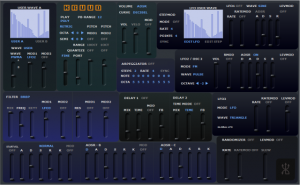
Xenobioz has released Kruud, a free hybrid Synthesizer that offers ‘a lot of modulation capabilities.’
Features:
- 1 Oscillator with low resolution user waveforms, and a few normal waveforms inlcuding
- noise.
- 1 LFO with OSC,FM, Audio rate modes.
- 1 LFO with low resolution user waveforms, and a few normal waveforms inlcuding noise.
- A Randomizer
- 3 ADSRs
- A Filter with 9 different modes
- 1 Delay with tuned mode for physical modelling.
- 1 normal delay
- Both delays can be modulated
- 1 Arpeggiator
- 1 Step modulator
Unleash the Beast – Bit Beast Synth Demo
A demo song of the Bit Beast synthesizer. All sounds (including drums) are made with the Bit Beast and recorded into Ableton Live. Some minor FX were added to some tracks (reverb, delay, EQ).
The Bit Beast utilizes a method of tone generation commonly called ‘bit banging’. It turns a digital bit on and off at the frequency of specific notes. This method of creating sounds is typical of old videogame and computer systems. The processor that reads the MIDI signal and ‘bit bangs’ the notes is the same one used by the Arduino UNO (ATMEGA328P-PU). All the code is written and compiled in the Arduino software. This means that anyone with an Arduino UNO can edit and tweak the code. This will allow musicians to customize their synth to some degree, and expand upon the base functionality.
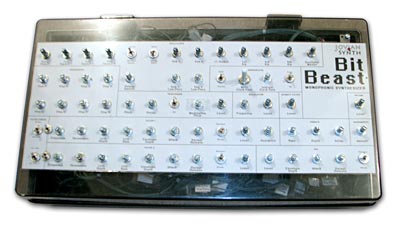
The notes are then chopped up and processed using CMOS logic chips. The effects created are common in the DIY realm, but seldom available in commercially available synthesizers.
The sound then passes through two analog voltage controlled filters. Both filters are unique designs that offer very different sounds. Filter 1 is a 12db state variable filter with low-pass and band-pass modes and overdrive control. Filter 2 is a 6db filter with low-pass and high-pass modes and a squelchy distorted resonance. The filters can be configured in parallel or two different serial configurations. Both filters have their own LFO and envelope generator.
The final step that the sound passes through is an analog VCA with a dedicated envelope generator.
More info on the Bit Beast here: http://www.joviansynth.com/bit-beast.php
The Bit Beast is not currently in production. The estimated cost is about $500-$600. Please send us an email if you would like to be notified when more information and availability is known – info@joviansynth.com
Ade Fenton (Gary Numan producer) loves the Analogue Solutions Vostok synthesiser
Ade Fenton (Gary Numan producer) loves the Analogue Solutions Vostok synthesiser.
Loves the true analogue sound.
This demo features a variety of sound types and sequences (traditional and non-traditional) demonstrating the Vostok’s sound palette and variety of timbres. All sounds, with exception of the obvious acoustic drums (used for context), are created on the Vostok using either traditional patching or the pin matrix — or a combination of both.
Sounds are being driven by either the on-board sequencer, MIDI sync (via GATE to CLOCK), or direct MIDI connection to a controller keyboard.
Emphasis for this video was more traditional synth sounds (basses, leads, sequences) as there are plenty of non-traditional (fx, ambient, noise) sound demonstrations on YouTube. The filter section at the heart of the Vostok was also a focal point of this video and is tweaked extensively for the various sound types.
Also, see the Telemetry (mini Vostok) in action at the following link:
http://www.youtube.com/watch?v=rvo5x5G4YJg
KEY FEATURES OF VOSTOK Pure analogue voice circuitry. Suitcase style design. 22×22 matrix pin panel. Rugged Steel construction. Quality chrome catches and cool steel spring handle. Stuffed full of electronics. No front panel space is wasted. Joystick, retro-VU meter, MIDI, jack socket patch points, more, more, more!
Derek Sherinian with the KORG Kronos Music Workstation and KingKorg Synthesizer
Long-time Korg endorsee Derek Sherinian (Black Country Communion, Dream Theater) performs at Korg’s Winter NAMM 2013 booth, showing off the Kronos Music Workstation along with the all-new KingKORG analog modeling synthesizer. For more information about the instruments, please visit www.korg.com/kingKORG and www.korg.com/kronos. For info on Derek, please visit www.dereksherinian.com.
DATAMASKIN

