
Novation SUPERNOVA II – Arpeggiator synthesizer jam
Background description and details below:
Just got my Novation Supernova 2 so am learning the ropes! What a wonderful synthesizer..
In this video I’m just experimenting with a preset arp patch, some delay and reverb effects, resonance and filters.
Hope you enjoy the jam.
For more demos and music, subscribe to my channel: http://www.youtube.com/synth4ever
Facebook: http://www.facebook.com/synth4ever.music
Eurythmics – Sweet Dreams (Are Made Of This) – Get That Sound
The title track from 1983’s Sweet Dreams (Are Made Of This) album has one of the most instantly recognisable synth riffs around. There have been many different theories about the synths used on it, but the consensus seems to be that either an Oberheim OB-X was used for both the left and right riffs, or perhaps a Juno-6 and Roland SH-09 for the left and right channel riffs, probably sequenced using a Roland CSQ-100.
I guess asking Eurythmics themselves wasn’t an option 😀
NovaDroneLights
The NovaDrone was designed (and continues to evolve) in collaboration with experimental musician and epic visionary Lucas Crane aka Nonhorse and with support from Perte De Signal in Montreal.
The Nova Drone is an open source, analog experimental sound and light synth.
It it can be used to create effects ranging from slowly fading drones to chaotic harmonic sequences. It also functions as a complex visual pattern generator when combined with a digital/phone video camera. See the video below for an example of the color patterns generated by holding a camera up to the LED.
The Nova Drones offers 12 potentiometers, 10 switches, 6 oscillators, 9 oscillator sync inputs, 6 frequency modulation inputs and an epic 15 voltage outputs as well as 3 high current outputs for controlling external LEDs. All of the ins and outs have been routed to a prototyping breadboard at the bottom of the unit which allows for liberal experimentation and development of custom circuits. The prototyping area is especially useful for syncing the oscillators of 2 or more Nova Drones together.
Artemis Synthesizer Overview
A basic overview and presentation of the Artemis Synthesizer built in about a month as a kit for a group of 24 rising high school freshmen enrolled in Boston University’s Women in Technology outreach program called “Artemis”. Made by the Boston University EDF headed by Christopher Woodall (cjwoodall.com and happyrobotlabs.com), and with the support of the BU Physics department.
More info at happyrobotlabs.com
Pictures of the first production Boomstar synthesizer
Studio Electronics has released these photos of the first production Boomstar synthesizer – a Boomstar 4075. Earlier this year, Studio Electronics announced a new line of four Boomstar synthesizers, each with a different style of filter:
- 4075-classic Arp 2600
- 5089-classic Moog 24db ladder
- SEM-classic Oberheim 12db
- 303-classic Roland TB.
The Boomstar synths are priced at $799.
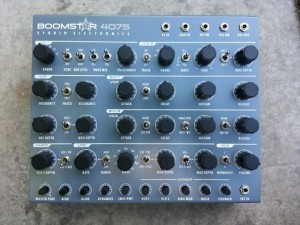
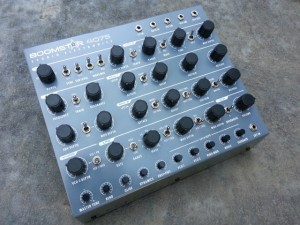
Official Description:
Back to the raw power and purity of non-programmable* discrete analog––where STUDIO ELECTRONICS started in 1985. The snap and punch of hardware envelopes drive the BOOMSTAR’s brilliant voltage controlled circuits with unparalleled sonic integrity and versatility. BOOMSTAR is the ultimate desktop analog synthesizer for those who remember and desire still, the electronic Analog sound that changed the world and for seekers who have yet to discover that magic and delight… in their time.
This new blazing brainchild of STUDIO ELECTRONICS represents the design collective ethos of circuit and software “Saseong” Tim Caswell, tactile layout and lead feature specialist Greg St. Regis, graphic and sound consultant Marc St. Regis, art design wizard of vector truth, John Greczula, cool-headed concept leader Geoff Farr and our relentless and wise feature and functionality consultant, Drew Neumann.
Four Models/Filter types: 4075-classic Arp 2600, 5089-classic Moog 24db ladder, SEM-classic Oberheim 12db, 303-classic Roland TB.
This All-American-Made music machine’s discrete voltage controlled analogoscillators, hand matched transistors in its filters and amplifiers and STUDIO ELECTRONICS’ typically expressive programming feature realizes its name: Earth Grounding Subs to Deep Field Shimmers… BOOMSTAR!
“Time Synthis” a tour inside the Ensoniq SQ-80 Hidden Waves
An electronic piece called “Time Synthis” explores some of the hidden waves of the SQ-80 “Cross Wave Synthesizer”.
Photo slide show of pictures Jack Girouard took showing the steps of the upgrade as well as other shots inside and outside.
“This is an improvisation done on two tracks, (did not use the sequencer, all done live) it’s all SQ-80 sound with a Lexicon MX-300 doing some effect processing. Note: these are patches I’ve created, the upgrade to 1.8HW doesn’t give you a new set of patches, it just gives you 52 more wave types that can be used for the three oscillators. They simply add to the list of waveforms simply as numbers 75-127. The patches used in this video used hidden waveforms 78, 79, 80, 82,”
The SQ-80 is basically a reved-up ESQ-1 with a total of 75 waveforms, a 61-note keyboard with velocity & aftertouch, floppy disk drive for storing patches and sequences, and an enhanced sequencer. Great for organs, analog-type sounds, pads and sound effects. Like the classic ESQ-1, the SQ-80 functions in providing analog-type 4-pole lowpass filtering and editing of digital waveforms. Each voice can combine up to 3 of the 75 waveforms. These waveforms include multi-sampled transient attack waves such as violin bow, plectrum picks, mallet, hammer, breath attacks and percussive sounds. There are also 5 sampled drum sets. Three LFOs are onboard for some pretty wild modulation of the sounds you create or edit. Complete MIDI implementation makes the SQ-80 great for any studio or live use too.
As for playing the SQ-80, it is a dream! Its 61-note keyboard is full, responsive and has polyphonic aftertouch. Polyphonic aftertouch simply means that each key pressed will respond to aftertouch independently of the other keys. The aftertouch can be used to control a variety of modulation parameters such as the LFO. Pitch and mod wheels and plenty of front-panel buttons and a few sliders make accessing and editing fairly easy and hands-on. The keyboard can be split or layered. The pattern-based 8-track multitimbral sequencer is great for creating short to complex sequences live, or in step time with quantization, bounce-able tracks, 60 sequence patterns and 20 songs. And they can be saved to disk along with any patches you’ve created and any SysEx Midi data. Unfortunately, the SQ-80 has no built-in effects. The SQ-80 is certainly a classic analog/digital hybrid of the late eighties which still holds up well today.
Raspberry Pi running Pure Data w/ DR-OM patch
Video from Shawn Greenlee’s first session with the Raspberry Pi running Pure Data.
“I’m running Pd 0.44 (test version) with “-nogui -noadc -alsa” flags + a budget USB audio device, and a Novation ReMOTE ZeroSL as the midi device. Raspberry Pi OS is Raspbian “wheezy.” Note, I’m running from the command line, not from inside the X window system (performance with GUI seems more likely to glitch, at least with my first tests). I did not try headphone jack for audio given initial reports were not good (and presently I’m unable to test HDMI audio).
Pd 0.44 here: pure-data.git.sourceforge.net/git/gitweb-index.cgi
I used notes from Miller Puckette sent to the Pd-list (check September 8 & 9, 2012) and some info. from log.liminastudio.com/programming/running-puredata-on-the-raspberry-pi to get things going.”
DR-OM Pd patch from protoDROM version (Processing+ libPd) available at github.com/s3g/protodrom
blog.makezine.com/2012/09/24/protodrom-prototyping-with-pure-data-and-processing/
DR-OM code for Fluxama iOS app: github.com/fluxama/Drom
DR-OM ready-to-go for iOS: itunes.apple.com/us/app/dr-om/id555409573?mt=8
TANSU Synth DEMO
Released last week, here´s the first demo of the new iOS synth
Description:
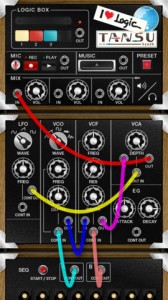
The iOS application – which is named “TANSU (dresser)”, is a miniature
version of a Modular Analog Synthesizer. This synthesizer is the same as the
one used and mastered by Hideki Matsutake of LOGIC SYSTEM.
The sounds that were sampled and used for the VCO (Voltage Controlled
Oscillator) come directly from the actual “TANSU” owned by Hideki Matsutake
himself.
In addition, it also contains many original LOGIC SYSTEM recordings. The
application condenses the fun, experience and sound of an actual modular
synthesizer onto the small screen of an iPhone!!
What will the sound be like when using the application? This application is
focused on providing the user with the feeling and excitement of using the
actual synthesizer for which it is based.
Not only for a techno fan, but for any music lover!! Feel what it is like to
create your own music!!
Try this application to experience the “the birth of sound and music.”
Impaktor Drum Synthesizer app for iPhone & iPad with Drum Sticks! – Demo and Looping Jam
Impaktor for iPhone and iPad (universal app) is a drum synthesizer that you trigger with your device’s built in microphone. The app is EXTREMELY accurate in perceiving the volume (velocity) of the notes you play, and even can trigger different tones from the synth with different sounds. “The real acoustical impulses from the built-in microphone are used as an excitation source for advanced sound modules that simulates behavior of membranes, cymbals, metallophones or strings. This makes Impaktor a highly responsive and expressive instrument.”
DSI Mopho x4 Demo with Peter Dyer
Checking out the Dave Smith Mopho synth, details below:
Special thanks to Peter Dyer! Peter Dyer plays keyboard for Mariah Carey, Aloe Blacc, Van Hunt, and others. More info at: www.peterdyer.net. Available in 1080p HD. Peter demonstrates some Mopho x4 factory sounds. Drums provided by Tempest, some effects used where noted.
DATAMASKIN

