
New free VST – the Kassiopeia
Dual Line Phase Distortion Synth.
Features:
– Casio CZ Inspired Dual Line Phase Distortion Synthesizer
– User selectable 1-8 Note Polyphony
– 6 Graphic 16-stage Envelope Generators with Stage Looping, Independent Stage Contouring and Key Follow
– 2 Pitch LFOs with Delay and Contoured Fade-In
– Reverse Routing Multi-timbre Ring Modulator
– Variable Noise Generator
– User Adjustable Key Scaling
– Stereo Reverb
– 2 Independent Cross Feedback Delays
Stout’s favorite tools
Musician and sound designer Jim Stout talks about some of his favorite tools for sound design, including the Open Labs NeKo and the Korg Kaoss Pad.
Rare stuff from the Cure

The Cure have launched a special standalone website dedicated to the upcoming “Disintegration: Deluxe Edition” that features videos, liner notes and photos plus streaming audio of 20 additional demos and live tracks that won’t be featured on the 3CD set which is to be released on June 8. The additional set got the name “Alternative Rarities 1988-1989, the collection of unreleased tracks” and is an extra to the 20 outtakes which will be appearing on the upcoming reissue (to be released as a 3 CD deluxe edition, digital download, and a double gatefold vinyl). Head for www.TheCureDisintegration.com or download right here.
The complete set features 13 of Robert Smith’s home and full band demos, three studio mixes and four live cuts, including a recording of “Faith” from a 1989 concert in Rome. The rest of the tracks are songs that ended up on “Disintegration”, that became B-sides or that are leftover session material, including a different version of “Delirious Night” which appears on the deluxe edition. Also added are 2 previously unheard full-band jams: “Tuned Out” on RTV5″ and “Fuknnotfunk”, an odd foray into funk.
Music notation classic
Lilypond is something of a cult secret in music notation circles. It’s free software for high-quality computer engraving, it runs on any platform (Mac, Windows, Linux), and it produces exceptionally good-looking output, often exceeding leading commercial programs in particularly tricky notational situations. But it could easily scare off beginners, because it isn’t necessarily graphical software. The tool generates its output from text files, a bit like the way in which a Web page is rendered from an HTML file.
Here’s a video illustrating who’s been participating develop Lilypond.
The inspiration for LilyPond came when two befriended musicians got annoyed with the bland and boring look of computer print-outs. Every musician prefers reading beautiful music, so couldn’t we programmers solve that printing problem?
LilyPond just does that: it prints music in the best traditions of classical engraving with minimum fuss. Don’t waste time on tuning spacing, moving around symbols, or shaping slurs. Impress friends and colleagues with sharp sheet music!
John Foxx plays live at Roundhouse electronica festival Short Circuit
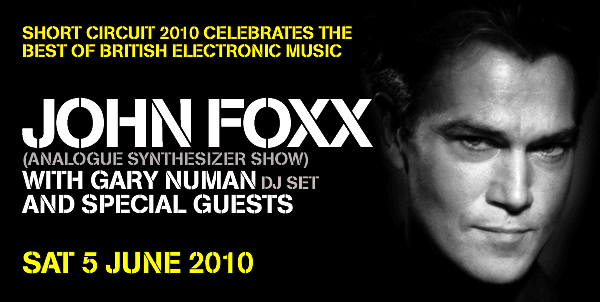
John Foxx will perform a unique analogue synthesizer show to mark his 30th anniversary as a solo artist. He and a one-off group of special guests will assemble on stage for the first time with the machines used on his 1980 debut solo album, Metamatic – the Moogs, ARPs and drum machines that created the sound of the future – to perform material from Metamatic and a selection of early Ultravox music. Also former Ultravox guitarist Robin Simon has been confirmed as special guest to perform on a selection of material including songs from the band’s pioneering 1978 album, Systems of Romance.
The set will also include brand new material created in collaboration with Paul Daley from Leftfield, along with new songs by John Foxx & The Maths – an all-analogue synthesizer project with London-based artist Benge.
Equipment list:
Synthesizers and Sequencers:
ARP Odyssey x 2
ARP Sequencers x 2
Crumar Multiman
EDP Wasp
Korg MonoPoly
Korg 700
Logan String Machine
Moog Mini x 2
Moog Modular plus Sequencers
Moog Opus 3
Roland Modular System 100m x 10 Modules
Roland SH2
Roland SH-101
Roland Juno 60
Sequential Circuits Multitrack
Drum machines:
Amdek Percussion Synthesiser
Boss Dr Rhythm
Linn Drum
Klone Drum
Roland CR78
Roland TR808
Creating audio effects in Ableton Live
This video takes a look at the Ableton Live audio effects rack.
This is part one of a planned video series that will show you how to use each each of Ableton Live’s built-in effects.
Wii Nunchuck controlled Korg Monotron synthesizer
This is nice – Wii Nunchuck controlled Korg Monotron synthesizer:
My second attempt in circuit bending the monotron. You can control the monotron with Nunchuk’s accelerometer and analog stick. I used todbot’s WiiChuck adaptor to connect the Nunchuk to the Arduino. http://www.sparkfun.com/commerce/product_info.php?products_id=9281
The WiiChuck Adapter is a small PCB that is designed to be inserted into the connector of a Nintendo Wii Nunchuck to provide access to all 4 wires of the remote. The power, ground and two-wire interface of the Nunchuck are all broken out to a 4-pin 0.1″ pitch header.
So what is Master Linn up to?
Roger Linn posted this sneak preview of an amazing new musical instrument prototype – the LinnStrument – that features a multi-touch pressure sensitive control surface:
My particular interest is in a new instrument that while capable of entirely new sounds and playing techniques, is also able to reproduce the sounds, virtuosic performance capabilities and subtleties that we’ve come to know and love from traditional musical instruments, but without all their problems and limitations.
I’ve come up with a prototype of an instrument design that I like.
The prototype consists of a multi-touch, pressure-sensitive, high-resolution USB touch surface from a company called TouchCo (details below), plus a Max/MSP patch written by me and my wife Ingrid, and an OSC/TUIO driver written by a friend and fellow music/art/technology enthusiast named Tim Thompson.
Linn writes:
I came up with this design in 2006 and development has been slow because my small company has limited resources to develop such a complex product. (Any interested investors?)
Also, there aren’t many musicians who see anything wrong with current instruments, so not too many people would buy it anyway. A key expense is in developing a multi-touch, pressure-sensitive, high-resolution, fast-response, low cost touch surface technology.
Then in 2009, a new company called TouchCo introduced a technology for a multi-touch, pressure-sensitive, high-resolution input surface that’s also very low cost, quoting $10 per square foot in high volume. In fact, I’m using one of their technology evaluation units for the input surface in the video above. Unfortunately, Amazon bought them in January 2010 in order to add touchscreen technology to Kindle, then immediately shut them down and took their product off the market.
Alas, until someone else comes up with a similar touch technology or Amazon decides to make the TouchCo technology available, development of our product will be limited to refining our Max/MSP patch. One promising new technology we’ve evaluated is a touchscreen from Stantum (same company as JazzMutant, makers of the Lemur) that senses surface area of your fingers, which is not a bad alternative to sensing pressure because your finger surface area increases as you increase pressure. However, I found that their current resolution wasn’t high enough for what I’m trying to do, plus true pressure sensing is better for musical control.
So given this situation, I decided to call this a research project and publish what I’ve done so far in an effort to get more people interested in and thinking about new musical instruments. Maybe even Jeff Bezos will read this and see that in the grand war between Kindles, iPads and Android tablets, it wouldn’t be such a bad thing to permit some sort of controlled usage of the TouchCo technology.
Note that the demo above is a prototype – see the image below for an idea of what a finished LinnStrument might look like:

Got apetite for some more vocoder demos?
Continuing on the vocoder theme hare a nice demo of the Roland SVC-350 together with a Roland Juno 60 and Roland TR-808.
The Bloo free VST
The blooo
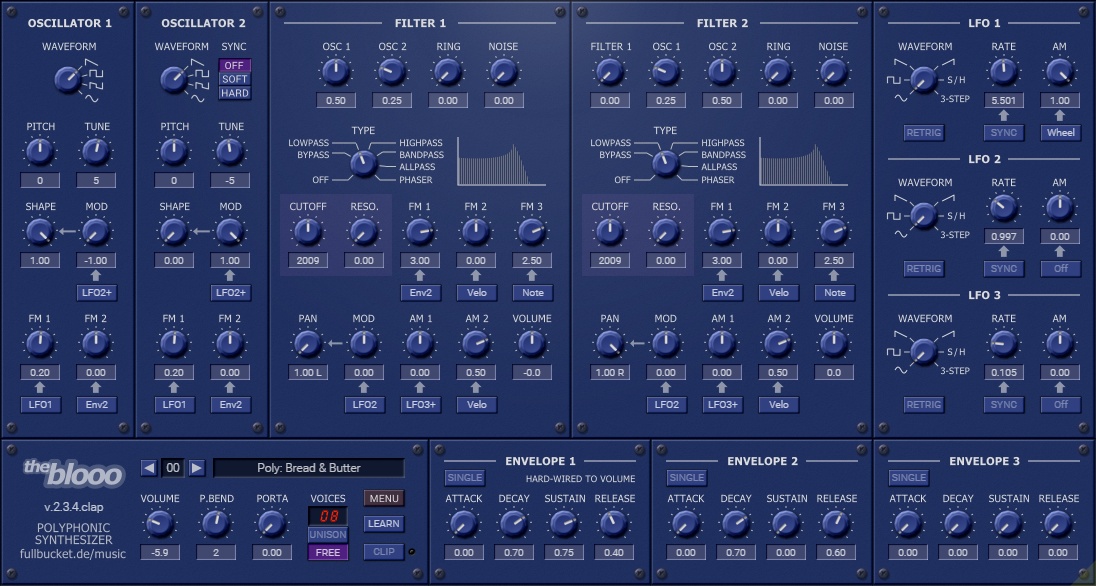
The blooo is a VST™2.4 polyphonic software synthesizer plug-in based on the classic subtractive synthesis architecture. It is written in native C++ code for high performance even on “lighter” systems. Main features are:
- Up to 32 voices polyphony including portamento
- Two band-limited oscillators including Ring modulation and hard sync
- Four oscillator waveforms (sawtooth, pulse, sawpulse, sine) with shape control
- Additional white noise generator
- Two multi-mode four-pole filters (lowpass, highpass, bandpass, allpass, phaser) with resonance and panorama control
- Three envelopes (ADSR) with exponential slopes
- Three low frequency oscillators (LFOs) with tempo synchronization
 Download the blooo Version 1.0 (ZIP file)

DATAMASKIN

