
Diamonds are forever – Interview with Johan Kinde, Lustans Lakejer
Stereoklang got an exclusive interview with the legend in Swedish new wave, glam rock, and synth pop – Mr. Johan Kinde. The frontman behind the cult band Lustans Lakejer (in English it would be something like “the lackeys of lust”). LL has been around since the early 1980’s and their music has always dealt with the passions in life, at least from a male perspective; women, champagne, love, dreams, passion, forbidden fruit, but at the same time with a glimpse in the eye and you can sometime sense that there is a backside to the life of a playboy. Johan and LL has made a long list of classical songs over the years and even had collaborations with some of the members in the UK cult band Japan (Mick Karn and Richard Barbieri). Stereoklang wanted to catch up with Johan now that LL has a new album out and they are ready to hit the road again.
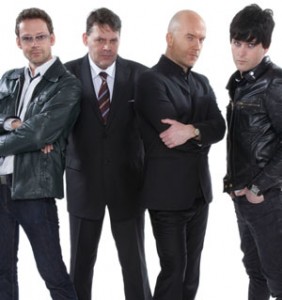
How has the new record been received and are you happy yourself with the result?
“Absolutely!!! The record has been receiving great reviews and has actually climbed to the highest position in the album charts relative to all previous LL albums. Now we are so eager to tour with the new album all across Sweden.”
The album for those of you have not heard it yet, is to us an album that takes LL back to its roots, with the synthesizers more in the front, a more electronic touch, but still flirting with sounds found on more recent works like Åkersberga for example.
“In a sense you can say that we really had this ambition from the start, to write more hip songs that are more immediate and perhaps shorter, kind of more fit to be synthesizer based. We wanted them to be more up-tempo songs with more bass sounds. We even had a version of the album that was even more “synthish” – kind of like LL meets Depeche Mode. The Swedish synth pop act SYSTEM even made a remix of the song “Eld och vatten”, it was almost as if Vince Clarke had been involved.” More over having Jenny Silver singing a duet with Johan almost gives it kind of a “Fade to grey” – kind of feeling.
“As I see it the synthesizers actually won the war over the rockers. Just listen to today´s music scene where synths are more important then ever – Lady Gaga just to name one, even though the traditional “synth music” became more of a niche scene. I think this partly because they just became carbon copies of bands like Depeche Mode – for that reason I found it more interesting when the electro wave came about.”
So what synthesizers can we find on the new album?
“It is a combination of hardware and software synths.” Johan let us know that he is not very much of a synthesizer guy at all, even though he sometimes gets the lust of acquiring some of them. On the new album, however, you will find the KORG Polysix on almost all of the songs (played live in the recording sessions), coupled with some vintage modular synths kindly supplied by P. Levin from System. The fact that Johan plays most of the instruments himself on the album (not being a true keyboard guy), synthesizers and guitars, gives the album a more natural feeling and not too perfect, a live feeling kind of.
The lyrics has always been a central piece in the works of LL, so we asked Johan for the real story behind the lyrics
The life of a romantic – is probably the best description you can give to the works of Johan and LL, but are they true stories or just dreams? “Most of it is actually self-experienced. Often people say that in the early days it was dreams, but now it is self-experienced, but the truth is more that in the early days I did experience the things I was writing in my lyrics, but PERHAPS I dressed it in words that made it sound better than it was ☺.
Duel: Robots
Fun with SK-5
This is a circuit bent Casio SK-5 by Tablebeast, my first bought bent item, seven years ago now. The intro tinklings come from a Casio VZ-1 on the guitarsichord patch. I think it sounds like a Rhodes, aka John Paul Jones. Korg Koass pad looping a modular sound, reminds me of Trey from Phish loop he uses.
All other sounds from the Casio SK-5, sorry that my stupid mixer settings muddied up the wonderful low tones generated by the SK-5 in bend mode play. 
Via ISOTROPOSPHERE
PR8 – pattern-based drum machine that runs on a Nintendo Entertainment System
PR8 is a 6-track, pattern-based drum machine that runs on a Nintendo Entertainment System, designed and created by Neil Baldwin. PR8 is unlike any other NES music application in that it uses ‘virtual’ tracks that are not explicitly linked to any hardware voice. As a consequence, sounds in PR8 (and by association, each Track) are able to simultaneously use any combination of all five of the NES’s sound-generating voices and a simple priority system is employed to dynamically determine which of the 6 tracks have control over them. Even though PR8 is referred to as a ‘drum synth’, it is also possible (and quite easy) to create melodic instruments and patterns, though the entry and editing of musical notes is a little more abstracted if you’re used to traditional sequencers or trackers. Because of this rather radical approach, the learning-curve for PR8 might be a little steep but patience will reward you with a pretty unique and fun way to create NES music.
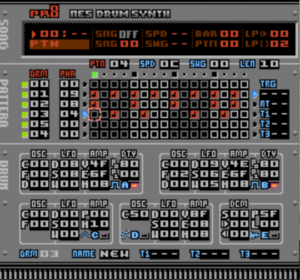
Amazing drum machine-like softare PR8 for the NES has been finally released! Neil Baldwin’s long awaited new software, running on Pulsar’s engine, has seen its first public release in a romantic today. Only two emulators run this baby so you better get your NES and Powerpak ready for proper action!
Snapdragon – modular synth ambient music
Apart from being a nice ambient video, here’s what they have to say about it:
4 melodies generated from Numerology software to a MOTM 650 MIDI-CV converter and selected with a DIY switcher. Mostly synthesizers.com system with Modcan VCDO and Digital Delay, MOTM 440 filter and MegaOhm Delta filter and Suit and Tie Guy Wavefolder. Music, including Drumaxx drums generated in real time, no edits or overdubs. Noisy sounds generated mostly by cross-FM’ing filters. This is my first HD video with new cameras and lights with some effects from Final Cut Pro all in a new bigger studio space. Thanks for watching!
Simple and easy to use drumpad controller for your iPad
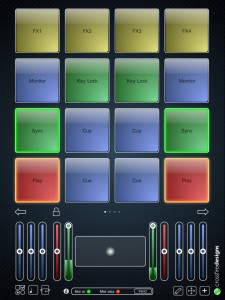
Crossfire Designs has released MidiPads, a simple and easy to use drumpad controller for your iPad.
It sports 16 drumpads on four pages. The bottom part is fully configurable by the user with resizable touchpads and sliders. Both sliders and touchpads support snapping to a value and fading to the touch position (duration user-configurable). One very unique feature is the drumpad-integrated X/Y-controller: Change your instruments’ or your effects’ sound just by moving your finger while still triggering – very useful also for DJ software like Traktor Pro (see video in App description to see how it works).
All elements can be edited by the user: Color, label, Midi channel, Midi CC can be changed for each element individually. Both sliders and drumpads can receive incoming Midi values: Sliders act as VU meters, drumpads glow depending on the incoming value.
MidiPads supports USB Midi over the iPad camera connection kit and network Midi – take your iPad on stage and trigger your music wirelessly! Included is also an extensive manual which helps you to set up all connections and configure MidiPads.
MidiPads features
- Supports USB MIDI over iPad Camera Adapter.
- Supports network MIDI over WiFi.
- All elements customizable (color, label, Midi channel, CC/key, range…).
- Bottom part fully customizable with resizable touch pads and sliders.
- Four pages with 16 touch sensitive drum pads each.
- Several modes to influence velocity: Two-finger-tap, vertical pad position, rand ndom velocity, and min and max velocity always definable.
- Touch pads and sliders support snapping and fading.
- Use drum pads as tap or toggle buttons, either in key or CC mode.
- Drum pads can act as X/Y controller and pad at the same time.
- Sliders can act as VU meter and slider at the same time.
- Drum pads can show incoming values (e.g. that a sample is on that pad).
- Gravity controller (use iPad’s rotation axis as controller).
- Lock mode hides all elements that would hinder your performance.
- Supports all 16 midi channels (for each element separately!)
- Drum pads can blink on incoming midi sync and hence support you with the beat.
- Extensive help covering connection, editing the user interface and troubleshooting (tap i-symbol).
MidPads is available to purchase on the iTunes App Store for the introductory price of 4 EUR / $5 USD.
More information: Crossfire Designs / MidiPads
TinySID on a 16 bit PIC
Ater successfully getting the TinySID library running on a PIC32 [1] some time ago, I recently wondered, if the 16 bit MCUs from Microchip would also be fast enough to run the code. It turned out, that they are, at least the 40 MIPS models (PIC24H and dsPIC33F).
A big hurdle is the (compared to the PIC32MX) small RAM on these chips. Since the SID tune must be loaded into RAM, only some small tunes will fit into the 8 kB of the MCU used on the Web Platform [2] I had at hand.
However, the source code [3] and binary [4] are available from Google Code. The PWM output is on IO7, and IO8 is used to switch the tune when pulled to GND.
Have fun,
Markus
[1] http://www.youtube.com/watch?v=ZNu0-M…
[2] http://dangerousprototypes.com/docs/W…
[3] http://code.google.com/p/dangerous-pr…
[4] http://code.google.com/p/dangerous-pr…
Via markusgritsch
Concretedog’s BLARP CMOS Synth
Here’s what he has to say about it:
A quick video of my new build “BLARP” a small portable perfboard based synth instrument built mainly using CMOS 4000 series IC’s.
Been working on this synth for a while and it’s finally finished. Its mainly made from CMOS 4000 IC’s and is designed to be portable and noisy! It’s a modular system and uses trimpots and header sockets instead of pots and patch cables, this has 2 benefits, cheapness and smallness. More information about the synth here.

Code 64 – Progenitor
Our home made video for Progenitor, taken from the album “Trialogue” released on Progress Productions
Via code64music
Korg iMS20 controlled by Korg Legacy MS20 hardware
If you have a old Korg Legacy MS20 USB controller in a cupboard then dig it out and dust it off because it works as a 1-1 controller with the Korg iMS20 iPad app – no joke. Even patching with physical cables on the controller is mirrored on the iMS20 app. Caveats: naturally you need the Apple USB iPad adaptor but you also have to connect the MS20 controller via a powered hub. Not all powered hubs seem to work with this combo so try a few. Please don’t ask me where to get the MS20 controllers from, they went out of production about 5 years ago.
Of course you’ll need the Korg iMS20 app (v1.1 or higher) running on an iPad with the Camera Connection Kit – which includes the requisite USB adaptor. To be honest initially it wasn’t exactly plug n’ play and it took me a few attempts to to get the iPad to recognise the MS20. The reason for this is that iPad wont let you use any external MIDI hardware that draws more than a minuscule amount of power but the MS20 controller needs quite a bit of USB juice. Unfortunately the MS20 doesn’t include an external PSU socket so you’ll need to use a powered USB hub as a bridge between the two. I’m not entirely sure why but it seems not all powered hubs are equal to the iPad (or the MS20) and it wasn’t until I tried my third hub (a small Belkin unit) that the iPad recognised the controller. Actually there’s a free App called MIDI Monitor that can be useful in these situations.
DATAMASKIN

