
Chipslapper for Reaktor
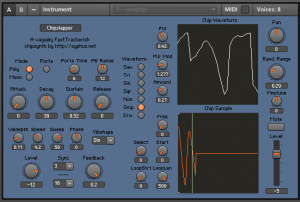
Chipslapper is a new instrument for Reaktor, here’s what the maker has to say about it:
Sure, the world probably doesn’t need another simplistic, single-osc Reaktor synth, but I made this specifically to mimic the behaviour of so-called ‘chipsamples’ in ProTracker, FastTracker2 and similar trackers.
Traditionally, since the late ’80s, tracked chipmusic has been created by looping short (~32byte) samples which the tracker automatically uses as pitched instruments. Effects are applied using hex commands and more advanced trackers had extended instrument options which emulated the behaviour of basic synths.
Anyway, purely for my own work, I wanted to have a straightforward, cross-platform means of composing using my old tracker styles/technique in newer DAWs like Ableton Live. If it’s useful to any other afficionados, great – but most people will just find it to be a very dull synth that looks like a Reaktor beginner’s project 😉
Features etc:
- Drop the polyphony in Reaktor if you want to emulate XM channel-count limitations, or switch to mono and use the severely restricted delay controls to mimic pattern-delay.
- Vibdepth (pitchmod vibrato) behaves in the FT2 way, with sweep delaying the effect and phase allowing you to turn the triangle waveshape into FT2’s two optional sawtooth shapes.
- Pan has a Random Range control which, when twiddled, means each successive noteon event will be given a random pan position within that range. This is the closest I can be bothered to get to FT2’s pan envelope, as it wasn’t synced with the song anyway…if you want proper panning envelopes for phrases of notes, do them in your DAW!
- One thing which definitely doesn’t appear in FT2 or PT is the pulsewidth modulation. However, I often use a bank of around 8 squarewave samples with varying pulsewidths and then cycle through them over the course of a melody line: the pulsewidth mod emulates *that* trick, which in turn was always supposed to emulate pulsewidth mod 😉
- Chip Waveform – draw it yourself. This is a bit flakey and doesn’t seem to save the shape if you switch waveforms to something else and then back again.
- Chip Sample – I’ve included a single small looping sample which *hopefully* gets included with the .Ens (if not, I need to figure out how), but the idea is just to load in a short sample and then play it like an instrument. Because Reaktor isn’t as limited as PT/FT2, it’s slightly less fun to use…but you can experiment with longer samples too and play around. ‘Select’ chooses between samples in the sample map, so I guess you could load in a tonne of samples and then automate the Select knob in your DAW to get a wavetable thing going on…
- Arpeggiator – There isn’t one. Real musicians write their own arpeggiations; proper oldschool chipmusicians, even more so 😉 But if you’re really keen on abdicating compositional responsibility, your DAW probably has an arpeggiator built in as a MIDI effect. Go nuts!
Download it here.
Electronic music: HAUJOBB | Dead Market [official video]
Haujobb is a German musical project whose output has ranged drastically within the electronic music spectrum, from electro-industrial to IDM and techno. They have become a staple crossover act, bringing several forms of electro into the mainstream industrial music world.
More info:
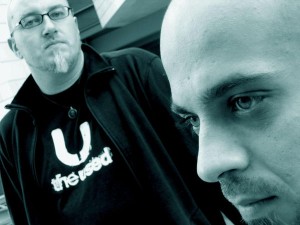
Haujobb was formed in 1993 by Daniel Myer, Dejan Samardzic, and Björn Junemann, pulling the name from the Blade Runner translation of “skin job”. They were soon signed to Off Beat, and began distributing their music in North America via Pendragon Records. 1995 saw the departure of band mate Björn, and the lineup has consisted of Daniel and Dejan ever since. After Metropolis Records acquired Pendragon, the two musicians have been able to spread their music to a larger fanbase in North America, and have remained continuously popular in the European industrial music scene.
Over course of their subsequent releases in the 1990s, they wove increasing amounts of drum’n’bass and IDM influence into their sound. 1999’s ‘NinetyNine’ was a sparse, downtempo collection of ambient electronic compositions. They have since reintroduced some of the more rhythmic elements back into their sound on their more recent albums, but have continued to experiment, drawing concepts from a wide variety of musical styles.
Director: Boris May | Director of photography: Dominik Kuhn
http://haujobb.bandcamp.com/album/dead-market
http://haujobb-music.com
Inside the KORG Kronos manuals – system approach
“This is Part 1 of our video manual for the Korg Kronos Music Workstation, focusing on basic navigation. For more details, please visit www.korg.com/kronos.”
Kronos Highlights
* 9 Sound engines, each offering a unique sound-creation technology (see list below)
* 16-part Combis allow all engines to function together in perfect harmony; Dynamic Voice Allocation keeps the polyphony high.
* Available with 61, 73 or 88 keys. The 73 and 88 key models feature Korg’s finest RH3 Graded Hammer Action. The 61 key model borrows the responsive synth action from the Korg M3-61.
* Comprehensive interface, based around a new large 8” TFT TouchView™ display
* Virtual Memory Technology (VMT), aided by a fast SSD (Solid State Disk) provides high polyphony and massive, ultra-long, and unlooped samples; offering unheard of performance from a hardware instrument
* Smooth Sound Transition: this often-requested feature allows held or sustained notes to keep sounding when changing sounds or modes.
* Set List mode: Organize the Programs, Combis, and Songs you need to perform your set in a single, easy-to-select screen – including performance notes!
* Use up to 16 premium-quality effects at once; individual effects rival dedicated units
o 12 Insert effects
o 2 Master effects
o 2 Total effects
* On-board sequencer offers 16 MIDI tracks + 16 audio tracks (24-bit, 48kHz recording quality)
* Open Sampling System – Instant sampling and resampling from any mode: Program, Combination or Sequencer.
* Sophisticated KARMA® technology generates infinitely variable performance-driven phrases, musical effects, and backing tracks to catalyze your creativity
* Expanded Drum Track for play-along grooves and inspiration
* Signature sounds created with guidance from world class musicians
The most portable MIDI system ever
…at least Line 6 is claiming this
Learn more about MIDI Mobilizer™ and compatible MIDI Mobilizer apps at at http://line6.com/midimobilizer
The only one of its kind, MIDI Mobilizer™ is the most portable MIDI system ever. Connect it to an Apple® iPhone®, iPad®, or iPod touch® to play, record, and backup MIDI information any time, any place.
Software developers around the world have been producing amazing apps for use with MIDI Mobilizer™. All of these are available now on the App Store™, and more are being added all the time. http://www.apple.com/iphone/apps-for-iphone/
Classic Roland drums processed with an Ensoniq DP/4
TR-SONIQ is a collection of classic Roland drums processed with an Ensoniq DP/4. Apart from the 318 WAV files there are ten ready to use kits for Fxpansion Geist and Guru, Native Instruments Maschine and Akai MPC.
Once upon a time, there was an innovative American company called Ensoniq that quickly gained a reputation with affordable samplers such as EPS and ARS. Ensoniq was a bit like that kid you were sitting next to in school who did everything in his own way. Not clean and stylish as the Akais or as sophisticated as the Emus. But that was a long time ago and since then Ensoniq got bought up by Emu, and Emu got bought up by Creative – who unfortunately haven’t done much real caring for either brand.
While many producers (mainly hiphop producers) still treasure their ASRs for their coloring of sound – our favorite feature of the EPS and ASR samplers is without a doubt its effects. The Ensoniq DP/4 is a dedicated effect with four separate effect units you can set up as four individual sound processors, or create series of complex chains.
Ensoniq meets Roland TR909, TR808 and TR606
TR-SONIQ is the result of combining the classic sounds from the well-known Roland drum machines TR909/808 (and also some from the underrated TR606) with the sonic capabilities of Ensoniq. It must be said that the Ensoniq effects were never subtle and with this collection of sounds we wanted to capture the spirit of Ensoniq. The dirt, the noise, the odd cut-offs, the distortion, the compression – the whole lot – all over the place.
The Buchla goes chip á la C64
Using the 259e for C64 style music. Full length audio at soundcloud.com/7thdansound/bitsandbuchla
The Buchla 259e:
Popular demand does work occasionally – we’ve resurrected and renamed the original 259e Complex Waveform Generator. The new 259e is practically identical to the original, and is replete with all of the original digital waveshaping, aliasing noise, and foldover frequencies. However, we’ve added new self-modifying, screeching, snarling responses that reflect weird internal origins. Hence the name “twisted”.
Otherwise similar to the 261e Complex Waveform Generator, with voltage-controlled modulation of pitch, amplitude, and timbre, both hard and soft synchronization, and pitch tracking.
In conjunction with the model 225e MIDI Manager, the 259e’s pitches respond to internally routed MIDI messages. Up to four 259’s can peacefully co-exist in a single system, each with its private MIDI channel.
As in all 200e series modules, the settings of the 259e’s pots and switches can be memorized as a part of a preset configuration. Provided you have a 225e or a 206e in your system.
Roger Linn goes Bach on his new prototype
Roger Linn performs “Air on a G String” by J.S. Bach on his prototype of the LinnStrument, a new musical instrument with 3D Note Expression, coming from Roger Linn Design.
destrOrgan – breakable anti-stress organ for the iPhone
DestrOrgan, the destructible anti-stress organ!!
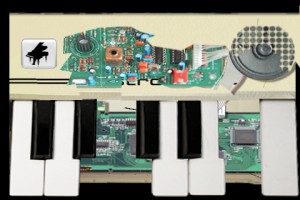
If you don’t like the sweet sound of piano, cats, dogs and flatulence… DESTROY IT!
Features 13 playable keys, 4 Instruments and over 70 Breakable parts!!!
Pricing and Availability
DestrOrgan is available in the App Store for $.99.
Link:
Powerful modular system in operation
Here is a quick video of the MacBeth Mk1 ‘Majestic 12’ System in operation. It’s basically four Analogue Syntrhesizers in one! Each synth features 3 x VCOs/1 x Mixer/1 x 24dB/Octave Transistor Ladder Filter/1 x 12dB/Octave State Variable Filter and 2 x Dual Envelope Generators with built in output VCAs.
This was recorded directly into the Canon 60D that I use- and on edit- as scene fades into scene- the sounds overlap a bit.
The sequencer here is an ensoniq ASR-10- a fantastically easy sequencer to use. Also used is a four channel MIDI to CV converter- a Kenton Pro4.
It’s a short vid- shot in HD, hence the size!
Fairlight Demo “TRON” at CRAS
Presentation at The Conservatory of Recording Arts and Sciences with Jeff Harris demonstrating the Fairlight CMI as used on the movie TRON.
The Fairlight CMI was a development of an earlier synthesizer called the Qasar M8, an attempt to create sound by modeling all of the parameters of a waveform in real time. Unfortunately, this was beyond the available processing power of the day, and the results were disappointing. In an attempt to make something of it, Vogel and Ryrie decided to see what it would do with a naturally recorded sound wave as a starting point. To their surprise the effect was remarkable, and the digital sampler was born. In casting about for a name, Ryrie and Vogel settled upon Fairlight, the name of a hydrofoil (named in turn after Fairlight, New South Wales) that sped each day past Ryrie’s grandmother’s large house in Point Piper, New South Wales, underneath which Ryrie had a workroom.
By 1979, the Fairlight CMI Series I was being demonstrated in Australia, the UK and the US, the latter country covered by Bruce Springsteen’s concert sound engineer Bruce Jackson, once Ryrie’s neighbour in Point Piper. At this time the sound quality was not quite up to professional standards, having only 24 kHz sampling, and it was not until the Series II of 1982 that this was rectified. In 1983 MIDI was added with the Series IIx, and in 1985 support for full CD quality sampling (16 bit/44.1 kHz) was available with the Series III.
The Fairlight ran its own operating system known as QDOS (a modified version of the Motorola MDOS operating system) and had a menu-driven GUI. The basic system used a number of Motorola 6800 processors, with separate cards dealing with specific parts of the system, such as the display drive and the keyboard interface. The main device for interacting with the machine apart from the keyboard was a light pen, which could be used to select options presented on a monochrome green-screen.
DATAMASKIN

