
Teenage Engineering OP-1 Demo
Demonstration video of the Teenage Engineering OP-1 portable synthesizer by Nigel Mullaney & Ray Sherwin from Mazmoneth.
Synthesis Tutorial: Tuned Ring Modulation
Using a keyboard tracking external VCO to achieve Tuned Ring Modulation.
The track used in this tutorial for download:
Adam Pietruszko – Chillishit.mp3
Hπ Instruments Microsynth: New Synthesizer App For Mac
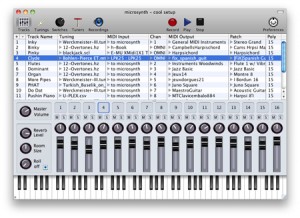
Make some microtonal music on your Mac with Hπ Instruments Microsynth, a polyphonic multi-timbral microtonal synthesizer application (standalone). It’s now available in two versions: the multi-timbral version and the mono-timbral (single-track) version dubbed Microsynth-mini.
Both are Mac OS X SoundFont synthesizers for microtonal music, supporting seven types of tuning files, instant retuning, audio file recording, routing to and from standard MIDI hardware controllers, and sequencing and notation software such as Sibelius and Finale. Overall, Microsynth is designed to give you total control of tuning in your music.
The tuning features are the same in both Microsynth and Microsynth-mini. There are 16 independent tracks, each with tuning, MIDI I/O, SoundFont, and patch selection. Check out all the synth features, below.
Microsynth features:
- Unlimited tunings, any key to any pitch
- Individual tuning per track
- Supports MTS real-time Sysex messages
- Supports .scl .tun .hz .csv .mtx .gly and .tonex tuning files
- Supports single channel tuning tables of 128 tones
- Supports OMNI-channel tuning tables of 2048 tones
- Allows real-time transposition and remapping of scales
- Unlimited user-defined MIDI CC tuning switches and tuners
- Supports pitch bending of microtonal pitches
- Comes with GM / GS sound set
- Built in reverb
- Loads .sf2 SoundFonts
- Unlimited MIDI connections
- One virtual MIDI input and output
- Records WAV audio files
- Loads and saves scenes
- Multiple Undo
The Hπ Instruments Microsynth synth for Mac (standalone) is available for $19.99. Microsynth-mini (single-track) is half as much, at $9.99. For more information, go to the company’s Web site at h-pi.com.
Moog Doodle Sonic Experiment and Google honors
What happens when you take Animoog, a MF-102 Ring Mod, a MF-104Z Analog Delay, the Moog Google Doodle, and put them in a room together? Pure sonic creativity.
Has Bob Moog inspired you? #celebratebob
check out the whole celebration at: www.moogmusic.com
By the way here’s a birthday gift from Google – Google Honors Bob Moog, Turns Search Engine Into A Synth!

Ghost Machine – new multipart algorithmic composing machine
HG Fortune has released Ghost Machine – a multipart algorithmic composing machine for Windows.
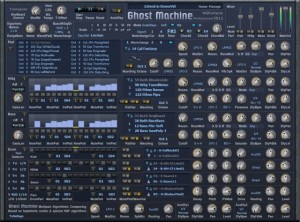
Ghost Machine features:
- a Pad part with Long Wave Sequencing
- a HiSq part with a 16 step sequencer and customizable note pattern
- a bass part with a 16 step sequencer and customizable note pattern, and
- a drum part with 4 instruments parts each with a 16 step sequencer.
Here’s what they have to say about Ghost Machine:
These 16 step sequencers are pattern driven which are changing due to an internal algorithm to create music. In AutoPlay mode you can let the machine do all the composing work for you, or you can transpose manually at realtime to change the current rootnote. As the system is based on scales (97 heptatonic) you need not worry about getting some ‘wrong’ notes in between. For a more advanced usage i.e. not just playback of a patch, it is recommended to fade in/out and/or mute a part at realtime, or, even more, ‘hold’ some pattern for a certain time in disabling algorithmic pattern change. In fact the spirit of this machine is more about flowing pattern changes and arranging a track or performance at realtime.
There are three different sequencers driving one the other. The main sequencer with 16 beats drives HiSq, Bass and Drum part, and after several loops triggers the Note Sequencer to change the root note which then triggers the third sequencer to advance the count for the Wave Sequencer at the Pad part til its end count is reached to change to next wave. The step count at the Note Sequnecer for the root note is also incremented, and the one at the Wave Sequencer respectively, if transposed manually via MIDI keyboard. Thus the algorithmic system does work in manual transpose mode too. Along with the fairly slow progressing of Note and Wave Sequencer certain algorithmic rules have been applied to change pattern and waves at the HiSq, Bass and Drum part.
GhostMachine Pro Suite is available now for 49 Euro til June., 21st. After that, it will be priced at 79 Euro. See the HG Fortune site for details.
Gary Numan speaks on his influences like Ultravox
In the first of a series of five films featuring headliners playing at BLOC, Gary Numan sits down to chat Ultravox.
Bloc sat down with a selection of headliners from the 2012 festival to talk about who – or what – has influenced them in becoming the artist they are today.
First in the five part series is synth pop pioneer Gary Numan.
He joins Orbital, Snoop Dogg, Richie Hawtin and Steve Reich on a festival programme like no other..
We’ll see you on the 6 July 2012.
Native Instruments: The Giant – based on the world’s biggest upright piano

Native Instruments has a new instrument they’ve named The Giant – based on “the world’s biggest upright piano.” The Giant features the sound of the Klavins Piano Model 370i, described as “a super-sized instrument delivering a colossal sonic spectrum equally well-suited to urban pop projects, soft piano ballads, driving rock riffs and jazz numbers, as well as providing a separate ‘Cinematic’ version of the piano for darker, atmospheric projects and sound design.” This upright piano stands over three meters high and weighs over two tons, with a soundboard roughly twice the size of a typical 9′ concert grand piano soundboard. The Giant was produced by sampling expert Uli Baronowsky – creator of the ‘Galaxy’ piano series – and comprises two separate instruments in one (‘day’ and ‘night’ versions), as well as controls for shaping and modifying the sound, and 40 production-ready presets to provide instant starting points for numerous musical styles.
Click for more details and sound samples.
The Giant runs in Kontakt 5 or the free Kontakt 5 Player, and is available now for $119 at the Native Instruments online shop.
New Cwejman DP-1 Dynamic Processor Eurorack Module
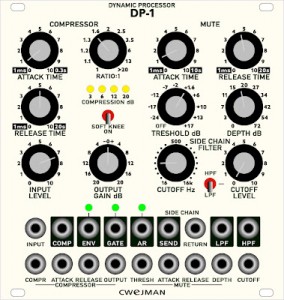
The DP-1 is a one knob compressor with additional features for dynamic treatment of music material in standard and some unique ways. The module consist of three main parts:
Compressor
The compressor is build around a high performance VCA circuit with low distortion and low noise floor. Instead of two controllers it has only one RATIO controller which compensate the signal loss at increased compression. It means that the low level signal is boosted and the high level signal is attenuated. The incoming signal passes the LEVEL INPUT controller and the outgoing signal is controlled by the OUTPUT GAIN. All parameters, such as the envelope follower (output ENV) with ATTACK and RELEASE, RATIO and OUTPUT GAIN are controllable manually by knobs and by CV inputs. The switch SOFT KNEE activates the function for gradual compression action.
Mute
The Mute (or squelch) circuit allow amplitude re-shaping in many ways for compressed or uncompressed audio signal. The muting circuit has four controllable parameters, TRESHOLD for activating the circuits at variable signal level, DEPTH for the muting process, from 0 to 72 dB deep, ATTACK and RELEASE controls for the muting process derived from the Gate. The Mute allows a complete re-shaping the dynamics for the audio signal. You can remove the unwanted and high spikes from heavy compressed signal due the compressor attack time which prevent overload the outgoing signal. The result is a compressed signal with short attack time and with no overshoots of the signal. Another example is treatment of beats, drum sounds or other sounds with variable accents or dips, variable fade in and out, also called as “push, pull”, “breathing”, or “suction” sounds. Just two examples and all four parameters are CV controllable, as well.
Side Chain Filter
The side chain is the circuit which determinate the compression and mute action related to the frequency characteristic of the side chain filtering. A side chain with equalization controls can be used to reduce the volume of signals that have a strong spectral content within a certain frequency range: it can act as a de-esser, reducing the level of vocal sibilance in the range of 6–10 kHz using the high pass filter or “de-bumper”, as I called, for reduction of strong bass or sub bass signals by using the low pass filter in the sidechain path. The build in side chain filter is a 12 dB/octave multi mode filter with low pass and high pass outputs for mentioned duties and others since the corner frequency is controllable by external CV signal.”
via http://www.cwejman.net/dp-1.htm
In the early days of sampling – radio exploration
This programme is an experiment. An exploration. It’s been put together with enormous enthusiasm and equipment designed for other purposes. The basis of it is an unlimited supply of magnetic tape, recording machine, razor blade, and some thing to stick the bits together with. And a group of technicians who think that nothing is too much trouble – provided that it works.
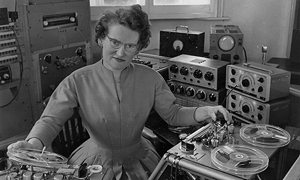
“You take a sound. Any sound. Record it and then change its nature by a multiplicity of operations. Record it at different speeds. Play it backwards. Add it to itself over and over again. You adjust filters, echos, acoustic qualities. You combine segments of magnetic tape. By these means and many others you can create sounds which no one has ever heard before. Sounds which have indefinable and unique qualities of their own. A vast and subtle symphony can be composed from the noise of a pin dropping. In fact one of the most vibrant and elemental sounding noises in tonight’s programme started life as an extremely tinny cowbell.
“It’s a sort of modern magic. Many of you may be familiar with it. They’ve been exploiting it on the continent for years. But strangely enough we’ve held aloof. Partly from distrust. Is it simply a new toy? Partly through complacency. Ignorance too. We’re saying at last that we think there’s some thing in it. But we aren’t calling it ‘musique concrète’. In fact we’ve decided not to use the word music at all. Some musicians believe that it can become an art form itself. Others are sceptical. That’s not our immediate concern. We’re interested in its application to radio writing – dramatic or poetic – adding a new dimension. A form that is essentially radio.
“Properly used, radiophonic effects have no relationship with any existing sound. They’re free of irrelevent associations. They have an emotional life of their own. And they could be a new and invaluable strand in the texture of radio and theatre and cinema and television.”E
CONDOM · Live in NYC [teaser]
Album and music video available for download on May 23, 2012
condom.bandcamp.com/
DATAMASKIN

