
The Knife – Let’s Talk About Gender Baby, Let’s Talk About You And Me (Planningtorock rework)
The Knife have invited Planningtorock to reinterpret ‘Full of Fire’, from the album ‘Shaking The Habitual’. Using the ‘Full of Fire’ lyric, Planningtorock went about creating a brand new track:
“Going through the tracks I pulled the awesome lyric ‘Lets Talk About Gender Baby Lets Talk About You and Me’ out from ‘Full of Fire’ and was completely moved by its groovy directness .. started recording this super fun bass line and totally went for a funky celebration feel”
The video for the single has also been directed by the Berlin based artist.
‘Let’s Talk About Gender Baby, Let’s Talk About You And Me’ (Planningtorock Rework) will be released October 14 (15) on Rabid / Brille / Mute Records. On the B side, Hannah Holland presents a new remix of the track,’Raging Lung’.
‘Shaking The Habitual’, is out now:
CD: http://smarturl.it/sth2cd?IQid=youtub…
iTunes: http://smarturl.it/sthitunes?IQid=you…
LP: http://smarturl.it/sthvinyl?IQid=yout…
DIR – Planningtorock
DOP – Imogen Heath
MUSIC – The Knife – Let’s Talk About Gender Baby, Let’s Talk About You And Me (Planningtorock rework)
The Uninitialized Show: Creating Electronic Music
In this episode, Andrew and Pete discuss hardware and software for making music. We’ll cover the basics of how electronic music is created and recorded in modern home and pro studios, and then dive in on the stuff we can all use.
Links:
Hardware Recorders
========================================
Zoom R24: http://www.amazon.com/Zoom-R24-Digita… Retails for $500.
There’s also an R16 that’s $100 cheaper, and an R8 which is $200 cheaper (the R8 also looks like it’s a good bit smaller, so it might be a nice one to use for “found” sounds:
http://www.amazon.com/Zoom-R8-Multitr…
Synthesizers, Workstations, and Controllers
========================================
Korg Kaossilator: http://www.amazon.com/Korg-Kaossilato…
Korg Kaossilator 2: http://www.amazon.com/Korg-KO2-KAOSSI…
Korg MicroStation: http://www.sweetwater.com/store/detai…
Turns out their Virtual B3 is also available separately: http://www.sweetwater.com/store/detai…
Korg MS-20 Mini
http://korg.com/MS20mini
AKAI MPKmini controller: http://www.amazon.com/Akai-Pro-MPK-Ul…
Moog Sub Phatty
http://www.moogmusic.com/products/pha…
Synthesizers.com Modular Synth
http://synthesizers.com/
(many other modular manufacturers. If you want to investigate Eurorack, I recommend visiting http://analoghaven.com )
Recording and DAWs
========================================
Audacity (free sound recorder/editor)
http://audacity.sourceforge.net/
Ableton Live (desktop DAW PC/Mac)
https://www.ableton.com/en/live/new-i…
FL Studio (desktop DAW)
http://www.image-line.com/documents/f…
FL Studio Groove (for Windows 8, Surface, etc.)
http://www.image-line.com/documents/f…
The Celebes Sea (featuring vintage analogue keys)
Original music featuring ARP2600, Moog Voyager, Mellotron, D6 Clavinet, Nord Electro 3 and Fender Rhodes
Applied Accoustics Systems introduces the Ultra Analog VA-2
Thiago Pinheiro introduces AAS’ analog synthesizer
Ultra Analog VA-2 — Analog Synthesizer: What’s new:
Factory library
The completely renewed factory library has well over 600 production-ready sounds classified for fast and intuitive exploration.
Compressor and equalizer
These new additions are perfect to add punch and definition to your sound, letting you cut through any dense mix or stage.
Limiter
The new output limiter protects your ears and monitors during experimentation with the synth’s parameters while providing a maximum of distortion-free dynamics.
Streamlined interface
Redesigned from the ground up, the new interface now divides Ultra Analog VA-2 into three panels: Play presents shortcuts to the performance and effect parameters including bypass switches for quick edits; Edit lets you tweak and create your sound; while FX supplies equalizer, compressor, multi-effect, and reverb processors for a final sheen.
Bank and program manager
Ultra Analog VA-2’s new manager allows simple and efficient organization, backup, and sharing of your sounds.
Overhauled effects
Reinvigorated and polished, Ultra Analog VA-2’s multi-effect processor features our best sounding chorus, delay, phaser, flanger, distortion, notch filter, wah-wah, auto-wah, and reverb to date!
Native 64-bit AU, VST, and AAX plug-ins
Ultra Analog VA-2 now runs in native 64-bit on Mac OS X and Windows making it compatible with the latest sequencers.
Renown sound designer Richard Devine delved into the new Ultra Analog VA-2 to forge a state-of-the-art collection of 110 presets that are simply essential.
Vogel CMI Demo and in depth Turorial of the classic Fairlight CMI Sim for iPad
This is a demo and tutorial for the Vogel CMI..A sim of the iconic and classic Fairlight CMI, one of the most famous keyboards ever..
Checking out the Arturia iSEM – Oberheim iPad recreation
Arturia has announced availability of iSEM, its second subtractive synthesizer recreation for Apple’s iPad. Here’s the story in their own words…
Like Arturia’s Oberheim SEM V desktop (or laptop) software solution before it, iSEM uses proprietary TAE (True Analog Emulation) technology to faithfully reproduce the analogue warmth and ingenious interface of the vintage Oberheim Synthesizer Expander Module (SEM) to which it also owes its inspiration and name, but brings it all kicking and screaming to this day and age in the most musical and ingeniously interactive ways possible by making the most of the latest developments available to its iPad host. Helpfully, Arturia has seen fit to take advantage of iOS 7’s inbuilt Inter-App Audio, allowing iSEM users to send MIDI commands and stream audio between apps on the same device. And that’s just for starters!
But first, a little history: hatched by legendary synth designer Tom Oberheim back in 1974, the dual-oscillator SEM was originally conceived as a way of beefing up weaker-sounding compatible analogue monosynths of the time before becoming a sought-after sound in its own right — so much so that its American creator came up with a series of successive SEM-based instruments, first pairing up two SEMs with a 37-note keyboard and a simple analogue step sequencer to form the Two Voice, Oberheim’s first self-contained compact, duophonic synthesizer in 1975, thereby beating rivals to the polyphonic punch. Programmability came courtesy of Oberheim’s breakthrough Polyphonic Synthesizer Programmer which — when hardwired into the fair-sized Four Voice (featuring four SEMs and a 49-note keyboard) in 1976 and enormous Eight Voice (eight SEMs set across two tiers) in 1977 — enabled the control voltages of many parameters for up to eight SEMs to be memorised for the first time. Though these instruments were undeniably groundbreaking, quickly finding favour with the likes of popular prog-rockers Rush and electronic music trailblazers Tangerine Dream, polyphony was, after all, achieved with multiple SEMs so each voice/module had to be programmed independently, which was quite a daunting task — even by somewhat shaky Seventies standards!
Fast forward, then, to 2013 and the truly 21st Century musical landscape has changed considerably, as has music technology itself. Today, of course, we take polyphony and programmability for granted, though not necessarily that still-sought-after Oberheim sound. Ingeniously, iSEM quite literally taps into all of this and then some, putting more musicality at anyone’s fingertips than its analogue namesake designer dared dream possible back in Oberheim’s Seventies salad days!
On the surface, anyone in any way familiar with the original Oberheim Synthesizer Expander Module® will immediately feel right at home when launching iSEM since the majority of its MAIN screen graphically mirrors the VCO 1, VCO 2, VCF, ENV 1, ENV 2, and LFO 1 layout and all associated controls to a tee — right down to the old Oberheim logo within the VCF section! Speaking of recognition, recreating that still- sought-after Oberheim sound is a challenge that iSEM readily rises to meet from deeper within thanks to that TAE® technology. This allows accurate modelling of analogue circuitry behaviour — in this case, an original Oberheim Synthesizer Expander Module®. Meaty, Seventies- sounding sounds stream forth from iSEM with over 600 highly-usable presets always accessible from its eye-catching browser — a quantum leap forward from Oberheim’s Polyphonic Synthesizer Programmer of way back when, surely?
Of course, communicating with the outside world in the pre-MIDI age was always a testing time back in the Oberheim SEM-launching Seventies. Not so today with iSEM… simply tap CONNECT and the iPad world is your musical oyster, thanks to Core MIDI, WISTTM, and Audiobus support — not forgetting the aforementioned Inter-App Audio.
But that’s not all iSEM has to offer. Far from it, in fact! Pressing the VOICE PROG button brings into play a voice programmer that makes simulating a huge polyphonic sound similar to Oberheim’s original Eight Voice hardware heavyweight a breeze — albeit without having to wrestle with eight monosynth modules hardwired together to create complex tones. Tellingly, MOD MATRIX makes creating complex modulation routings equally easy while the FX page brings built-in chorus, delay, and overdrive effects into the musical mix. Meanwhile, multiple performance parameters are accessible from the PERF page boasting ARPEGGIATOR controls, assignable sliders, and effects mix controls.
Amazingly, all of this is available in iSEM as an ear-opening iPad app for a tiny fraction of what its notable namesake analogue ancestor cost almost 40 years ago. The times they are a-changin’ here for sure! And admit it. Will you miss having to haul heavyweight hardware around? That’s progress. Portability pluses apart, iSEM is a supreme software recreation of a supreme subtractive synthesizer, pure and simple. So surely Apple’s App Store should be your next port of call? Get iSEM today and get back to the future of that still-sought-after Oberheim sound with Arturia!
Appropriate iPad owners can purchase and directly download iSEM from Apple’s App Store for $9.99 USD/€8.99 EURO/£6.99 GBP
Korg R3 – Analog sounds: test, tweak & listen
Testing sounds (stock and non stock), modulations, filters and general ooomphh on Korg’s virtual analog synthesizer.
Recorded in 24bit/48Khz uncompressed wave – enjoy!
Details about the Korg R3:
Occupying the middle ground in Korg’s MMT lineup between the flagship Radias and the ultra-portable microKorg XL, the R3 delivers sophisticated virtual analog power in a compact yet sturdy package. Its 37 full-sized, velocity-sensitive keys and four assignable knobs make it a lightweight yet flexible performance instrument for shaping classic modeled sounds with a synthesis engine in the spirit of the MS2000.
The R3 is marketed as a “Synthesizer/Vocoder”, and the included gooseneck mic lets you take full advantage of its 16-band vocoding capabilities right out of the box. Simply enter Vocoder mode for access to all of the vocoder’s variables that work with an internal or external carrier signal. It also lets you record up to sixteen 7.5-second Formant Motion sequences, allowing you to play saved phrases—albeit at a fixed tempo—through the vocoder without external input. Whether you’re looking to channel the spirits of sci-fi robots, make a guitar do backing vocals or are in need of some unconventional choral accompaniment, the R3’s pro-grade vocoder earns its place in both the mix and the title.
Each of the 128 editable patches can contain up to two timbres, sharing the somewhat meager polyphony between them. These can be layered or divided across the keyboard and can be assigned to individual MIDI channels. Each of these two timbres contain all the capabilities listed, so despite being well suited for mono and lead styles it’s possible to get surprisingly complex, evolving pads which belie its 8-note polyphony. This is best displayed when using each timbre’s modulation sequence, which lets you record a variable’s knob changes and can yield complex changes in a single key press. There’s also a 6-mode arpeggiator with a toggle button and latch control to further animate the sound.
Every timbre consists of two LFOs, two oscillators, a wave-shaper with sub-oscillator options, two insert effects, and three envelope generators for filter, amp, and one for assignment using the Virtual Patch system. This feature lets you define up to six additional routings, giving the unit a fitting touch of modular dynamics which can add subtle dynamics or make sounds spiral off into mayhem. Unfortunately the routings are limited, but most of the logical sources and destinations are included. The two oscillators cover a wide range of traditional analog waveforms with some useful extras (osc1 includes 64 DWGS preset waveforms and the vowel-like Formant wave) and allow a number of interactions between them: ring mod, VPM and unison, among others. External signals can also be processed through the filters, gates and effects. All of this is wrapped up with one master effect and a variable 2-band EQ with some other fine-tuning mods to polish the finished sound.
All of this programming demands an intuitive interface, and although it involves some menu-diving, this is handled by selecting the category with a rotary encoder and then editing individual variables with the 4 main pots. Though it isn’t “per-knob” editing, each pot is encircled by a slick-looking LED halo which shows the value regardless of the knob’s current position. Each knob also has its own small LCD screen which can show the variable or its value by hitting the shift key. This combination along with the Original Value light takes much of the drudgery and guesswork out of building your own patches, but it’s recommended to load up the included software editor since some sub-variable and effects tweaks can seem cryptic at first.
Overall, the R3 is a fun, good quality, affordable synth for anyone who enjoys sculpting sounds using traditional subtractive synthesis, and offers enough complex features and character to earn its place in the mix. Great to program and built with portability in mind, the R3 has what it takes to rock the stage!
Boomstar 4075 sequenced by Doepfer Dark Time
This is a demo of the Boomstar 4075 (ARP 2600 filter) being sequenced by a Doepfer Dark Time. Because of the nature of the demonstration, it could get a little boring during some sections. Pay attention to the subtle changes and you will be impressed. Stay tuned through the whole video to see how much range the Boomstars can cover. This is only a short segment as well, these synths are capable of much more. This is a Perfect Circuit Audio favorite of 2013!
Look out for another Boomstar demo coming soon, this time played by a MIDI controller.
The Jellyfish – new DIY double delay, with modulation options
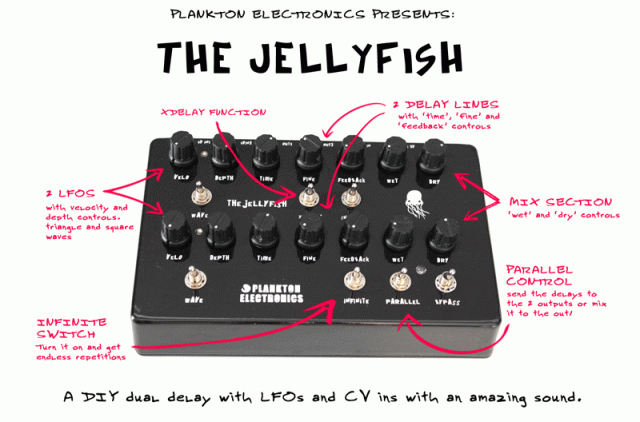
Plankton Electronics has introduced The Jellyfish – a DIY double delay, with modulation options capable of a wide variety of sounds, from simple delay lines to crazy modulated stereo sounds.
Features:
- Analog passive filters
- CV inputs
- Two LFOs
- Infinite feedback switch
- Xdelay function
- Dry/Wet controls
- Pseudo-stereo (1 in-2 outs) or mono mixed sound
The Jellyfish is available as a kit for 120 Euro (the case is additional). Schematics and other documentation are provided on their site – right here >>
Electronic music from the North: SILENT WAVE – Landscapes
SILENT WAVE
Electropop from Gothenburg
First official video
For more information, visit:
http://silentwavesweden.tumblr.com/
DATAMASKIN

