
Jordan Passmore Demo of the Roland JX-10, Roland SH-2, Akai MPC-60
This is a demonstration of two Roland analog synths, a JX-10 and a SH-2, combined with the sequencer/sampler the MPC-60. The MPC-60 is loaded with Linn LM-1 samples (courtesy of ToneBldr, http://www.drivenmachinedrums.com ) and is also sequencing the JX-10 and SH-2. The SH-2 is doing the bass while the JX-10 is doing the melody; Jordan is playing lines over the melody on the JX-10 occasionally. All sounds are mixed on a StudioMaster mixer and there is an analog delay (Washburn Accellerator) on one send and a EH HolyStain on another.
“The MPC-60 is sort of out of shot so near the end I bring the camera around to show what I’m doing with that.”
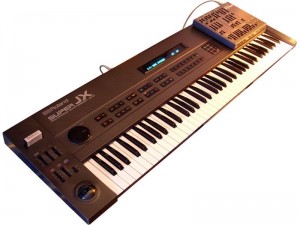
Released in 1985 the JX-10 (Super JX) combines two individual JX-8P’s for an outstandingly warm, rich and analog sound which is still used in many modern studios all over the world. This synth was the first Roland Synth to be fitted with a quality 76 note keyboard with velocity and aftertouch. Two DCO’s per voice, two ADSR envelope generators per voice, and a resonant lowpass & non-resonant highpass filters are only the beginning. It has a 12 voice polyphony for a total of 24 oscillators and it is by far one of the most programmable synths of its time! However, as on the JX-8P, knobs and sliders have been replaced by low-profile buttons and a nice LCD display. Although this may look sleek and elegant, it makes editing a chore. Assign parameters to the alpha dial for tweaking, one at a time, or get the optional PG-800 Programmer to provide traditional, hands-on, dedicated sliders for editing the JX-10’s parameters.
The JX10 has a Chorus effect and a chase-play Delay function. The chase-play function allows programmable delayed repeats of voices by alternating patches of the upper and lower modules. The simple chorus effect is either off, slow or fast. It has two programmable sliders (if you don’t use the PG-800) for some real-time control which can be recorded along with other effects and keyboard modes into one of the 64 Program Patches. This is in addition to its standard 50 preset and 50 user patch memory. A simple sketch-pad 1-track real-time sequencer is also on-board. It stores sequence data directly to an M16C card, or an M64C card for Patch/Tone OR sequence data. The M16C has a capacity of 400 notes, the M64C 1440, according to the manual.
The JX-10 also comes in a rack-mount version known as the MKS-70. It’s worth noting that the JX-10 can not be edited via SysEx, however the MKS-70 can which is one reason many have chosen the rack version of the keyboard. The JX-10 can make bulk dumps of its sounds over sysex, but only with (discontinued) Roland M64C RAM cartridges.
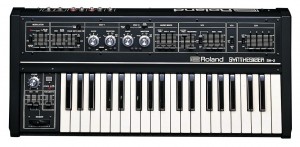
The SH-2 is one of Rolands’ early synthesizers. It is very simple in design, look and function. It sounds much like the SH-101 synth, including the typical SH-style sub-oscillator. But the SH-2 employed 2 oscillators for a much fatter sound. It has the typical Roland SH sound – it’s a monophonic bass synth that’s flexible enough to provoke punchy analog basses, leads and squelchy sounds. The oscillators can be de-tuned as well, another feature the popular SH-101 lacks. But it isn’t very pretty to look at as it shares the same design and layout as the SH09. Still it makes a simple and easily programmable mono-synth that can be used in place of the more common SH-101. However the SH-2 is harder to find and so it usually has a higher price than other SH-type synthesizers from Roland.
XaKT VSTi – Free Spectral Synth For Dark Textures

Krakli Synths has released the XaKT synth. A spokesperson had this to say, “A completely new plugin from the Krakli dungeon. This spectral synth is gifted at dark textures and sounds with plenty of movement. Take the time to become accustomed to its unusual interface and you will have a real beast on your hands.”
Pricing and Availability:
Free download.
More information:
Modular: A Night alone with my friends
Nice modular pics in the night with bleeps, bloops and blinking lights
Interview: Morton Subotnick – The Electronic Music Pioneer on Music Technology
More info: http://blog.dubspot.com/electronic-music-pioneer-morton-subotnick
In this episode of Dubspot’s Wireless interview series, influential composer and electronic music pioneer Morton Subotnick invites composer, producer, and educator Raz Mesinai to his studio for an interview. Their discussion ranges from the innovations and rapid acceleration of music technology over the last sixty years to developing an iOS app that presents a new way for kids to create music.
Subotnick has worked extensively with interactive electronics and multi-media, co-founding the San Francisco Tape Music Center with Ramon Sender, and often collaborating with his wife Joan La Barbara. Morton Subotnick is one of the pioneers in the development of electronic music and multi-media performance and an innovator in works involving instruments and other media, including interactive computer music systems. Most of his music calls for a computer part, or live electronic processing; his oeuvre utilizes many of the important technological breakthroughs in the history of the genre.
TB Midi Stuff 2 template for FL Studio 10 (beta)
TB Midi Stuff 2 template for FL Studio 10 (beta).
More info : www.ipadtouches.com
For performance mode, normal mode and controls.
“TB Midi Stuff is a much cheaper App than Lemur.
Version 2 has a lot of new features, so I was able to port my FL Lemur template for Lemur to TB Midi Stuff 2.”
With the template you can “jam” your music and samples in performance mode in Fl Studio 10.8 beta. Pages for controlling FL Studio in normal mode and for controlling with XY pads, sliders and knobs are present in the template.
Random Walk Generator Demo (ArdCore, Kraftzwerg, & A148)
The Snazzy FX ArdCore is a Eurorack module based around the Arduino microcontroller. You can create programs (a.k.a. sketches) on your computer and upload them via USB into the module.
For this video, ‘chisel316’ loaded the Random Walk Generator sketch into the ArdCore and use it to modulate the VCOs on the Kraftzwerg. Also in play in this patch are the Kraftzwerg’s Dual cross-modulating LFOs and the Doepfer A148 Sample and Hold module.
“As you can see, I started expanding my modular setup. I’ve been collecting modules that I feel compliment the Kraftzwerg.”
Three part demo of SYNTHOR – new audiovisual modular synthesizer
Synthor is a hardware and software synth consisting of 8 audiocubes and software for mac and PC
4 Green cubes: sine, triangle and saw oscillators with frequency and duty cycle/sync inputs
2 Purple cubes: state variable filters with HP/LP and BP/NT outputs and cutoff frequency inputs
1 Blue cube: pink/white noise with sample and hold and state variable filters (LP) outputs, SAH control signal and filter cutoff inputs
1 Red cube: stereo output
The two other videos can be found here >>
Yamaha Synth MX61 & MX49 Introduction
MX Serie Synthesizer Introduction with Adrian Zalten: MX61 & MX49
Differentiated only by keyboard size, each of these 61-part multitimbral keyboards contains over 1000 of Yamaha’s flagship MOTIF sounds, effects and an ‘easy’ split/layer/performance mode that enables you to quickly come up with custom tones.
What’s more, the MXs are designed to integrate tightly with your DAW: audio can be piped directly over USB, and you can switch to a DAW Remote mode that enables you to use the hands-on controls to adjust parameters in your software.
You can also use the Ms as an audio interface, though disappointingly, the only input comes in the form of an aux mini-jack. Another thing that’s lacking at present is the option to use the MX’s synth as a VST instrument (complete with software editor) though we’re told that this is on the way.
The MX49 and 61 both ship with a copy of Cubase AI, plus Steinberg’s Prologue synth and Yamaha’s own YC-3B virtual organ. As such, anyone who buys one is getting a full music production starter kit.
Perhaps the most striking thing about these keyboards, though is their price: the MX49 has a target price of £499 and the MX61 should be available for £649. Both models will be shipping in December.
Yamaha MX49 and MX61 specs
- 166MB of internal Wave ROM
- More than 1000 Voices taken directly from MOTIF
- USB Audio/MIDI interface built in
- VCM Effects
- Auxiliary input and WAV/MIDI file playback
- One touch Layer and Split function
- 128 note Polyphony / 16 part multitimbral
- 999 arpeggio patterns
- Advanced synth editor
- Remote Mode for DAW control
- Bundled with Cubase AI, YC-3B organ emulator, Steinberg Prologue analog synth
- Lightweight design: (MX49: 4kg, MX61: 5kg)
Tronsonic microtape 5 – Dirty Cymbals
Recorded through vintage valves to Clean 1 inch tape.
Artificial tape damage created by the ‘degrader’.
For Native Instruments Kontakt 4.2.4 or later, and in wav format.
www.tronsonic.com
Live looping with Ableton Live
An improvised live looping jam with analog keyboards, USB controllers, iOS devices, and Ableton Live. All loops are recorded live.
Equipment:
Oxygen 49 controlling Sunrizer on an iPad via an iConnectMIDI,
Akai MPD26 controlling Kontakt,
Akai APC20,
DSI MoPho keyboard,
DJ TechTools MIDI Fighter 3D in “MF3D Launcher” mode,
Novation Launchpad,
Moog Prodigy,
Fender Rhodes with an MXR Wylde Overdrive,
Lemur on an iTouch and 2x iPads,
PreSonus 1818VSL,
Macbook Pro running Ableton Live
DATAMASKIN

