
Announced today: Polar – old school harmonizer coming to Reason 6.5
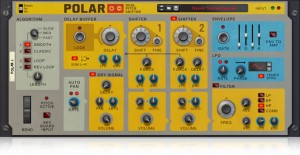
Propellerhead today announced Polar, a new Rack Extension audio effect to be available at the launch of the next versions Reason and Reason Essentials later this month.
Polar is an old school harmonizer and pitch-shifter effect with a host of modern tricks up its sleeves. Designed for classic harmonizing, stereo widening, and real-time pitch shifting, Polar also invites users to experiment with buffer looping and audio freezing to create otherworldly effects.
Consisting of selectable dual pitch-shifters with classic, smooth and looping algorithms, Polar is created for singers, producers, guitarists and remixers looking for transparent pitch-shifting as well as creative ways of turning bland recordings into wide, evolving soundscapes. The built-in LFOs, auto-panning, envelope and buffer lock provide further sound sculpting possibilities, while delay and feedback turns single-note recordings into arpeggios.
For more information about Rack Extensions, Polar, and to listen to audio examples, visit www.propellerheads.se/go/74B1DC9D
Pricing and availability
Polar will be released simultaneously with version 6.5 of Reason and version 1.5 of Reason Essentials Q2 2012, at a price of USD $69/EUR €55. Polar will be available for purchase in the Propellerhead Shop.
Bucephal – the delay that is not meant to be used as a delay
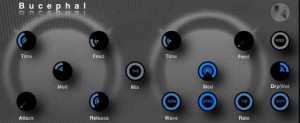
Bucephal is a delay plug-in that is not meant to be used as a delay. It gives you two parallel delay lines, each one up to 2 seconds, and lets you mangle delay times with two nice modulators.
A spokesperson told us, ” Thanks to an envelope follower and a LFO, Bucephal can fulfill some of your daily glitch needs, morphing between vibrato, flanging, pitch shifting, and crushing effects. The large modulation range of delay times can lead to some pleasingly annoying artifacts, and if your incoming audio needs even more dirt, the randomizer and waveshaper will be there to help.”
Bucephal is available for both Windows and Mac Os X, as VST (32/64 bit) and AU (32/64 bit, Mac only).
Features:
- 2 parallel delay lines with up to 2 seconds length
- Time parameter interpolation provides nice pitch artifacts
- First delay line time can be controlled by an envelope follower
- Second delay line time can be controlled by a LFO (tempo free or synced)
- Classic waveforms for the LFO (sin, square, saw up, saw down, triangle, sample and hold)
- 7 mix modes
- Soft clipping and waveshaping can be applied to the output
- Randomizer
- Clean minimalist interface
- Lifetime free updates for registered customers
Pricing and Availability:
20€ – all platforms and formats
More information:
Droning Machine
The Freqbox is a very underrated device.
This is very simple programming, just some slight modulation of the waveshape, to an overdriven 101 LPF. Then a random sequence with most of the pots totally CCW seemed to simulate a two person morse code conversation using the Ringmod as a pitch source.
Oscs sent to a synthesiers.com VCA and to the MF 104z Delay prior to going to the board.
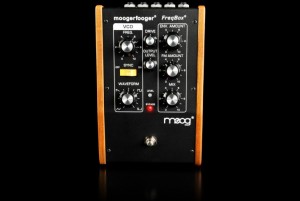
The MF-107 FreqBox is different from other effects – the effected sound is not a processed version of your input signal, but the sound of the input signal modulating an internal oscillator. It contains a VCO with continuously variable waveshape, and the capacity to modulate that Oscillator in the following ways:
– the VCO can be hard synced by the input signal
– The VCO can be frequency modulated (FM) by the input signal
– The VCO frequency can be modulated by an envelope follower which tracks the dynamics of the input signal
– The Amplitude of the VCO also tracks the dynamics of the input signal
Hard sync is a classic analog synthesis technique where the start of an oscillator’s cycle can be reset by another. The oscillator being synced takes on the frequency characteristics of the other oscillator, and when its frequency is swept, it reinforces the harmonics of the fundamental frequency. In the case of the FreqBox, the input signal is used to reset the FreqBox’s VCO.
FM is a technique used to get really rich sounds from simple waveforms. The type of FM used in the FreqBox is linear FM. Sounds range from gong or bell-like tones to sizzly sweeps.
The FreqBox, like all moogerfoogers, works with any instrument to line-level input. In addition to the panel controls there are control inputs for use with expression pedals or control voltages and control outputs for interconnecting moogerfoogers like you would a modular synth.
The demo was recorded with an electric guitar, the FreqBox, a Moog EP-1 expression pedal, and recording software on a laptop. That’s it!
The FreqBox can provide some really unusual processing to all types of signals – guitars, synths, drum sounds, vocals or wind instruments allowing you to enter previously unexplored sonic territory.
TONSTURM 07 | The Sound Of Water
New library released by TONSTURM, The Sound of Water.
With this soundpack you get a vast variety of deep, splashing, bubbling and bursting water sound effects recorded during extensive field recording sessions above and under the surface of water. The underwater sound effects of this library were captured with the mind blowing, high quality underwater stereo recording rig from Sonar Surround.
With TONSTURM 07 | The Sound Of Water you get 140 Soundfiles in Stereo, 24 Bit, 192 kHz. Over 4 GB of Data (@ 192 kHz) plus extra pitched down versions of the high resolution underwater recordings for convenience (additional 2,47 GB).
TONSTURM 07 is available for $99 (192kHz) or $84 (96kHz)

Hear water like you´ve never heard before!
The recordings for this soundpack took place at three different locations: Two beautiful lakes and one outdoor swimming pool. We recorded above and under the surface of water and used all kind of props to perform and capture characterful, deeply bubbling and bursting water sound effects.For the underwater recordings we rented the high quality, mind blowing underwater stereo recording rig from Sonar Surround. These microphones are able to capture a huge frequency range between “5Hz to 85 kHz”! and their “enormous sensitivity and the resulting signal to noise ratio offer a usable dynamic range of more than 100dB. Thus, even the smallest grain of sand movement can be recorded without disturbing noise floor.“
(Quoted from: http://www.ambient.de/produkte/ambient-recording/unterwasser/hydrophone.html)
Checking out the Aurex master effects rack – MFX1
Here’s a direct link to the aurex master effects .adg file
For additional info about Aurex go here >>
Lizard Morph – new freeware effect plugin
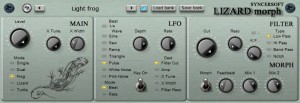
SyncerSoft has announced the release of its Lizard Morph freeware effect plugin for Windows.
Lizard Morph is detune and morph effect designed to deliver the powerful, penetrating sounds favoured by trance musicians. It’s ideal for use in trance, dance, techno, dubstep, electronica, drum n bass, big beat, dub, reggae and all other styles.
LFO modulation sections was designed specialy for Dubstep genre but can be used in other styles too of course. The plug-in contains: Main section. Filter section. LFO section. Morph section.
The plug-in is available to download as a freeware VST effect plugin for Windows.
Universal Audio UAD Ampex ATR-102 – Extended Video Review
Russ gets his hands on the UAD Ampex ATR-102 tape emulation and puts it through its paces in this extended video. He takes a novel approach and looks at the effect it can have on different instruments rather than just as a mix-buss process. Find out more and get top Pro Tools and recording tips and tricks at http://www.pro-tools-expert.com
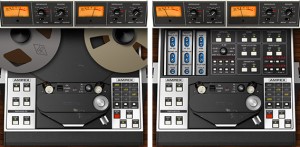
Background data:
It’s Not a Record Until it’s Mastered on an Ampex® Tape Machine.
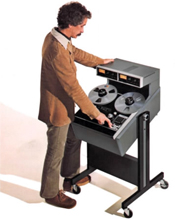
For more than three decades, the two-channel Ampex ATR-102 Mastering Tape Recorder has turned music recordings into records. With its cohesive sound, punch, and ability to provide subtle-to-deep tape saturation and color, the ATR-102 is a fixture in major recording and mastering studios — and is considered by many engineers to be the best-sounding tape machine for final mixdown. The perfect complement to the workhorse Studer A800 Multichannel Tape Recorder, the ATR-102 Mastering Tape Recorder plug-in for UAD-2 can provide the final “analog polish” on your music, turning songs into albums.
Features
- Ampex®-authenticated plug-in emulation of the ATR-102 Mastering Tape Recorder — the most popular professional 2-track machine ever made
- Provides rich, cohesive tape sound, without the hassles of calibration, maintenance, tape degradation, etc.
- Models entire ATR-102 electronic path, including transformers, amplifiers, Repro, Sync, and Input paths
- Features multiple tape formulas, head configurations, and calibration levels
- Adjustable Wow, Flutter, Hiss, Hum, Crosstalk, and (L/R) Tape Delay
- Requires a UAD-2 DSP Accelerator Card available from authorized dealers worldwide
- View All Features
Impeccably modeled in the renowned UAD engineering tradition — and incorporating presets from noted ATR-102 users Chuck Ainlay, Richard Dodd, Buddy Miller, Mike Poole, and more — the ATR-102 Mastering Tape Recorder plug-in emulation for UAD-2 faithfully replicates the unique dynamics, frequency response, and saturation characteristics of the original hardware. Scrutinized and fully authenticated by the Ampex Corporation, the sound of the ATR-102 plug-in for UAD-2 is virtually indistinguishable from its analog cousin.
History
Introduced in 1976, the Ampex ATR-102 2-Track Tape Recorder was a near-instant hit, thanks to its revolutionary servo-controlled reel motors and capstan, which provided smooth, continuous tape tension and handling. The large capstan, and absence of pinch rollers, provided nearly non-existent speed drift and ultra-low flutter. The clever ATR-102 design allowed users to change out heads and guides in mere minutes, with a 1″ head being a very popular “hot-rod” modification in more recent years — especially when running at 15 IPS (inches per second). The ATR’s role in modern recording history is so prevalent, that it would be easier to list classic albums that weren’t mixed down on this machine, rather than to try to list all those that were.
Richard Devine – The Analog Voodoo Effect
Richard Devine is an Atlanta-based electronic musician and sound designer. He is recognized for producing a layered and heavily processed sound, combining influences from hip-hop, to old and modern electronic music. Richard Devine has released records through such esteemed labels as Schematic and Warp Records, and is the creative force behind his own sound design company, Devine Sound. Though he has contributed sound design to a number of hardware and software manufacturers, he recently released his first official sample library through Sony Creative Software. Devine has also scored commercials for the likes of Nike and Touchstone Pictures.
Since the late-90s, Richard Devine’s sound has been synonymous with taking cutting-edge computer-based DSP (digital signal processing) to its limits. In recent years, however, Devine has also become a convert to the unlimited sonic capabilities and hands-on “analog voodoo effect” of the Eurorack modular format. I Dream of Wires spoke to Devine at NAMM 2012, which he attends annually. Judging by the studio footage on his Vimeo channel, and his wild enthusiasm on the subject, Devine is a bonafide Eurorack obsessive!
All music and sound in this video is by Richard Devine. Additional studio footage supplied by Richard Devine.
For more info on Richard Devine
richard-devine.com
devinesound.net
soundcloud.com/richarddevine
vimeo.com/channels/richarddevine
I DREAM OF WIRES is a forthcoming documentary film about the history and resurgence of modular synthesizers. The film is currently in production. This is the 6th in a series of extended interviews, which will be produced and released in various formats throughout the production, and following the release, of the film. I DREAM OF WIRES extended interview segments are sponsored by MATRIXSYNTH (m.matrixsynth.com).
inValve – new collection of software models of tube preamp and effects
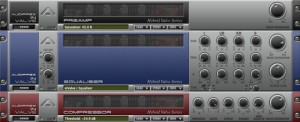
Audiffex has released version 1.5 of inValve, a collection of software models of tube preamp and effects.
As the production of PowerCore is discontinued and there are some musicians and engineers still interested to use the warmer sound produced by the inValve effects, we are releasing the native version of inValve.
inValve features
- inValve Preamp, a precise software emulation of a tube amplifier. The sound is not affected too much, it adds just warmth and smoothness you need for analog-like mixes.
- inValve Equalizer, a four-band equalizer with a tube circuit emulation for each band.
- inValve Compressor, a standard analog compressor emulation utilizing the characteristics of tubes.
inValve Native is available to purchase for $49 USD (previously $249 USD). The update is free for all customers who purchased VL2 or inValve for PowerCore.
Gotharman’s Little deFormer – A few presets
Playing back a few of the included presets on my Little deFormer Limited Edition. All sounds are made with the included sampling bank. The sound is recorded directly from the Little deFormers output. I hope you will enjoy this:) More info:
www.gotharman.dk
Granular effects processor with sampler and sequencer
Gotharman’s Little deFormer combines a granular effects processor with special effects like TimeStretcher, Step-Granulator and PitchShaper and more usual effects like Reverb, delay, distortion, compressor, filters and bit manipulation, with some special parameters, with a 100 minutes sampler and a step sequencer. A MIDI Note Randomizer is also included.
Both the samplings and external gear, connected to it’s 2 audio input can be effected. A complete list of effects can be found in the specs section. Watch and hear Little deFormer in action, in the video’s section. I have planned to use the Little deFormer as a platform for engineering new effects, so additional effects will be added now and then, which will be available as free downloads on this site. These updates will be available as MIDI sysex files in”.syx” format, and you will need a program like Midi-Ox to download these to Little deFormer.
The 4-note polyphonic sampler makes it possible to record your own samplings directly from the 2 audio inputs, or re-sample it’s audio output. Samplings are stored in FLASH RAM for instant recall, without any loading times. Up to 100 minutes/999 samplings can be kept. Start and end points can be changed in realtime and modulated, and it also has functions like AutoChop, for a conveniant and easy way to cut up long samplings. Each sampling has it’s own Phaze effect and filter with LPF, BPF, BPF8, HPF, ADD, BEF, BASS and LO-FI modes, and a filter mix parameter. It is also possible to adjust the filter response, to create filter types, that have never been heard before. The Little deFormer comes loaded with samplings of other Gotharman gear.
The Little deFormer comes with an expansion port. Right now, only an analogue expansion box, that adds CV inputs and trigger inputs/outputs are available, but it is my plan, to add more expansions later.
DATAMASKIN

