http://www.mcrow.net/ Will be released on March 2012
With Sound Pilot you are the pilot! Blurring the difference between an effect and a sound generator, Sound Pilot opens new sonic dimensions for the innovative music producer and sound designer. Sound Pilot is part of Musicrow Golden Ensembles pack for NI Reaktor.
Here’s an introduction to Propellerhead ReCycle. ReCycle is a creative tool that helps you make the most of your grooves. In simple terms, ReCycle lets you do with sampled loops what you can do with beats programmed from individual drum sounds — like alter the tempo, or replace sounds and process them individually. A tool for quickly editing sampled parts, chopping up riffs, remixing and doing mash ups.
Propellerhead has released ReCycle version 2.2 for sale–an update to the industry standard tool that creates REX files. Sporting a completely overhauled graphical user interface, ReCycle 2.2 adds new key commands, workflow enhancements and a new Online Help system–making it, say Propellerhead, even faster and easier to use. Version 2.2 is a 64-bit compatible application with full support for Windows 7 and Mac OS X Lion operating systems. Here’s what Propellerhead has to say…
About ReCycle
An industry standard, ReCycle is the fastest way to make sampled material your own. ReCycle lets you do with sampled loops what you can do with beats programmed from individual drum sounds–like alter the tempo, or replace sounds and process them individually. Producers use Recycle for making loops tempo-independent, for quick editing of sampled parts, chopping up riffs, remixing and doing mash ups.
Load any loop or musical phrase into ReCycle. The program will look at the file, analyze it, and slice it up into its rhythmic components. The file can then be rearranged, pitched or have its tempo freely adjusted. Artists have full control over the individual slices and can alter the timing or even quantize the groove, keep the feel of the loop and replace the sounds with their own. Or load the file into a software sampler and trigger the individual parts from a MIDI keyboard to turn the sampled material into a completely new performance.
A favorite among sound designers and producers, ReCycle’s REX file format is supported by all major music software titles including applications such as Apple Logic, Avid Pro Tools, Steinberg Cubase, Cakewalk Sonar, Ableton Live, MOTU Digital Performer and Propellerhead Reason, as well as software instruments such as Native Instruments Kontakt and Spectrasonics Stylus RMX.
Pricing and Availability:
ReCycle 2.2 is available now for purchase worldwide, at a suggested retail price of USD $249 / EUR €229.
The ReCycle 2.2 upgrade is available as a free download for any registered owner of ReCycle version 2 or higher.
Upgrades from 1.x of ReCycle can be purchased from the Propellerhead web shop.
Nucleus SoundLab would like to introduce you to a brand-new ReFill exclusively built for Propellerhead Reason 6 – Celluloid Beats. Celluloid Beats features an amazingly unique set of cinematic percussion loops suitable for filmscoring, game sound design, IDM and other electronic genres. The loops inside have been specially processed using a proprietary additive vocoding techique to emphasize long, smooth decay stages. Beyond the high-quality loops themselves, Celluloid Beats is also the first ReFill in an innovative new series called Modular Grooves.
Modular Grooves ReFills are meant to provide musicians and producers with a infinitely configurable palette of loops. These loops sound great at virtually any tempo thanks to being sampled using Wide BPM technology – anywhere from 60bpm to 300bpm is fair game. There is no reason to be limited by the original tempo of a loop any more!
Each Combinator patch in a Celluloid Beats contains 8 loops – 1 original loop and 7 creative loop remixes. This is achieved by using the Slice Edit Mode on Dr. OctoRex to change filtering, decay, volume and more on a per-step basis for each loop. Going farther than that, unique FX are added to each patch which are used to effect specific loop slices – so each slice in a loop can have a different distortion, filtering or delay! The resulting loop remixes sound incredibly complex, but they certainly aren’t complicated to use. A single Combinator Rotary switches between all 8 loops; and you can also easily dive into Dr. OctoRex to tweak any loop remix to taste! To help users understand the Modular Grooves technology and get the very most out of it, PDF documentation is included.
Celluloid Beats also comes packed with all its loops in raw REX2 format outside the ReFill itself at no additional charge. So users can easily load these loops into other sampler, such as Kontakt, Ableton Live, Battery and more without any hassles.
40 24-bit 44khz REX2 loops form the base of Celluloid Beats
280 loop remixes using all 8 loop slots on Dr. OctoRex
Each patch built exclusively for Reason 6
All REX2 loops included outside the ReFill, for use in other samplers
Detailed PDF documentation on the creation and operation of the ReFill
January 28, 2012 · Posted in Uncategorized · Comments Off on Zynaptiq PITCHMAP: Changing Melodies and Harmonies in Musical Recordings in Real-Time via Live MIDI
Video demonstration of and step-by-step tutorial on changing melodies and harmonies of a mixed musical recording in real-time, using the Zynaptiq PITCHMAP AudioUnits Plug-In controlled by live MIDI input in Apple Logic Pro. Original recording provided courtesy of absolutesongs.com
Stevie Wonder and legendary music producer Robert Margouleff reunite for this historic performance of Live for the City. After 40 years Robert Margouleff programed Stevie’s Moog 3 Synth for performance.
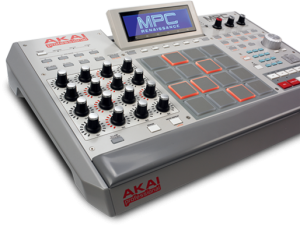
Fusing Akai Professional’s legendary MPC layout and workflow with the power of your computer, MPC Renaissance is an unrivaled instrument for music production. The new flagship is a fully integrated hardware/software system: MPC Renaissance allows you to create using classic hardware controls and an integrated pop-up display, while it’s exclusive MPC Software empowers you with unprecedented, expandable production capabilities on your Mac or PC.
MPC Renaissance Hardware
Fuses legendary MPC production with the processing power of your computer
Vintage Mode changes output sound character to MPC3000, MPC60 and more
“An audio processing graph is a Core Foundation opaque type, AUGraph, that you use to construct and manage an audio unit processing chain. A graph can leverage the capabilities of multiple audio units and multiple render callback functions, allowing you to create nearly any audio processing solution you can imagine.” – From Apple’s “Audio Unit Hosting Guide For iOS”
AudioGraph is a superset of Apple’s MixerHost application.
Features include:
* Mono and stereo mic/line input
* Audio effects including:
o Ring modulator
o FFT passthrough using the Accelerate vDSP framework.
o Real-time variable pitch shifting and detection using STFT
o Simple variable speed delay using a ring buffer
o Recursive moving average filter with variable number of points
o Convolution example with variable filter cutoff frequency
* Stereo level meter
* Synthesizer example – sine wave with an envelope generator
* iOS 5 features (from Chris Adamson) including:
o MIDI sampler audio unit
o file player audio unit
o audio unit effects
* Runs on iPad, iPhone, and iPod-Touch
* Basic audio session management including detection of input devices and available channels
* Commented source code.
* Original music by Van Lawton
* Plus everything from MixerHost
More info – http://bit.ly/vKrfPY
Dubspot Electronic Music Production and Sound Design Instructor Evan Sutton explains how to make basic connections and building a subtractive synthesizer using Native Instruments Reaktor’s Built In Modules in this new tutorial. There are many levels to Reaktor’s hierarchy. In the last tutorial, we spent most of our time on the Instrument level, making small changes and swapping out effects. If you missed the first tutorial, you can find it here: http://bit.ly/nxoNjs
In the second installment, we’ll go even deeper and build our own instrument from the ground up. We’ll be using Reaktor’s Built In Modules, which are tools that range from simple math to complex signal processors. Many of these modules are the basic tools used in modular synthesis. We’ll use these to build a simple synthesizer with one oscillator and an amplitude envelope. Remember to keep the volume down while you’re setting up your modules.
It’s important to explore basic signal flow in Reaktor. There are infinite possibilities for experimentation, but these concepts are the starting point for building larger and more complex ensembles.
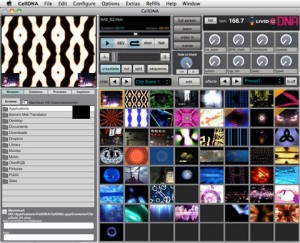
CellDNA is designed for realtime performance of video, images, and sounds. The intuitive, easy to learn interface gets you quickly mixing video, images, and sound. Live video input, realtime recording, an advanced database for tagging, organizing, and finding clips, network control, and integration with Ableton Live makes CellDNA one of the most advanced and flexible video tools in your kit. Extensive MIDI learn, and templates for all of Livid’s Controllers as well as a growing library of other controllers (including the Akai APC40 and APC20) allows you to use any MIDI controller for expressive hands-on performance of real-time video. Extensible with Cycling74’s Max software, the possibilities are endless.
Features
• Mac OSX 10.4+ and WindowsXP, Vista and 7 Compatible
• Assignable effects to knobs or sliders
• 64 slots per clip bank
• Up to 64 clip banks and 32 effect bank presets
• Two Channel (A & B) Control
• Additional Layers
• Record QuickTime videos with sound
• Crossfader for mixing multiple videos
• 3D effects
• FreeFrame support
• Captions
• Easy MIDI learn
• Control speed, direction, and loop modes
• Use Quicktime movies, images, audio, and flash files
• Open GL accelerated
• Networking for multiple computer control
• Mutli-screen controls
• Development Kit for using your own Max patches can be downloaded here
• MIDI Talkback (MIDI OUT) for visual feedback with your controller
• Automap feature for the Ohm64 and Block
CellDNA builds on the standard Cell interface for video designers looking to alter and composite images in realtime. With dozens built-in effects and free-frame compatibility, you can mix up your videos with radical warpings, keying, feedback, tints, and captions. CellDNA is the easiest VJ software to learn and get started with, yet provides massive mixing potential.