
Jeremy Ellis performs on Maschine Mikro + NI’s Transient Master effect
Here’s one more video about the Maschine Mikro sprung out of the NI labs 
Check out finger drumming phenomenon Jeremy Ellis as he performs an amazing live routine on MASCHINE MIKRO, the upcoming compact version of the acclaimed computer-based groove production system.
For more information on Maschine Mikro, go here: http://www.native-instruments.com/maschinemikro/
“Check out TRANSIENT MASTER – a must-have dynamics effect. Uniquely powerful, deceptively simple and extremely useful. The magic wand for mixing drums and percussion.”
In beta: Groove Machine – new groove box instrument plug-in by Maxx Claster
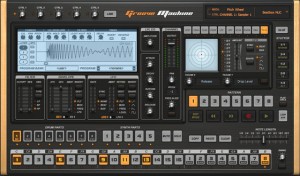
Image-Line has released a beta version of Groove Machine, a groove box instrument plug-in by Maxx Claster.
Groove Machine is a performance-oriented multichannel (drum)sampler, multitimbral hybrid synthesizer, sequencer and last but not least a ‘Groove Box’ inspired by hardware Groove Boxes. Special attention is paid to live performance via MIDI controllers.
Groove Machine features
- Step sequencer with integrated Note Editor driving 8 sampler tracks, 5 synth tracks and 10 performance oriented effects for every track.
- Synthesizer features a hybrid additive, FM & RM design.
- Per step automation with automation graphs.
- Pre-mapped to general MIDI keys.
- Stutter, beat repeat effects module.
- 2 envelopes, 2 LFO’s.
- Multi-mode filter.
Groove Machine beta is currently available to download as a VST plug-in for Windows for registered Image-Line users.
More information: Image-Line
Live performance featuring the Korg EMX, Access Virus Snow, FutureRetro Revolution and IPad Sunrizer App
Live performance, Korg EMX is providing drums and sequencing the Snow, FutureRetro is providing the bass and sequencing the Sunrizer App.
Featured hardware:
The ELECTRIBE-MX is a major step up in power and quality from the original ElecTribe series of dance music sequencer/synthesizers from Korg. The EMX-1 comes in a sturdy metal chassis with larger back-lit LCD display, expanded memory, voices & multitimbrality, more real-time controllers and vacuum tubes! Effects, Motion Sequencing, and Pattern length have also been expanded. And a new ribbon controller and slider have been added, providing a remarkable realtime interface for accessing the powerful arpeggiator.
Starting with its synth engine, the EMX-1 uses MMT synthesis (Multi Modeling Technology) which offers sixteen different oscillator algorithms, providing powerful analog synthesis models as well as sophisticated additive, PCM, chord, unison, combination, wave shaping, formant models and more. The built-in PCM library includes 207 drum PCM sounds and 76 synth PCM sounds ready for immediate use, ranging from powerful kicks and snares through amazingly unique organic sounds. External audio signals can be manipulated using the Comb Filter oscillator algorithm, and then further processed by the internal filter and effects. The EMX-1 allows you to create up to nine drum parts, five synth parts, plus accent parts that let you add dynamic accents to the drum and synth parts (for a total of 16 parts). Each part features extensive LFO and EG modulation. Each algorithm of the synthesis engine has two realtime adjustable parameters, plus some other menu-based parameters like waveform type, or chord quality. The brand-new filter lets you chose Low Pass, High Pass, Band Pass or Band Pass Plus.
The two Vacuum tubes (Valve Force Circuitry) create an analog tube circuit to add warmth and presence to your sounds. The tube gain knob adjusts the level of the output signal passing through the vacuum tubes, creating dynamic sounds with the distinctive tonal quality that only tubes deliver. Three stereo effect processors are available for simultaneous use. Each part can be independently routed to any of the three effects processors, and you can even use the Chain function to link multiple effects in series. Each processor offers 16 effect types including reverb, delay, flanger and chorus, tempo-based delay, talking modulator, grain shifter, decimator and more. The edits you make to each of the effects processors can be saved with each pattern.
As for the sequencing capabilities, up to 256 patterns can be created and stored to the internal memory. The EMX-1 ships with 196 assorted patterns covering house, hip-hop, R&B, electronica, drum n bass, techno, trance and more. You can combine patterns, add mute data and knob movements to create up to 64 songs, the EMX-1 ships with 3 demo songs. Favorite patterns can be assigned to Pattern Sets for instant access. Data can be quickly saved and loaded via SmartMedia cards. Realtime recording lets you record phrases as you perform, and step recording allows you to input the timing, pitch and duration one note at a time. Motion Sequencing records your realtime knob tweaks and plays them back as part of the pattern. Two types of motion sequence are provided; one for effects and one for parts, and you can also edit the value of individual steps. Up to 24 motion sequences can be used in a single pattern, allowing you to control virtually every sound parameter. And, using Auto BPM detection, the EMX-1 can follow the tempo of an external audio source. You can also use Tap Tempo to input the beat, set the tempo internally, or sync up to an external MIDI clock.
Chris Jeffs Releases the iOS Monnix synth
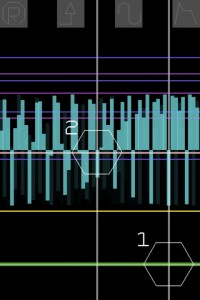
Chris Jeffs has released a new synth for iOS called Monnix. This live performance synthesizer uses three points of touch to control the distribution of up to 16 harmonics, allowing for unique sound effects.
Features:
Monnix is a synthesizer app which can distribute up to 16 sine waves in various harmonic or inharmonic ways. There are 5 screens allowing performance, playback or synthesis patch editing.
Perform
Use up to 3 fingers to control the frequency and distribution of harmonics and the LFO parameters.
Replay
Any movements made in the Perform page are stored, and can be played back here.
Sample & Hold
Controls the sound as in the Perform page, but with the periodic freezing of the partials, according to the selected tempo.
Synthesis
Select the amount of FM or jitter applied to the synthesis, and the balance between odd and even harmonics.
Envelope / FM
Change the volume envelope and FM ratio
Movements can be played back in the Replay page and the pitch altered by tilting the device forward. The Sample & Hold screen freezes the partials according to the selected tempo. FM ratio, jitter and envelope parameters can be set in the remaining pages, allowing for a wide variety of sonic mayhem.
Available through iTunes. To learn more about Monnix’s many features go to http://chrisjeffs.com/monnix/
Realtime Composition and Performance
“A Demo of my University Final Year Project titled “An Investigation Into Realtime Aleatoric Composition and Performance””
Aleatoric music (also aleatory music or chance music; from the Latin word alea, meaning “dice”) is music in which some element of the composition is left to chance, and/or some primary element of a composed work’s realization is left to the determination of its performer(s). The term is most often associated with procedures in which the chance element involves a relatively limited number of possibilities.
The term became known to European composers through lectures by acoustician Werner Meyer-Eppler at the Darmstadt International Summer Courses for New Music in the beginning of the 1950s. According to his definition, “a process is said to be aleatoric … if its course is determined in general but depends on chance in detail”. Meyer-Eppler’s German terms Aleatorik and aleatorisch, however, both mean “aleatory”. By mistakenly rendering them, his translator inadvertently created a new English word, “aleatoric”, which quickly became fashionable.
Attractive Crossmedia Performance
Mortal Engine is a dance-video-music-laser performance using movement and sound responsive projections to portray an ever-shifting, shimmering world in which the limits of the human body are an illusion. Crackling light and staining shadows represent the most perfect or sinister of souls. Kinetic energy fluidly metamorphoses from the human figure into light image, into sound and back again. Choreography is focused on movement of unformed beings in an unfamiliar landscape searching to connect and evolve in a constant state of becoming. Veering between moments of exquisite cosmological perfection and grotesque evolutionary accidents of existence, we are driven forward by the reality of permanent change.
DIRECTION AND CHOREOGRAPHY Gideon Obarzanek
INTERACTIVE SYSTEM DESIGN Frieder Weiss
LASER AND SOUND ARTIST Robin Fox
COMPOSER Ben Frost
COSTUME DESIGNER Paula Levis
LIGHTING DESIGNER Damien Cooper
SET DESIGN Richard Dinnen and Gideon Obarzanek
MULTIMEDIA ENGINEER Nick Roux
More info: http://www.chunkymove.com/Our-Works/Current-Productions/Mortal-Engine.aspx
DJ / Performance – Creating A Unique Setup (Dorian Concept)
New Ableton Live tutorial uploaded by DubSpot. In this tutorial, we’ll explore some techniques inspired by two incredible conversations I had this past week. We will look at the creative possibilities of using the Simpler, some portamento, LFO, and delays, and we’ll also explore a great technique for crafting 8 bar drum patterns.
First up, I had the great pleasure of catching Dorian Concept’s insanely inspiring set at Low End Theory last week. Dorian Concept is a Vienna-based producer who has developed his own completely original style of keyboard playing. He’s been tearing it up at Festivals around the world since bursting on to everyone’s radar with the massive tune “Vertical Output” a few years back. His latest release on Ninja Tune is called Her Tears Taste Like Pears, full of funky, synth driven club heaters. He often sits in live improv style with his friend Flying Lotus when they cross paths internationally, and his series of YouTube videos ‘Fooling Around With The MicroKorg, Alesis Micron, etc’ are straight jaw droppers.
So I had the honor of chatting with him at length at Low End, and I thought I’d share some tidbits from our inspiring conversation. He shared some serious wisdom that would be helpful for any aspiring producer. Turns out he is not classically trained, and he’s actually completely self-taught. The great thing about what he has done, is that he has kept it simple and really mastered his instrument, developing his own unique style. With all the tools we have available in our toolbox these days, it is easy to get overwhelmed and the reality is that sometimes it is better to simplify and limit yourself. That is what he has done, truly mastering his Microkorg and Micron and developing his own very distinct style of playing these instruments. We talked about our shared admiration of Squarepusher, as he had a very similar approach, mainly he used one particular sampler for all of his pre-year 2000 productions. He also developed his own very recognizable style of bass playing.
Applying these concepts to working in Ableton Live, I strongly recommend finding a compositional process that works best for you. These tutorial videos are about sharing various production techniques, find the ones that give you the best results and develop them further. Put a few of these techniques together into your bag of tricks, and then work at becoming the master of them. Identify a few elements that will become your signature sound, and then create a body of work with them. Develop your meat grinder, and then crank out the jams.
Stay tuned for the next tutorial, in which Professor Nalepa shares some great tips and techniques for drum programming and sequencing he picked up from Dutty Artz co-founder and Dubspot Instructor Matt Shadetek. The track used at the end of this video is “Wonton Garden” from Matt Shadetek’s Dutty House EP, out now on Dutty Artz.
Free step sequencer for live performances
Judging from the UI it appears to be very straight forward and easy to use. Just load your samples and run. Question remains around audio quality and real time use, but if any of you have or will try it feel free to leave your thoughts on it.
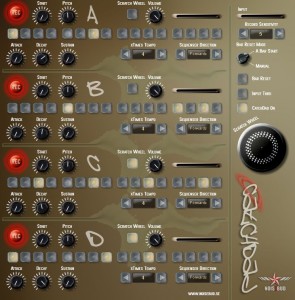
Noisebud has released CatchDad, a new plug-in created strictly for live situations.
With CatchDad you can catch 4 different sounds with just the click of a button and instantly start to program rhythms with the built in step sequencers.
Put it on a channel (or return track) in Ableton Live (or any other VST host that send time signals). Activate live monitoring if you like to record live sounds or run a loop trough CatchDad and start programming beats on the fly, or you could use loops as sound banks to change sound as you go or catch a live drummer and start to rearrange what he’s playing in real time or just add hits here and there.
CatchDad is free and is available for Windows as a VST effect plug-in.
Visit: Noisebud
MARK JENKINS “Space Dreams & Sequencers”
MARK JENKINS “Space Dreams & Sequencers” live at the Shaw Theatre, London. Background video effects by Mark Jenkins using the Fairlight CVI Computer Visual Instrument. Includes part of “Millennium” from the CD “Space Dreams” available worldwide through Amazon (dealer; mark jenkins music) and www.markjenkins.co
Instrumentation includes;
Roland JD800 (recorded), Korg M1, multitrack sequencer, Kawai PH50, Roland Octapad
Live Korg KRONOS performances

To celebrate the launch of the amazing new KORG KRONOS Music Workstation in Europe at this year’s Musik Messe in Frankfurt Germany (April 6 to April 9), is very proud to announce a series of limited performances by the world-famous keyboard player, Tom Coster (Santana, Billy Cobham, Vital Information, etc.). Tom, along with sensational German musicians Stefan Rademacher (bass – George Duke, Billy Cobham, Chaka Khan, etc.) and Daniel Schild (drums – Afshin, etc.) will be performing on the stand A71 in Hall 3, three times each day of the show. Each half-hour performance will have limited seating. So be there in time.
DATAMASKIN

