
VVOC- – free plug-in for vocal sounds with a vintage electronic touch
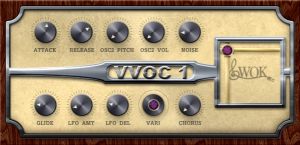
WOK has released VVOC-1, a new free synth plug-in that generates vocal sounds with a vintage electronic touch, from single formants to synthetic choir sounds.
The integrated triple-chorus and the X/Y pad for adjusting the formants, a pitch glide function and a hidden secret unveil more power than the easy GUI might imply.
Price: Free. As with all of WOK’s plugins there is no adware or spyware included.
VOX Continental V – vintage keyboard recreation from Arturia
Arturia has announced the release of VOX Continental V, a vintage keyboard recreation, bringing back the classic sound of the famous VOX Continental 300.
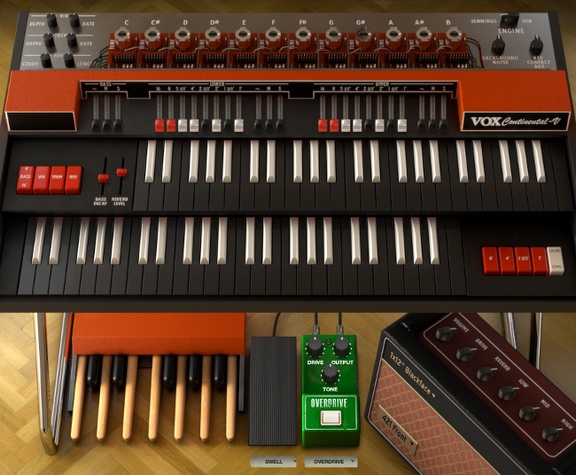
As a high-end software recreation of the Sixties-vintage VOX Continental 300 transistor-based combo organ, VOX Continental-V is the latest addition to Arturia’s acclaimed Analog Classics lineup where it sits alongside an authentic recreation of another archetypal Sixties staple, Wurlitzer-V (based on the classic ‘Wurly’ electric piano). Introduced in 1962, the VOX Continental — or ‘Connie’ as affectionately it became known — was originally designed to address the needs of touring musicians, but became musically much-loved in its own right. As such, it prominently featured on many hit records of the time, including The Animals’ classic ‘House Of The Rising Sun’ in 1964 and, a little later, ‘Light My Fire’ by The Doors. Onstage, The Beatles performed a memorably frenzied version of ‘Help!’ B-side ‘I’m Down’ during their August 1965 performance at New York’s Shea Stadium with John Lennon playing a VOX Continental using his elbows at times!
Despite being phased out of production in the early-Seventies, the VOX Continental has stood the test of time, too, playing a pivotal part in generating many of the distinctive keyboard sounds supporting later musical genres, including almost everything ever recorded by British Ska revivalists Madness, as well as New Wavers like Elvis Costello and The Attractions and American counterparts Tom Petty and The Heartbreakers. However, VOX organs have become increasingly difficult to acquire due to the high prices that they can command, compounded by the limited supply of working units. Today, VOX Continental-V gives contemporary, computer-based musicians instant access to those same hit-making sounds of yesteryear, and much more besides — and all without breaking the bank!
VOX Continental V features
- Physical Modeling of the VOX Continental 300.
- Added models of the ultra rare Jennings J70.
- Extended mode allows for more controls and more sound possibilities.
- Includes classic stompbox-type modeled effects.
- Modeled Guitar Tube Amp and Rotary Speaker outputs for vintage live sound.
- Extensive MIDI mapping of pedals, effects and sound engine parameters.
- Modeled amplifiers: Fender Deluxe Reverb Blackface, Fender Twin Reverb Blackface, Fender Bassman, Marshall Plexi, Leslie Speaker.
- Modeled microphones: Shure SM57, Sennheiser MD 421, Neumann U 87.
- Convolution reverb with custom classic spring reverbs.
The Vox Continental V is available for Windows and Mac (VST/AU/AAX/Standalone) for $99 USD/99 EUR (download) / $129 USD/119 EUR (boxed).
MFB 301 – Old analog drum machine
Maybe the first MFB drum Machine, with some mods added like drum triggers
best quality
Robotic Drum Set and Analog Bass
This is drum & bass piece performed live using an automated drum kit and other percussion, playing together with a selection of vintage and new analog synthesizers.
All the sound is being generated in real time, the analog synths coming through the main rack mixer and the robotic percussion being recorded by microphones.
List of the main gear used :
Modulars : Roland System 100m (sub bass), Roland System 700 (basses), Doepfer system (stabs and atmospheric sound).
Other Synths : Yamaha CS-10 (more basses), Studio Electronics Omega 8 (chords and atmospheric sound), Korg Monotron Duo (more basses).
If you would like to download the audio file, you can do so at kxnz.bandcamp.com where you can find it in high-quality formats on a pay-what-you-like basis. All proceeds will go towards supporting a trip to London to present a paper about musical robotics at NIME 2014.
How Do Synths Sound Through Crystalline?
Vintage Yamaha PS-20 analog keyboard connected to iPad using Apogee Jam interface, played through Crystalline. Also features iOS apps Animoog, Audiobus and Arturia iSEM. No other effects or processing done.
Crystalline: Shimmer Effects Processor for iPad
http://crystallineapp.com
VERMONA ER-9 Vintage Rhythm Box 1976
The Vermona ER-9 is a rare East German rhythm box. The manufacturer is VEB (Volkseigener Betrieb) Klingenthaler Harmonikawerke.
It’s not programmable, but the presets are free combinable. Every drum sound has its own volume knob, that makes it flexible. Check out that GDR sound 😉
Juice 3 – vintage synth emulation built in Reaktor
Minimojo is an emulation of an old synthesizer built in Reaktor, available for all registered product owners in the NI Reaktor User Library.
The Juice 3 is not in any way a copy of MONARK. The builder did not have access to or ever used MONARK during the making of Juice 3. Instead, the old ensemble Minimood made by NI in 1999, which has then been modified by several users, has been used as the starting point. I think that the basic structure will be recognizable from that early ensemble.
As the Model D is the most emulated synthesizer the world probably don’t need yet another one. Juice 3 should be seen as a proof of concept; how to emulate the should of vintage synthesizers using the Reaktor environment.
The technology developed for this is called Analog Legacy. Analog Legacy is the theory of modulating all functions in a synthesizer at all frequencies. The key is to find the right balance of the modulation depth for each frequency. Juice 3 is the first attempt to use this theory in practice.
http://youtu.be/cAhNylHjX_4
Boom 808 for iOS – Vintage beats in a modern workflow
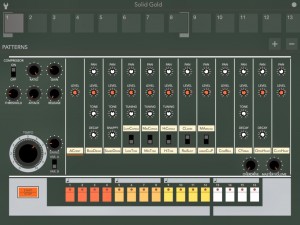
Boom 808 integrates one of the most popular drum machines of the 80’s into the modern mobile producers workflow.
With Boom 808, getting the classic 808 drum sounds into your music has never been easier. Audiobus compatibility, background audio, and audio export options allow Boom 808 to fit into your music without slowing you down.
Personalize your beats with the sound of the 808!
Features:
- Step sequencer
- High fidelity audio
- CoreMIDI
- Audiobus and background audio modes
- Record and export live performance to Soundcloud, Audio Copy, email and iTunes file sharing
- Compressor
- Swing
- Overdrive
Boom 808 provides the superb audio quality found in our other Pulse Code apps. Along with the classic drum sounds, Boom 808 has a built in compressor that is tuned to add punch to your drum beats. Soft saturation overdrive rounds out the signal chain adding warm crunch to your beats.
Using Boom 808 with Audiobus allows you to add any number of Audiobus compatible effects as well as record your beats into the app of your choice. Writing beats is easy by using the internal step sequencer or trigger the drums with CoreMIDI. Control your groove with two swing variations.
QUALITY HEADPHONES / MONITORS RECOMMENDED
BOOM 808! is priced at $0.99.
Arturia: VOX Continental-V – emulation of the vintage Vox Continental 300 organ
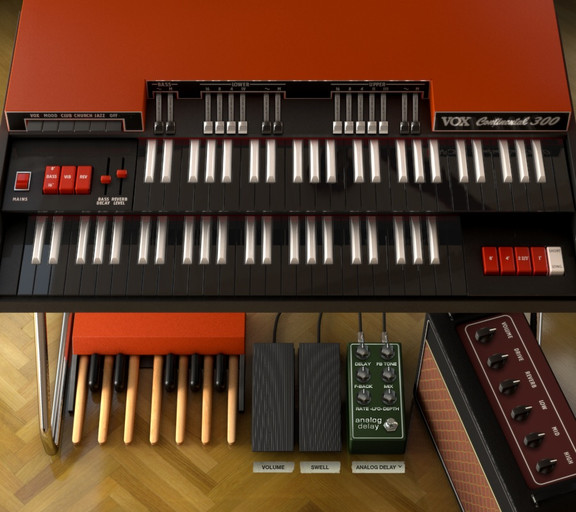
Arturia has introduced VOX Continental-V, a virtual instrument emulation of the vintage Vox Continental 300 organ.
As a high-end software recreation of the Sixties-vintage Vox Continental 300 transistor-based combo organ, VOX Continental-V is the latest addition to Arturia’s acclaimed Analog Classics lineup where it sits alongside an authentic recreation of another archetypal Sixties staple, Wurlitzer-V (based on the classic ‘Wurly’ electric piano).
Like the transcontinental history of the original Vox Continental, the road to creating VOX Continental-V was a long and winding affair. Arturia started its latest software developmental journey in the company of a rare Vox Continental 300 dual-manual model, capturing every nuance of the original right down to key contact timing and background noises — no elbows needed! Next, Arturia acquired a rare Jennings J70 — developer Tom Jennings’ Vox organ forerunner — and added a J70 Mode to the VOX Continental-V voice engine. End users have effectively ended up with two ultra-rare organs for the price of one as a result — with more tones to play with, which musically is a good thing to have!
The end result is surely the most authentic dual-manual Vox Continental 300 emulation that money can buy. Notable VOX Continental-V features include upper manual, lower manual, and bass pedal sections; multiple output effects processors; and independent channels per manual. Moreover, Expanded Mode adds a full compliment of drawbars for each harmonic; a new waveform drawbar on each section; several popular effects; Leslie™ and guitar amp simulator outputs; and an expanded percussion section. Similarly, Services Mode allows for individual tuning of each pitch — just like an original Vox; alterable key contact timing (to simulate older key contacts); and authentic background noise bleed control.
VOX Continental-V for Windows and Mac (VST/AU/AAX/Standalone) will be available in late April, priced at 119 EUR / $129 USD
Vintage Drum Machines Sampled For Geist
Geist Expander: Vintage DrumBox is a collection of synthesized analogue drum samples for FXpansion’s Geist. Created by Mr Hoodie from The Groove Criminals, Vintage DrumBox is the result of obsessively sampling a set of strange, esoteric and crusty old machines. FXpansion says that the included sounds are warm, rounded and perfect as an antidote or accompaniment to more modern timbres. The pack also features a bonus selection of riffs and arps from some classic analogue synths.
Some highlights of Vintage DrumBox include early preset accompaniment and organ-top boxes like the Hammond AutoVari and Watford Rhythm Generator, Amdek and Electro Harmonix percussion tone generators and rare drum machines such as the Vermona DRM-1. Legendary analogue BBD delay, tape echoes and spring reverbs are judiciously used to add further textures and flavours.
Vintage DrumBox features loops, kits and presets for FXpansion’s Geist software. Samples are supplied in 24-bit 44.1kHz WAV and RX2 formats and can be loaded into any software or hardware that supports them.
Content:
- Geist Expander with analogue drum samples
- Over 1200 WAV samples
- Over 500 RX2 loops
- Kit, Engine and full Presets
- 5 Pattern Banks
Pricing and Availability:
Pricing is USD $29.00, EUR €25.00, GBP £22.00 inc VAT for all registered Geist owners.
DATAMASKIN

