
Yamaha CS-80 Sound Sampler
Here’s some nice sound samples by Gavin Curtis featuring the CS-80. “My CS-80 restoration project about 1/3 completed and the instrument’s health bar is finally in the green. Most of the systems are working. Enough to present to you what a properly functioning CS-80 should sound like. Definitely resides in the category “most complex production electronic musical instrument”. Over 200 lbs of printed circuit board and wiring. Less than 800 CS-80s were made due to high cost and complexity. Serial numbers started at 1000 and ended before 1800. My CS-80 is serial number 1306, the 306th unit off the assembly line.”
Signal path is the CS-80 —- Lexicon 224XL digital reverberator —- direct line audio feed into Sony HDR-XR520V HD camera.
About the CS-80:
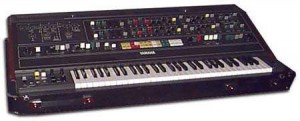
A very old and very huge (over 200 lbs.) classic synthesizer. Considered Japans first great synthesizer. It had some pretty amazing features for its time such as eight voice polyphony, patch memory storage and polyphonic aftertouch. It can generate great analog strings, brass, drones and pads with that instantly recognizable classic polysynth sound. No synth sounds greater. Some examples of its extremely fat sound can be heard in “Blade Runner” and “Mutiny on the Bounty” by Vangelis as well as “Dune” by Toto. The thing that really made this synth sound so powerful was its “natural” detuning….thus its brass and string sounds were unparalleled not only for authenticity, but for pure width! Unfortunately for the CS-80, it was released the same year as the more programmable and cheaper Prophet 5.
With two analog oscillators per voice, the CS-80 has the potential for some really fat sounds! A great VCF filter with independent hi pass and low pass resonant filters, a powerful ring modulator and plenty of modulation controls further enhance the CS-80’s sonic potential. There are 22 preset sounds (6 user) selected from bright and ugly colored buttons above the keyboard. The keyboard is weighted and has a full 61 keys with performance controllers for vibrato, pitch, brightness and volume. Surprisingly there’s also a long ribbon controller for the pitch-bending, located above the keyboard. There is no MIDI or cv/gate control. The only way to MIDI it is via a rather complex retrofit receive-only kit from Kenton.
Circuit bent Yamaha PSS-780
Analog Chorus Hacked to reveal sweet LFO, which is then patched into the Pitch-Bend wheel for Pitch LFO. Also can be patched into the drum circuits for unique Drum Pitch LFO……
Loads of Glitch Mods for the Digital Drum machine section, including Pitch Modulation Knobs (Pitch down & Pitch Up ‘Over-Clock’ Knobs), Tonal Distortion / Ring Mods, Glitch & Phat Modulating Bleep Tones / Bass Tones…
Description of the PSS-780:
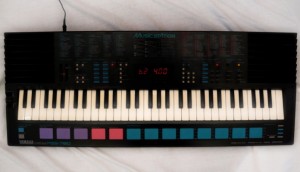
The Yamaha PSS-780 is a five-octave (61-key) small-key keyboard, and was a very sophisticated keyboard when it came out in 1989.
The keyboard uses a 2-operator FM Synthesizer to produce 100 pre-set voices, and also offers manual control of some (but not all) of the synthesizer parameters, so the user can create their own sounds. Five user-defined sounds can be stored in memory with single-button access. Percussion is PCM (sample) based, and can be played manually using the row of pads in front of the keyboard. A total of 32 percussion sounds are available, selectable in four banks of eight, and custom rhythm patterns can be created and looped using the “Custom Drummer” feature.
There are also 100 pre-set rhythm and auto-accompaniment patterns, each with an orchestrated ending and three different fill-ins available. The fill-ins are orchestrated, and are activated using the three large purple pads in front of the keyboard, and are therefore very easy to hit at the right moment during a live performance. The three fill-ins can also be used as Intros, but when used like this they play percussion only with no orchestration, and the orchestration begins after the Intro. With the “Synchro Break” function enabled, you can also add your own manual fill-ins or a drum solo (!) using the drum pads during the performance. This works with either the pre-set rhythms, or your own “Custom Drummer” loop.
There is also a five-track sequencer, which allows independent recording of each track using different voices (including user-defined voices) with simultaneous playback, together with auto-accompaniment or custom rhythm pattern, so complex orchestrations can be achieved.
There is also a pitch-bend wheel (configurable range between 1 and 12 semitones) and lots of other features and effects which I won’t detail here – get the Manual if you are interested.
While the PCM rhythm sounds each have a defined stereo “position” the voices are fundamentally mono, and the only stereo effect comes from enabling the “Stereo Chorus” function.
The built-in speakers are remarkably good (as expected on a Yamaha), but my example has an unusually hissy amplifier, and there is also a constant high-pitched whistle on the output. The hiss gets even worse when “Stereo Chorus” is enabled. I have owned my PSS-780 since I was bought it for Christmas in 1989, and it has always had this noisy output, so I suspect this is a design flaw on the PSS-780.
There is an interesting easter egg in the PSS-780’s firmware. If you hold down the top two white keys at the far right-hand end of the keyboard while switching on the power, the keyboard enters what I can only assume is some kind of diagnostic test routine. I won’t spoil the surprise for you, but try pressing some buttons and see what happens! Don’t worry – you can restore normal operation by switching off and back on again.
Demonstration of the Yamaha Voice Editor Essential
Voice Editor Essential is a simple Core MIDI iPad editor application to edit parameters in Yamaha synthesizers.
The editor focuses on detailed editing of insert effects, system effects, arpeggiator and EQ that are frequently modified and can take advantage of the iPad’s large graphic display. In addition to that, you can control parameters like EG or cutoff in real-time by using fader control or XY Pad. Some essential global parameters including tap tempo and volume control are also included.
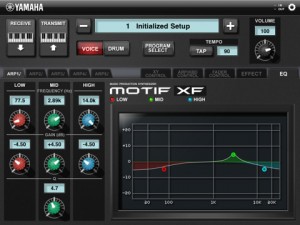
*Yamaha MOTIF XF offers you WiFi connectivity which enables wireless control.
Compatible model : MOTIF XF
Features
Effect Mode
・In effect mode you can select and edit Insert effects, the System effects and the routing and sends and returns for all the effects in a Voice.
EQ Mode
・You can edit the MOTIF XF’s Voice EQ and store different EQ setting for each of 50 Templates.
・you can adjust the Mid Bang EQ setting by pinching the band
Nice demo of the Roland D-50 Linear Synthesizer (1987)
Roland D-50 Linear Synthesizer from the year 1987
a real classic synth!
8-bit attack or looped PCM samples and digital oscillators (saw & square), low pass filter, chorus and reverb fx…
this demo shows the different sound possibilities. first a few legendary D-50 patches and in then second part some special sounds.

More on the D-50:
The D-50 is an all-time favorite digital synth that’s still just as popular today as when it first came out in ’87. Once Roland’s hottest digital synth, it competed against the Yamaha DX7, and was much easier to use. By joining 8-bit PCM samples with “LAS” synth-generated sounds, the D-50 is capable of unique and complex sounds. The PCM samples contained the attack transients, while the rest of the sound came from the Linear Arithmatic Synth (LAS) section which sounds very analog, with subtractive-style synthesis and low-pass-resonant filters. Built-in chorus and (for the first time) digital reverb are also included for giving your sounds space and life! It also has a joystick controller for real-time timbre manipulation. The D-50 was great for new and non-acoustic, percussive, ethereal and beautiful pads & sounds.
Both the D-50 and D-550 benefit from the PG-1000 external controller which gives you very plain and simple slider/fader type control of all adjustable parameters of the synth. The D-50 includes MIDI on all 16 channels but because it is monotimbral you can only use one channel at a time. There is an upgrade which will give the D-50 and its rackmount version a full 16 channels of simultaneous MIDI multitimbral data communication. This popular synth has been widely used in all forms of music.
“The Unknown” by TSF
“This new composition is about the unknown, and having no idea where things are going but knowing that you’ll get there somehow and enjoying the journey along the way.
The piano lead (Yamaha Motif-6/A-90) played by Danielle is improvised over the accompaniment of the Jupiter-8 res/bass patch and the D-50 synth strings patch played by Crystal.
TR-808 drum machine is also used for an analog percussion track.
Please enjoy the randomness.
and thanks for joining us on the journey. :)”
Joerg Schaaf – Flyday ’99
Background information: “Flyday” is a 1999 remix of a song, I made in 1989. It was originally planned as a bonus track on my album “sonar eXperience” but I decided against it as it was too different from the rest of the album. The following equipment has been used: MiniMOOG, DX7II, MKS50, D550, ESI 32 Sampler.
Profile:
Jörg Schaaf arbeitet seit 1985 erfolgreich in verschiedensten Bereichen der Synthesizer-Technik und Musikproduktion. Vom Sound-Design für Theater, Film und Industrie, Durchführung von Messepräsentationen bis zur kompletten CD-Produktion reicht sein Aufgaben-Spektrum.
Außerdem hat Jörg Schaaf an der konzeptionellen Entwicklung elektronischer Musikinstrumente mitgewirkt und sich dabei intensiv mit dem Design interaktiver, musikalischer Bedienoberflächen beschäftigt. Bei der Erstellung von Werksprogrammen und Samples für alle Arten elektronischer Musikinstrumente können Sie auf einen erfahrenen Sound-Programmierer zählen.
Being creative – Polycheesy GX-800
This guy knows how to save some bucks 
No normal man can afford to own the synth of all synths: the Yamaha GX-1. So I decided to get creative. This is what I came up with It’s a Yamaha CSY-1, Yamaha’s first organ with an integrated analog synth. It actually contains GX1 technology. I made the synth fully programmable and exchanged the lower keyboard for a Korg Poly 800 . So now this isntrument contains an organ,a fully programmable monosynth with aftertouch and a polyphonic synth! This is just an improvisation but it gives an impression of what the isntrument can do.
The Polycheesy name comes from the row of yellow modulation wheels on the programmer. Bad joke, I know.

The GX-1 on the other hand was Yamaha’s first big polyphonic analog synth, and it was a beast! Considered the predecessor to the CS-80 (another huge poly-synth), the GX-1 featured a triple-tiered keyboard, pedalboard, ribbon controller, eight polyphonic voices, chromed pedestals and a $50,000+ price tag! OK, so it wasn’t designed for your everyday musician – less than 10 were ever made and have been owned mostly by legendary synth/keyboard players including Keith Emmerson, John Paul Jones of Led Zeppelin, Stevie Wonder, Rick Wright of Pink Floyd, George Fleury, Richard James of Aphex Twin, Benny Andersson of ABBA, and Hans Zimmer who bought Keith Emerson’s.
Although it may look like an organ at first glance, it’s all analog heaven inside! The two main keyboards have 61 (velocity sensitive!) keys each, and are supplemented by a smaller (3/4 scale, pressure sensitive) 37-note keyboard and a 25-note pedalboard at your feet – 184 keys total! Eight voices of polyphony plus an additional monophonic are available and can be shared and layered or split up among the different keyboards. There are also organ-style drawbars and a ribbon controller for tweaking the sounds. Additional programming buttons are hidden away under drawers and panels on the front-panel.
The GX-1 used two analog oscillators per voice which are pretty much the same one’s used later in the CS-80, along with a mild 2-pole VCF filter, standard LFO and some ADSR envelopes. The GX-1 also had two “swell” pedals and a spring-loaded knee controller. It was truly a lush synth for its time, and its frequent use by many rock-legends helped cement its place in history as well as pave the way for the legendary CS-80.
Please note that there are no built-in speaker in the GX-1 as with many other organs, they are external. See the speakers on each side on the photo.
Live modular performance – Muon Dependency
Would love to spend some time in this dude’s studio
A live performance. A 137 space modular synthesizer, Waldorf MicroWaveXT, Dave Smith Prophet 08, Nord Lead 2X, Yamaha TX816, DX7II, and Oberheim Matrix 6.
All synthesizers are controlled either with Numerology 3 Pro or from the modular synth on-board sequencers. Recorded in Cubase 4 from Steinberg.
I played a single line at various times on the DX7II. Everything else is fully automated including a pseudo-random sequence generated by a Catgirl Synth Suboscillator/Harmonic Sequencer module by Ken Stone.
The baseline is the Prophet 08 controlled by a midi output from the synthesizers.com Q172 midi output of a Q960 8 step sequencer pattern.
Background info on the Numerology 3 Pro:
Numerology 3 is a music sequencing and audio plugin environment which uses an innovative approach to electronic music composition based on modular step sequencing. With version 3 Numerology now comes in two flavors: a Standard Edition for anyone that wants an economical step sequencing addition to their studio, and a Pro version with advanced features for users looking to make Numerology a cornerstone of their compositional workflow. Another major addition is an AudioUnit version of Numerology that allows users of supported hosts to add advanced step sequencing to their DAW-based workflow. The Numerology AU is the first Audio Unit plugin to offer sample-accurate MIDI scheduling and built-in latency control.
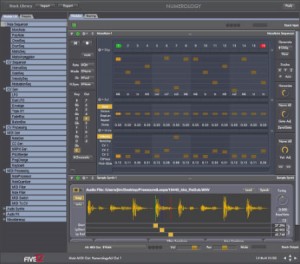
Other highlights of Numerology 3 include new generative sequencing options, a completely revised user interface, a preset playlist, a humanize function, Audio and MIDI recording for every part, and several new and updated modules. These features expand and complement the capabilities provided by Numerology’s extensive list of sequencing and signal processing modules. With version 3, Numerology’s library of modules now numbers more than 50, not including hosted Audio Units.
The Generate and Evolve features in Numerology 3 allow users to explore new compositional territory by using generative algorithms both to create new patters, and to make transformations to existing patterns. The Generate feature includes 18 algorithms for generating new patterns, and is setup to allow users to easily control the musical context in which the pattern is generated. Evolve goes a step further by allowing users to program specific algorithmic changes to a sequence. These changes can be triggered directly, or setup to automatically repeat for regularized pattern modulation.
Features specific to the Pro version of Numerology include multi-output support for hosted AudioUnits, monophonic audio routing support, OSC support, custom scale quantization, and several new modules specifically oriented for building advanced sequencer setups. Included in that set are gate generator and clock offset modules, a CV To Audio module for driving an analog synthesizer directly from Numerology (with a DC-capable audio interface), and a pair of operator modules supporting a total of 61 functions.
Both the Pro and SE versions of Numerology 3 come with much improved synthesis options for the built-in sample-based SampleSynth and DrumKit modules. These modules now include a multi-mode filter, 2 AHDSR envelopes, a beat-synchronized LFO and a modulation matrix. Complementing these additions are a new set of built-in audio effects, including tempo-synchronized delays, multi-mode filtering, and a ring modulator.
Two new features in Numerology 3 greatly expand user options for storing and sharing presets and patterns, the Stack Library and Module Presets. The Stack Library is a new centralized location for storing part-oriented sequencing and synthesis setups. The Numerology 3 download comes with a library of stacks that include a variety of demo tracks, examples and core sequencing templates. In addition, the new module preset function in Numerology 3 allows users to easily store and load settings for any module. This feature is particularly handy for keeping track of sequencer patterns as well as building preset libraries for the SampleSynth and DrumKit modules.
Yamaha MOX Artist Movie
Exclusive Yamaha artists see the new MOX synth for the first time and offer their opinions!
That interest is set to soar as Yamaha announce a highly informative and entertaining Artist movie featuring some of the UK’s top players including Marcus Byrne (Annie Lennox), Take That’s musical director Mike Stevens, George Michael’s keyboard player Luke Smith, Sean Barry (Ollie Murs, Pixie Lott, Girls Aloud), Luke Juby of Mike & the Mechanics and Bob Geldof’s synthmeister Alan Dunn.
About the MOX:
For the past decade the MOTIF has been the de facto industry standard in music production synthesizers for both live performance and studio use. Combining MOTIF technology with new USB computer integration technology, the MOX series is the most powerful, mobile and affordable Yamaha music workstation ever. They are destined to bring MOTIF music production power to a whole new generation of players.
– 1,217 Voices and 355 MB of waveforms taken from the MOTIF XS
– XA (Expanded Articulation) tone generation system
– More than 256 Performances that spark your musical inspiration
– Virtual Circuitry Modeling (VCM) effects
– 6,720 arpeggiator patterns and the 4 part interactive arpeggio engine
– Direct Performance recording
– Performance Creator for quick setting of Splits, Layers, and Drum Parts
– Category Search provides instant access to the Voices you want
– Comprehensive sequencer including step recording
– New developed 61-key semi weighted keyboard for MOX6
– 88-key Graded Hammer Standard for MOX8
– Lightweight body
– Built-in 4-in 2-out USB Audio/MIDI interface
– Bundled with Cubase AI
– The YC-3B Organ Emulator soft synth and Prologue analog synth available
– Advanced Integration with PC
Custom made drum sounds for Yamaha
Classic drum sounds
This is a demonstration of the custom sounds I made for my Yamaha FB-01 using the Atari ST program “Caged Artist FB01 Editor”. As you can see… its possible create drum sounds similar to what you’d hear on a drum synth, as well as create typical FM sounds… and even a very clear sounding square wave. I am sure someone will comment with “this sounds like Sega Genesis” and I agree mostly.
PS – there are no external effects applied… not that it sounds like there are
DATAMASKIN

