
Building DIY SammichFM 2011
Background data:
This year I build a Wilba SammichFM DIY synthesizer kit. It is bases on the famous Yamaha OPL3 sound chip that was also used on the famous Sound Blaster Pro 2.0 and SoundBlaster 16 ASP sound cards. It is a 4 voice FM synthesizer that sounds a lot like the famous Yamaha DX series. During the construction of the synthesizer I filmed the whole process. This movie is an excerpt of the 4 hours total build time. I made the 3D animations myself in Cinema 4D. The music you hear in the background in a track called ‘thermosphere’ from my ‘AtmoSphere’ album that I released in 2008. More information on the album on http://www.synth.nl/AtmoSphere. If you are interested in the whole build process of the SammichFM you can read that back on my blog on this URL: http://synthnl.blogspot.com/search/label/sammichfm
Yamaha DX7 – DeeEx collection of 80’s FM synthesis programs for Live, Kontakt, Renoise & Logic
Puremagnetik has released DeeEx, which they describe as a collection of 80’s FM synthesis programs based on the Yamaha DX7. It includes almost 500MB of professional multisampled instruments and is now available for Ableton Live 8, Kontakt 4, Renoise and Logic. Here’s all the details directly from Puremagnetik:
For Ableton Live
Each DeeEx Live Rack employs Sampler’s unique Frequency Modulation capabilities for extreme tweaking, beyond what the original was ever capable of. All DeeEx instruments were built and programmed within Live for a seamless production experience. With expertly crafted macro controls, powerful effects racks and high quality samples, DeeEx for Ableton Live brings one of the most legendary synthesizers in history right to your desktop.
For Kontakt, Renoise and Logic
DeeEx for Kontakt has been customized to offer a huge range of tweakable parameters. Within DeeEx’s KSP-based user interface, music and sound producers can immediately take control of numerous effects and sound shaping options. The Renoise and Logic versions of DeeEx have been built from the ground-up for a seamless user experience. XRNI and Logic Channel Strips integrate directly into their hosts for quick access and easy playability.
DeeEx Features
- Over 20 professionally multi-sampled instruments
- Over 600 high quality samples
- Advanced Ableton Live Racks with Macro Controls
- “Renoise Ready” XRNI files for instant playability
- Kontakt KSP easy edit GUI
Requires Ableton Live 8.2.1, Kontakt 3.5 or Logic 8
250 MB of physical RAM
600 Megabytes (MB) of free hard disk space
More information:
DXi FM synthesizer version 3.1.0 on iPad
DXi is a FM synthesizer application inspired by 80’s most popular synthesizer. Enjoy making music and creating sound by FM synthesis engine easily.
The movie show you the new great features about DXi version 3.1.0.
Please visit the URL for more information: http://itunes.apple.com/app/dxi-fm-synthesizer/id370138065?mt=8
FM synthesizer is still popular among many people by its unique tone. We carefully selected parameters from original synthesizer so you will be enjoy editing tone with them easily. You need to know some technique to tweak the tone, but you will be able to get DXi’s special tone and effects while having some fun!
Creating sound effects is another idea to enjoy DXi.
We loaded 16 step loop sequencer as a bonus feature!
If you remember the days of FM synthesizers, try creating the tone you remember from them.
If you have no experience with any FM synthesizer, we are sure you will be enjoying the unique tone world!
* 4 operators FM synthesizer
* Anti-ailiased oscillator
* 8 algorithms
* Envelope, frequency (Ratio or Fixed) can be set each operators.
* Feedback control on operator number 4.
* 2 master effects (LPF with Resonance and Delay)
* Import/Export function to save the tone you created. (URL schema text string format)
* Audio recording function. And you can transport recorded audio file, .wav, onto Mac/PC via iTunes file sharing.
* Clipboard audio sharing support. You can export recorded waveform to other application via clipboard. It’s compatible with Intua’s clipboard.
* Supports external MIDI keyboards via Core MIDI USB adapters. iPad users can use Camera Connection Kit. And iPhone/iPod touch users can use Yamaha i-MX1.
About the original – Yamaha DX7:
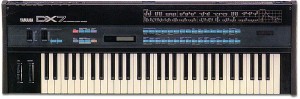
One of the most popular digital synths ever was the DX7 from Yamaha, released in 1983. It featured a whole new type of synthesis called FM (Frequency Modulation). It certainly is not analog and it is difficult to program but can result in some excellent sounds! It is difficult because it is non-analog and thus, a whole new set of parameters are available for tweaking, many of which seemed counter-intuitive and unfamiliar. And programming had to be accomplished via membrane buttons, one data slider and a small LCD screen.
Still the sounds it shipped with and that many users did manage to create were more complex and unique than anything before it. Percussive and metallic but thick as analog at times, the DX-7 was known for generating unique sounds still popular to this day. The DX-7 was also a truly affordable programmable synth when it was first released. Almost every keyboardist bought one at the time making the DX-7 one of the best selling synths of all time! It also came with MIDI which was brand new at the time – Sequential had already released the first MIDI synth, the Prophet 600. Roland had just released the JX-3P with very basic MIDI implementation, and wouldn’t get around to adding full MIDI for another year with the Juno-106, and it would be three years before Roland can counter the popularity of the DX7 with a digital synth of their own, the D-50.
Yamaha PSR-190 Drums for Ableton
Download the live set @ http://bit.ly/freesynth35
All sounds made with my Yamaha PSR-190 keyboard from the early 90s or so. Have fun with it and enjoy!
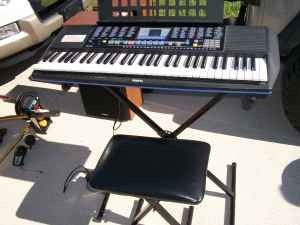
I like to think that there is a place for just about every sound or instrument, somewhere, in some song. It doesn’t matter how cheap it is or whether it’s top of the line gold or a bargain bin reject, sometimes things fit perfectly. I’ve found this to be true with a cheap RadioShack microphone, which barely qualifies as a nice toy, but actually records some nice room sounds for drum tracks. And another time with my far-from-classic Yamaha PSR-190. I got the PSR-190 shortly after starting to play guitar and was immediately amused by its built in rhythms and preset sounds that are nothing like the instruments they are named after. Its career in dust collecting was off to an impressive start. But as I grew and ventured off into the world of recording, I began to appreciate its character. I think I began incorporating it into some of my songs as its final test, failure meaning a swift trip to the Wednesday morning trash pick up or an adolescent reenactment of the final minutes of any good Nirvana concert (read: smashed to smithereens). Now I would never want to listen to a track composed entirely of PSR-190 sounds, but a layer or two often fit surprisingly well.
This week’s Free Ableton Live Rack is a drum rack made up of the Yamaha PSR-190′s awesomely late 80s-ish kit. There’s some really indispensable kick and snare sounds, and the toms… the toms are such a charming $80 attempt at Phil Collins that you have to love them. There were fourteen sounds in total, but to make things fit nicely on your MPC style pads, I modified a Kick and Snare sound, stretching them using Ableton’s Impulse instrument. I’ve included some FX to allow for some further sculpting. The video will take you through the particulars.
Switched on Buch la ti doddle
Buchla in full action, enjoy
Buchla System #1 and Roland System 102 (Filter Ringmodulator low drone)
Akai MFC 42 Panning
Alesis Metavox
Line 6 Filter Pro
Make Noise Format Jumper
Moog MP 201 C251 VX 351
The Knas Ekdahl Moisturizer
Yamaha MCS 2
Sequenced by Roland EF 303 (12 steps)
via Logic
Steinberg’s Yamaha Vintage Plug-in Collection
Steinberg has released the Yamaha Vintage Plug-in Collection. Announced at this year’s Musikmesse in Frankfurt, Germany, the Yamaha Vintage Plug-in Collection comprises three groups of plug-ins: the Vintage Channel Strip, Vintage Open Deck and Vintage Stomp Pack. Based on Yamaha’s Virtual Circuitry Modeling (VCM) technology, each plug-in can be used in multi-instances and is compatible with VST 3, VST 2.4 and AU plug-in formats.
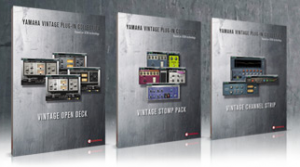
The Vintage Channel Strip consists of the EQ 601, Compressor 260 and Compressor 276, reproducing the sound characteristics of several classic Yamaha hardware equalizers and compressors from the 1970s.
The Vintage Open Deck recreates the analog circuitry and characteristics of four legendary tape recorders: Swiss ’70, Swiss ’78, Swiss ’85 and American ’70. For an even wider range of variation, the characteristics can be individually applied to the record and playback decks.
Vintage Stomp Pack features the Dual Phaser, Yamaha Phaser and Max 100 phaser plus one Yamaha flanger and one first-class wah-effect, providing effects processors for the typically 1980s’ rock sound.
A 30-day evaluation copy of the Yamaha Vintage Plug-in Collection is available through the Steinberg website.
Vintage Channel Strip features at a glance
- Yamaha EQ 601: six-band vintage EQ based on a legendary hardware model
- Compressor 260: replicates the trademark sound of a sought-after 1970s’ compressor
- Compressor 276: delivers classic-style compression with analog punch and fatness
- Brings the classic sound of top-end studio staples to your DAW
- Based on the popular VCM add-on effects for Yamaha’s digital mixing consoles
Vintage Open Deck features at a glance
- Four different machine types: Swiss ’70, Swiss ’78, Swiss ’85 and American ’70
- Various tweaking options: tape speed, tape type, bias, EQ settings, distortion and saturation characteristics
- Different machine types and parameters can be individually applied to the record and playback deck
- Faithfully replicates the unique sonic characteristics of legendary open reel tape recorders
- Based on the popular VCM add-on effects for Yamaha’s digital mixing consoles
Vintage Stomp Pack features at a glance
- Phaser galore: Max 100, Vintage Phaser and Dual Phaser for beautifully evolving phaser sounds
- Vintage Flanger provides authentic, ’70s-drenched flanger tones for every taste
- Vintage Wah brings back the distinct character of classic wah-wah stomp box effects
- Faithfully replicates the trademark sound of classic analog stomp box effects
- Based on the popular VCM add-on effects for Yamaha’s digital mixing consoles
Pricing and Availability:
The bundled versions of Yamaha Vintage Plug-in Collection are available through the Steinberg Online Shop and at certified Steinberg dealers. The exact time of availability is subject to regional variations. The plug-ins of the Vintage Channel Strip can be purchased individually and are exclusively available through the Steinberg Online Shop.
The suggested retail price for the Vintage Channel Strip bundle is EUR 379, including German VAT, and GBP £320, including British VAT. The suggested retail price for the Vintage Open Deck and Vintage Stomp Pack bundles are EUR 199 each, including German VAT, and GBP £168, including British VAT.
The suggested retail price for the Yamaha EQ 601, Yamaha Compressor 260 and Yamaha Compressor 276 plug-ins, also available as bundle in the Vintage Channel Strip, are EUR 149 each, including German VAT, and GBP £126, including British VAT.
More information:
Space music: The Aristocratic Mouse
A 1960s Space-Age/Lounge style song with Yamaha YPT-400, Moog Memorymoog, Synthesizers.com modular and Fender Stratocaster.
Nice Omega Code 8 Polyphonic demo – Arp 2600 and CS80 filters
Here’s some background information:
When I touch the big knob under the screen I’m changing the filter type or tweaking filter parameters for the CS80 filter. I picked up a fully loaded 4 month old Code 8 this week, with 8 Arp 2600 and 8 CS80 filters! I was up late last night playing it for hours….Sounds a bit like an Oberheim OBX. When you turn on all the waveforms it will saturate a bit, so it’s not super clean like everyone says.
Filter demo here
http://soundcloud.com/coolcolj/studio-electronics-code-8
And CS80 filter demo
http://soundcloud.com/coolcolj/code8-cs80-filter
Arp2600 filter demo
http://soundcloud.com/coolcolj/studio-electronics-code-8-1
iPad App – DXi FM Synthesizer Demo
Short demo of some of the sonic features of this FM app by Takashi Mizuhiki. DXi brings FM to your iPad, but it’s closer to the DX27 than the legendary DX7. There are four operators rather than six and polyphony is reduced from 16 to three, from what we can tell. DXi also offers a neat 16-step sequencer and an effective XY performance pad, to mix operators and patterns in real time.
Description
DXi is a FM synthesizer application inspired by 80’s most popular FM synthesizer. You will enjoy creating sounds as well as playing music with this application.
FM synthesizer is still popular among many people by its unique tone. We carefully selected parameters from original synthesizer so you will be enjoy editing tone with them easily. You need to know some technique to tweak the tone, but you will be able to get DXi’s special tone and effects while having some fun!
Creating sound effects is another idea to enjoy DXi.
We loaded 16 step loop sequencer as a bonus feature!
If you remember the days of FM synthesizers, try creating the tone you remember from them.
If you have no experience with any FM synthesizer, we are sure you will be enjoying the unique tone world!
* 4 operators FM synthesizer
* Anti-ailiased oscillator
* 8 algorithms
* Envelope, frequency (Ratio or Fixed) can be set each operators.
* Feedback control on operator number 4.
* 2 master effects (LPF with Resonance and Delay)
* Import/Export function to save the tone you created. (URL schema text string format)
* Audio recording function. And you can transport recorded audio file, .wav, onto Mac/PC via iTunes file sharing.
* Clipboard audio sharing support. You can export recorded waveform to other application via clipboard. It’s compatible with Intua’s clipboard.
* Supports external MIDI keyboards via Core MIDI USB adapters. iPad users can use Camera Connection Kit. And iPhone/iPod touch users can use Yamaha i-MX1.
Time machine – YAMAHA SY22 Vector Synthesizer 1990
Analog Audio continues to update us on classic vintage synths, today’s feature is the Yamaha SY22:
The Yamaha SY22 came out 1990. It is an interesting vector synthesizer. Other vector synths are the Sequential Circuits Prophet VS and the Korg Wavestation – but the SY22 was the most affordable of its kind.
Although instruments like Roland D-50 and Kawai K-1 have joysticks to mix waveforms, they are not vector synths. A real vector synth can reproduce the vector moves in a sound program.
Rumors said that some ideas from the developer team of Sequential were implemented, since they worked for YAMAHA for a short period of time.
The SY22 is a quite simple vector synthesizer – also simple to use and to program. The SY22 has no filters at all. Interestingly, 4 elements can built a sound, 2 FM (4-op frequency modulation) and 2 AWM (sample playback).
It also has a built in effect processor for reverb and delay. You can not tweak the effects except intensity.
It’s much more easier to program sounds on the SY22 than on a Korg Wavestation. The programming on a Korg WS is a nightmare, because you have to handle with the 34 patches / 50 performances problem. Also you can’t program vector moves in realtime – like on the SY22.
Of course, a Wavestation sounds “bigger” in the end, but the SY22 sounds not bad, either. The SY22 is great for strange pads and ambient stuff.
I played the YAMAHA SY22 without any additional effects or eq. The most sounds you are hearing in this video are my own creations – so don’t expect these sounds when you buy one…
DATAMASKIN

