
Playing the fat Oberheim OBXa
This truly powerful piece of music is played and shared by “magevers”, enjoy
Synth solo played on the fat “jump” analog Oberheim OBXa + Roland D 50 and the analog Roland JUNO 60.
Live recorded with Sonar 8.
EFX: Roland DEP 5 and Sonar stereo reverb.
Ableton Live 8 vocoder demo
Video shared by Torley
Geth Legion robot voice from Mass Effect in Ableton Live 8 vocoder
Routing tips for the KORG iMS20
With the new KORG iMS20 for iPad out now I thought it be good to revisit the original synth the MS20. Many who will download the iMS20 has probably never owned or used the original synth and how to go about routing it to make the sounds it has become famous for. Therefore I have uploaded a couple of tutorials with the original synth to give you an idea how to go about creating those sounds on your iPad version. Since that really is the beauty with the iPad version that it functions very close to the original.
If you have more input on the topic please leave your comments:
About the original machine:
The MS-20 was one of Korg’s first major successful portable analog monosynths and even today it is still a great little machine! The MS-20 is the big brother to the MS-10. It is an analog two-oscillator monophonic lead and bass synth with hard wired and patchable connections. The hard-wiring can be overridden however, using patch-cords. This type of hard-wired but patchable design was similar to the ARP 2600 of the late seventies. Of course the 2600 was much bigger and better. But the MS-20 offered a lot of flexible control and great sounds at a more affordable price.
In addition to two analog oscillators, the MS-20 featured two resonant VCF filters, two VCAs, sample and hold, a noise generator, an assignable mod-wheel and lots of knobs! The VCF filter section is capable of high-pass, low-pass, notch and band-reject which is unique and different than your basic lowpass style filter. External sound sources can be routed through the filter section as well. In fact William Ørbit uses the filter in his MS-20 relentlessly to filter and tweak his samples, beats, delay returns, vocals, etc.
There’s also a Pitch-CV converter for triggering sounds from external sources. Aphex Twin makes quite a bit of use of this, feeding the input stage of his MS-20s with drum sounds and other untrackable audio to get the synth to make a wide variety of crunch/squawp/screech noises by mistracking the filters, etc.
As for its sounds, the MS-20 sounds great! It makes a great alternative for Minimoog-seekers. The MS-20 is great for just about any type of analog synth sound you could want! Fat round bass sounds, percussive bass or sounds, noise effects, squiggly-bubbly sounds or sinuous-worm leads are all waiting to be unleashed from inside this classic beast. The MS-20 is not only a great sounding instrument, but a great learning-synth. It is fairly easy and intuitive to operate but in doing so you can learn and understand more about synthesis and signal-flow. It is used by William Ørbit, Aphex Twin, Hardfloor, Air, SkyLab, Stereolab, Vince Clarke, Astral Projection, Biosphere, Apollo 440, Mr. Oizo, Jimi Tenor, The Prodigy, OMD, Freddy Fresh, Luke Vibert, Einstuerzende Neubauten, Add N to (X), Daft Punk, Coldcut, Die Krupps, Skinny Puppy, Electronic Dream Planet, Jimmy Edgar, Front 242, Front Line Assembly, The Legendary Pink Dots, KMFDM, Severed Heads, Royksopp, The Faint, The Shamen, Jean-Michel Jarre, and Portishead.
Reaktor User Library Harvest week 45
Here’s a brief summary of what’s been uploaded to the Reaktor user library this past week.
Reaktor Harvest sounds bytes w45 by Stereoklang Produktion
WeAreGlass by Gabriel Mulzer 
Remember filling up dads wine glasses with water? Now you can do that in Reaktor. Play with wine glasses I mean. WeAreGlass is a physical model instrument of rubbing a glass rim. It has 10 parameters controlling the physical model and 3 The GUI has a slight glass touch. There’s only one snapshot to get you started. Based on my brief playing session the sound possibilities is quite narrow to playing wine glasses but the it does it really well if somewhat difficult to find the right playing technic on a keyboard. I would love to try a touch pad.
Wave Bouncer by Kristian Thom 
Here’s an ensemble showing the User Library at it ‘s best. Wave Bouncer is a remake of Kristian Thom’s Wave Scanner from 2002 combined with Chris List Newtonian Bouncer and the result is a synth with sonic capabilities not unlike Korg Wavestation. Although there’s a plenitude of parameters which might be a bit intimidating at first most are really just repeating the same for each of the eight steps in the wave sequence. A tape delay with reverb is also added. 20 snapshots give you a wonderful platform for explorations in the Boards of Canada territories!
Tape Buster by Stefan Knauthe 
Tape Buster is a tape emulating effect made initially by Kristian Thom (see above) here adapted by Stefan into a dedicated effect. Credit also goes to S. Millward for other stages of the Tape Buster. The effect is divided into 3 stages, wow & flutter, aging machine and tube distortion each with some pretty self explanatory parameters. One snapshot provided.
Easy Creator by Eric Le Guenan 
Easy Creator is a straight forward subtractive synth with 2 oscillators, lowpass filter and one envelope generator, chorus, delay and reverb. The GUI is pretty slick and some 40 snapshots are included.
Indecent Percusions by Paco Calostro 
Indecent Percusion is a sample based drum machine with a 4/8/16/32 step sequencer. Some 80 percussion samples are included. Each sample instruments is controlled by 4 parameters. Each stereo channel has a dedicated eq. 12 snapshots included.
Life.V1.3 Ekuacion Mode v1.0 by Paco Calostro 
Life.V1.3 Ekuacion Mode is a sample based drum machine controlled by a sequencer take from the Newscool ensemble from the factory library. Also a eq section is added.
Link to summary of previous week.
Two cool looking drum synths for Windows
Marvin Pavilion has released version 1.0 of Hexagon ’85, and version 1.2 of Tromine Z, two virtual drum synthesizer instruments for Windows.
Looking pretty cool to me 
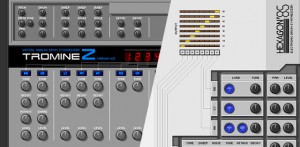
Changes in Hexagon ’85 v1.0
- Minor sound changes for drum sounds.
- Some parameter changes.
- MIDI CC support.
- Automation support.
- Fixed some issues.
Changes in Tromine Z v1.2
- Minor sound changes for drum sounds.
- Some parameter changes.
- Fixed some issues.
Hexagon ’85 and Tromine Z are available to download as freeware VST instrument plug-ins for Windows PC.
More information: Marvin Pavilion
It’s a game – pure electro pop
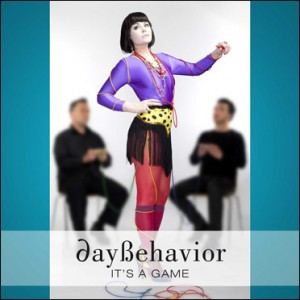
The new digital single from Swedish electropop trio Daybehavior is out now, complete with remixes by Parralox (Australia) and Marsheaux (Greece), two bands with a similar sound. The new album will be released later this winter.
SideLine offers a teaser below
Daybehavior – It’s a Game (free Side-Line magazine download) by Side-Line
New single to promote old stuff from old boys
“Together” is the title of the new Pet Shop Boys single, another collaboration with Xenomania. It’s in 5/5 waltz beat, and is a catchy little number made to promote their new compilation “Ultimate”, out since November 1. The single is out now in digital form and the physical release is on November 29.
The “Ultimate” special edition’s DVD includes BBC TV performances and their concert from Glastonbury this year.

A new documentary on the electronic pioneer Jean-Jacques Perrey
Dana Countryman has after seven years released a documentary on the electronic pioneer Jean-Jacques Perrey, read below for details

My biography on the legendary electronic pop pioneer, Jean-Jacques Perrey is finally out NOW!!!
This has been a seven-year project, and it feels so good to finally have my book completed, and out for sale!
It will be in stores soon, and also it will be on Kindle soon, but for now you can order physical copies from my web site.
The book is 312 pages long, and has over 250 photos and illustrations. This is the ONLY biography of this French genius, and I’m proud that Jean-Jacques chose me to write it.
I interviewed scores of Jean-Jacques’ collaborators and friends for this book, including Angelo Badalamenti, Robert Moog, Gershon Kingsley, Don Dorsey, Vinnie Bell, Billy Mure, and many, many more.
You can view sample pages on the ordering site here:
http://www.danacountryman.com/not%20yet.html.
I hope you’ll check it out.
New Necromare plug-ins
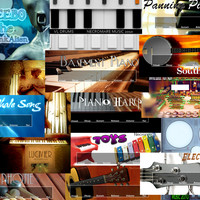
Necromare has released some more free sample-based VST instruments for Windows.
What can I say I love building instruments. I think it’s part of being a composer, to finally make the sounds you need and want. I keep coming up with ideas for instruments and there seems to be no end. I already have 50 plus most in the testing stages. Looks like I will be releasing them well into next year.
New Necromare plug-ins
- The Panning Piano – Simple piano that automatically pans left and right slowly as you play. Good for filing out a mix. The last octave includes some piano screeches.
- Piano Harp – Imagine if you played the piano like a harp? What would it sound like? It would sound like this VST great sound for mystical or romantic moods. Included in the last octave are Gliss samples for effect.
- Simple Acoustic Guitar – Straight Foward guitar. Good for picking or sketch work.
- Soft Mallet Xylophone – The xylophone played with a soft mallet. Velocity sensitive over 4 octaves.
- Toys – Toy Piano, a small scale piano with a tiny sound + an electronic children’s piano with baby xylophones instrument.
- VL-1 Drum – Drum sounds from the Casio VL-1 keyboard/calculator.
- Zeboo Drum Kit – Acoustic drum kit, GM Mapped. The last octaves are samples of Zeboo himself!
- Lucivier – The keyboard produces a celesta like tone while pipes produce flute like sounds at the same time. The bottom octave and the last are the sounds produced by using the three pedals on the bottom.
- Kazoo – The only instrument you need little to no experience to play. So why not try a VST. It’s a bit harsh but fun to knock around with.
- Gamelan Music – Three Gamelan instruments: Reyong, Gangsa and Calung.
- Electric Bass – Simple Electric Bass, keys are velocity sensitive to give a short note on harder strikes. The upper octaves include a classic bass slide.
- Whale Song – Made from CC whale song files. Includes a whale purr, a trumpet, gentle underwater sound fx, and more.
- Sinsonic Drums – Like many old toys from the past some have actually been used by pros. Mattel Synsonic drums have been used by kraftwerk and others. This is a knock off the original pays tribute to our toys of a bygone era.
- Basement Piano – Most homes might have one of these lurking in there corner basement. An old upright that you may have learned to play piano on or liked to beat on. Either way this pleasant piano will convey a warm nostalgic sound for your next tune.
- Southern Banjo – For some there is nothing like the sound of a picked banjo. for others they can do without. This is an attempt to faithfully recreate the sound of a great instrument.
The Necromare instruments are available as freeware VST plug-ins for Windows PC.
More information: Necromare
CMOS Sequencer Synth Jam
Simply speaking a square wave generated from a hex inverter, that is sent to a frequency divider (binary counter), and is sent to an 8-1 MUX
DATAMASKIN

