
Introducing ARP – advanced polyphonic arpeggiator and note sequencer
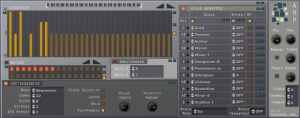
Homegrown Sounds has introduced ARP, an advanced polyphonic arpeggiator and note sequencer with scale remapping for powerful sequencing possibilities.
Here’s what they have to say about it:
With ARP, sequences can be re-mapped based on the played note – so, for example, a sequence can be forced to fit to the major scale. The idea behind this is to break away from the typical note sequencer where every key simply transposes the sequence, the ability to remap each note results in a much more creative sequence.
The Muter Section is a gate sequencer which decides which notes will play. ARP is also polyphonic and so can be used as a typical Gate Sequencer, or even more interesting as a polyphonic sequencer that syncopates. There is also the ability to offset the start note of each sequence so that when 2 notes are pressed together they automatically play syncopated. Finally there is OmniChorder which allows triggering up to another 2 notes when one note is pressed to create a chord, this becomes interesting when used with the Scale Remapper which can leave you with a selection of interesting one finger chords.
The demo version is fully featured, but times out after 10 minutes, it can downloaded here.
Full Feature List:
- Arpeggiator – Can be used as a classic ARP with the usual UP/Down/Alternate modes.
- Note/Sequence Repeats – This is used to play the note or sequence x amount of times before moving to the next note in sequence.
- 32 Note Sequencer Mode – This has a 2 octave range, centre value represents actual note pitch.
- 32 Note Muters – Basically a gate sequencer that decides if a note should play or not, can be used with the Sequencer or the Arpeggiator.
- 1-4 Octaves – Once the sequence is complete it will go up an octave as far as 4 Octaves.
- Fixed Velocity Mode – can use a fixed Velocity instead of played velocity, which is set via a knob.
- Latch Mode – Holds the note until the next one is played.
- Pulse Width – When Latch is off, this determines how long the pulse is, affecting how long the note trigger is held.
- Hold – This will hold any pressed keys until hold is depressed.
- OmniChorder – This can be used along with the Sequencer and also when the ARP is disabled. It allows setting 2 further notes to trigger to form a chord from pressing one key. Once this is enabled, the Scale Remapper can be used to manipulate the chord for each note in the octave, reminiscent of the classic Omnichord.
- Scale Remapper – Allows changing the Scale on each note (C – B) so that a sequence can be squashed to the scale:
- Over 70 scales to choose from.
- Sequence Offset – This allows offsetting the start note of each sequence when it is triggered. For example in Poly Mode pressing 2 keys together will start both sequences running, one could be set to start on step 2 so that it will syncopate. In Monophonic mode it allows building more complex sequence patterns as they iterate.
- Pitch Disable per note – This can prevent a sequence playing on the selected note, so that for example note C won’t play the sequence but just C notes. This is useful in Polyphonic mode so that one key can be consistent whilst another note can play a sequence alongside it.
- 7 Scale Mapping Modes – The mode decides how the scale is altered, when a note doesn’t match the scale, Up will select the next above, Down the next one down etc. There is also nearest, furthest and alternate. There is also a mode which holds the pitch of the octave, and simply uses the scale remapper to force the scale, useful for music without key changes.
- Works with the OmiChorder even when the ARP/Sequencer is switched off.
- Polyphonic – When used with a polyphonic instrument, notes can trigger individual sequences which is great for use with the Muters(Gate Sequencer) which can create complex rhythmic patterns.
- Midi Out – Can be used with any software or hardware midi instrument with host that support midi routing such as Reaper and Cantabile.
- Midi Volume and Pan – These can be used to set the volume and Pan of external gear (CC7 and CC10).
- Midi Channel – Use this to set which midi channel should be used.
- Manual Tempo – Normal Operation is based on the Host Tempo so that it remains in sync with the project, however manual mode can be used in the fashion of an old analog sequencer.
- Swing – Swing can be applied when the tempo is set to 32, speed can be reduced by changing the master clock tempo.
- Full VST Automation.
- Global / Local Randomizer/Default Buttons.
ARP for Windows (VST) is available now for US $20.
Millioniser 2000 • MIDI wind controller
http://www.millioniser.com Walt Miller Walter Müller Originator of Millioniser. Amazing Grace player by Rock Erickson.
Rock Erickson -The first American called to Europe to play and record with Walter Mueller’s Millioniser 2000. (Ronald Schlimme Engineer) Harmonica like in principal giving the end user complete control over synthesizer and midi functions with the sensitivity of your own breath. This instrument is a one of a kind powerhouse. The video starts off by showing the functions of Millioniser 2000 and then merges into the on stage video which was shot in London. Rick Fenn of “Lie For A Lie” Sony Music was the music director and lead guitarist along with Charlie Barret from The FIXX on bass. The Millioniser Breath Controller units that I’m currently using in the studio are breathing new life (literally) thru their capability to dynamically control some of the most popular software and rack synths ( Garritan Personal Orchestra, Roland Sound Canvas, Yamaha VL70 ect ) and samplers like SampleTank & Tascam Giga Studio ) in both the mono and polyphonic arena. If you have comments or questions please post here or email rock@millioniser.com
Keith McMillen Instruments introduces the 12 Step foot controller
Get going with your feet 
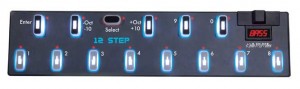
Keith McMillen Instruments (KMI) has introduced the 12 Step foot controller.
Keith McMillen had this to say, “With 12 Step, keyboardists, guitar players, bassists, instrumentalists and vocalists can accompany themselves with their feet, playing bass lines, notes and chords. 12 Step opens up a new dimension of performance by giving your feet unprecedented expressive control using polyphonic aftertouch and pitch bend. Upon the heels of the success of SoftStep, KMI’s versatile USB Foot Controller, 12 Step is another leap forward for performing musicians.”
Pricing and Availability:
$289.95
More information:
Emulator – Massive Multi Touch Screen System
“Essentially EMULATOR, provides a front end for creating multi-touch interfaces for existing MIDI controllable software. With a new modular editor enabling the design of custom interfaces, its possible to overlay your own control set while showing parts of the program if you wish (in thius case the Traktor waveform display is shown).
In this demo Alan Smithson (its creator) uses NI’s Traktor – DJ software, you can see the potential for some really great looking performances.
The system demonstrated here, comprises of the software package EMULATOR (£299) plus this 42 inch glass screen, stand plus projector its a great looking setup. (approx £5k)”
http://youtu.be/k4QS1xAWvU4
Emulator FT 1.5 now supports Native Instruments, Traktor 2 Professional DJ Software.
With the introduction of Emulator FT 1.5 for, DJ’s now have sample decks, loop recorders and more amazing effects literally at their fingertips.
Emulator gives the DJ all the functionality of Traktor 2 with a full multi-touch experience.
We tried to make Emulator more intuitive and easy to use so DJ’s can begin playing on a touch screen interface immediately. Whether they use a tablet PC, touch screen monitor or our holographic looking transparent touch surface, the DJ is now in total control”
Two new free soft synths: Jericho 4 and Opus 8 from Datura
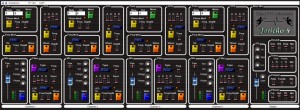
Jericho 4, the analog brass-synthesizer pushes down any wall. Using four independent sawtooth-modules, you will get fat brasses but also smmothy strings and pads. A flexible filter section, phase modulation, independend LFOs controlling the amplitude of each module and a four channel FX bus (reverb, delay, flanger and phaser) are ready for unique sound performances. For a creative work with Jericho 4, the workflow has been adapted to the 16:9 display format. All parameters and controls are visible well and can be changed comfortably. Mutch parameters can be remoted by the VSTi port of your host software. Changing sound while playback your song will be no problem.
For any advice check the manual that is found in the data-folder you get from the download.
– 4 channel sawtooth VSTi-syntehsizer
– 8 tone polyphony to any channel
– reverb, delay, flanger and phaser effect included
– separate modulators for each channel
– separate filter section for each channel
– easy to use
– 32 factory presets included
Jericho 4 is free.
Visit: datura-instruments.de
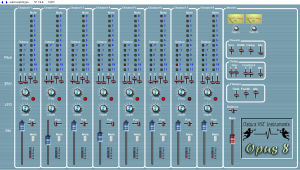
Opus 8 is more than a organ-sound-generator. Using unsyncronized LFOs on the amplitude of each channel it is possible to create complex soundscapes which appear endless. The well structured widescreen graphic design provides a creative workflow for smart progamming your new sounds. Just move and click your mouse a little bit and a new sound has born. Mutch parameters can be remoted by the VSTi port of your host software. Changing sound while playback your song will be no problem.
For any advice check the manual that is found in the data-folder you get from the download.
– 8 channel sinusodial additive VSTi-syntehsizer
– 12 tone polyphony to any channel
– reverb, delay and flanger effect included
– separate VCA-LFO for each channel
– easy to use
– 32 factory presets included
Opus 8 is free.
Visit: datura-instruments.de
New powerful EQ for magnificent mixes
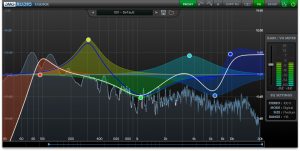
DMG Audio has released EQuick, an equalizer effect plug-in for Windows and Mac.
EQuick is a streamlined, ultramodern EQ built to help you make your mixes magnificent. Fast, intuitive and unbelievably flexible, we’ve packed it with digital functionality. We built its beautiful, clear graph with accessibility and efficiency in mind, and it’ll refine your workflow forever; but don’t take our word for it – test the claim and download the demo! We wanted to play with the idea of the interface; we wondered whether EQ could be made more intuitive, more direct, and how one would go about making an EQ that made the process even faster. EQuality speeds up your workflow because it sounds great, and you don’t waste any time compensating for defects in what it does. For EQuick we wanted to delve deeper into the design of the interface. Perfection is when there’s nothing more to take away, so we started by stripping down the interface to its most essential element – the graph. EQuick has nothing else. We had to work in all the controls (like Range and Shift) that made EQuality so special and we found that we could do that with the graph. Also, we took account of the fact that different people have different size screens – so you can pick your size for EQuick. But we couldn’t do that at the expense of control, so we built the tooltip system that provides you will all the data you need, when you need it.
EQuick features
- Overview
- Unbelievably low CPU usage for high instance counts.
- Generates super-high-quality prototypes. Clear undistorted top.
- Linear phase mode for mastering and special channels.
- 32 bands of EQ, Q 0.1->50, +/-36dB range.
- Each band can be Peak, HPF, LPF, High Shelf, Low Shelf or Notch.
- Each bank can process Mid, Side or the full stereo image.
- Fully parametric filters (high and low-pass), 6/12/18/24/30/36/42/48db/oct.
- Five different UI sizes.
- M/S processing per-band with listen.
- Windows VST and VST3 as 32+64bit, RTAS 32bit.
- Mac VST, VST3 and AU as 32+64bit, RTAS 32bit.
- Sound
- Bells and notches, with a +/-36dB range, and a Q range from 0.1 to 50.
- Shelves which let you move the resonance above or below the curve.
- Filters at 6/12/18/24/30/36/42/48 db/octave, sweepable resonance.
- Adjustable gain-q interaction for ‘musical’ usage.
- Vision
- Beautiful, clutter-free modern interface.
- Big, clear, antialiased graph.
- Hi-res Spectrum analyser.
- Range, to scale the EQ response, both +ve and -ve.
- Frequency shift, to allow you to retune the response.
- Large, configurable spectrum-analyser with readout.
- Control linking to move sets of bands together.
- Configurable VU, with variable ballistics.
- 8 banks of A/B.
- Full preset management system.
- Undo/redo.
- Autolisten mode, for quick finding/adjustment of frequencies.
EQuick is available to purchase for £74.99 GBP. A bundle with EQuality and EQuick is £124.99 GBP, and the EQuality, EQuick and Compassion Bundle is £224.98 GBP. Previous EQuality customers get EQuick at no cost.
Music in Neural Dimensions
This world premiere performance dives into an uncharted realm of human expression, as the conscious and subconscious minds of the performers become the very fabric of creation. Imagination becomes tangible, while hopes and fears are brought to life through EEG brainwave scanning technology. This performance was made possible with generous support from the Yahoo! Boost Award. The MiND ensemble (Music in Neural Dimensions) is a new-media performance group that utilizes custom interfaces to explore the mind-machine-music connection.
The traditional paradigm of creativity and art has been as following: there is an artist, a thought process, and fixed medium which reflects those thoughts, leading to the realization of the artist’s expressive vision. Neurofeedback radically shifts this paradigm. Now there is an artist, a thought process, and a dynamic medium that actively interfaces with the very thought processes of the artist himself, a form of expression that drastically reshapes the way we conceive of the creative process. This presents a unique design problem: how can we optimize interaction within a completely intangible instrument? The ensemble hopes to make strides towards a deeper level of understanding of this question, and a significant contribution to both the scientific and artistic communities in the form of software tools and reference material.
The MiND ensemble promotes a richly creative personal awareness in which the mind is the medium.
Pure Analyzer Essential – See What You Feel!
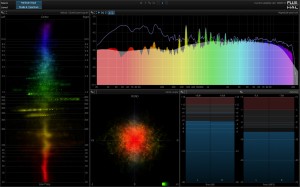
Flux has announced the release of Pure Analyzer System, a modular RTA-system providing an extensive range of analyzer options and metering standards, meeting the demands of any imaginable audio analysis and measurement applications within the fields of; Music Production, Audio Mastering, Live/Installation Sound, Broadcast and Post-Production.
The core of Pure Analyzer System is a standalone application presenting an unparalleled interface designed for ultra-rapid reactivity and intuitive instant user-interaction. The graphic analysis rendering is performed using a GPU-efficient OpenGL 2D/3D graphic engine, optimizing the audio to visual experience utilizing the GPU on a standard OpenGL graphics card.
Full I/O support through ASIO/Core Audio is provided, and for maximum flexibility and efficiency Pure Analyzer System present the option to separate the signal acquisition from the analysis utilizing SampleGrabber, a standard DAW plug-in (available in all common plug-in formats, VST, AU, RTAS as well as TDM for VENUE systems) to acquire the signal in any plug-in host environment and broadcast it through a local area network using the ZeroConf/Apple Bonjour protocol.
The Flux:: Pure Analyzer System presents a vast selection of analysis tools such as; Real-time Spectrum Analyzer, Vector Scope, Phase Meter, Oscilloscope, Real-time Metering History, Real-time and Offline Metering Statistics, furthermore, a wide range of enhanced metering options including the last EBU R128 loudness norm (PLOUD), ITU-R BS.1770, True Peak, K-System and all variants of PPM (BBC, EBU, Nordic etc.). A complete set of tools for System Analysis including; Multi-Channels reference support, Multi-Microphone support, Transfer Function, Coherence, Magnitude, Phase, Impulse Response, Delay Finder, Signal Generator and unlimited Snapshot with auto creation from Sweep and Average, is provided as well.
In addition to the extensive range of standard analysis options, Pure Analyzer System introduce a ground-breaking innovation: Flux:: Nebula Spatial Spectrogram and Surround Scope, presenting a unique representation of the audio material in terms of spectral content and localization in the stereo and/or surround space.
The Flux:: Nebula Spatial Spectrogram combines the functionality of a spectrum analyzer and a vector scope to provide a complete and detailed overview of the mix in order to literally be able to see what you hear and feel. The Flux:: Nebula Surround Scope presents a representation of how a surround signal’s various components are distributed in the surround environment.
The Pure Analyzer System is available for Windows, Mac and AVID VENUE, supporting up to 16 channels (for Multichannel/Surround and Multi-Microphone System Analysis) in up to 384 KHz.
Pricing and availability:
- Mandatory Base Version
- Pure Analyzer Essential 279 EUR / 399 USD
- Add on options (requires Pure Analyzer Essential)
- Pure Analyzer Metering 149 EUR / 219 USD
- Pure Analyzer Live 149 EUR / 219 USD
- Pure Analyzer Multichannel 149 EUR – 219 USD
interplay: john foxx and the maths (analogue video mix)
This new video uses analogue equipment in its creation, similar to the way John Foxx And The Maths have used analogue synths to make their music.
The pure analogue mix uses only video feedback and film processed through a 1980s video synth called a Chromascope. It gives an effect different from anything that can be done with software and matches the warmth and purity of the sounds used.
Spaceship-themed Synthesizer for Kids
“Several months ago I volunteered my skills to create a large, interactive control panel for an upcoming space-themed exhibit for the Kearney Area Children’s Museum. The project is multi-faceted and took quite a bit of time and energy to create, but in the end it came together very well!
Using the Auduino synth sketch for Arduino as a starting point, I created a synthesizer that uses two rotary potentiometers, two linear potentiometers and one infrared rangefinder to generate fun, interactive music. The sketch works best when multiple inputs are being used at once (i.e., moving your hand while moving a slider), but will generate some sort of tone regardless. The circuit board on the back is a simple class A amplifier and parallel 3.5mm audio jack to allow for more control over the volume of the synth. Now let’s just hope those kids don’t destroy the thing the first chance they get!”
Auduino: code.google.com/p/tinkerit/wiki/Auduino
Kearney Area Children’s Museum: kearneykidzone.com/
The Auduino is a sound synthesiser based on the Arduino platform. It works on all Arduinos running at 16MHz – everything from the original Arduino serial to the Arduino Mega. It uses granular synthesis techniques to generate a distinctive filter-sweep sound that had much more character than boring square waves. Sound is generated by playing the same noise (‘grain’) repeatedly at very high speed. This merges into a tone that is an audible hybrid of the repetition rate and the original grain. It sounds quite similar to an oscillator with two resonating bandpass filters, although the different architecture means there are lots of additional interesting noises at parameter extremes. The grain consists of two triangular waves of adjustable frequency, and adjustable decay rate. This is based on FOF synthesis model, but using triangle waves instead of sine and using a rectangular window. The repetition rate is set by another control.
DATAMASKIN

