
Fad Gadget/Frank Tovey tribute in New York – March 2012
Europe had it’s 2 Days Of Mute and now New York City will have FGFt, a three-part project series in homage to Frank Tovey – founder of the 1970s/1980s British electronic group Fad Gadget. FGFt will mark the 10 year anniversary of the pioneer’s death. Fad Gadget was Mute’s first signing in 1979, and an enormous influence on a whole host of electronic artists. Summoning a diverse group of artists and musicians who have been both directly and indirectly influenced by Tovey, the series will take place from March 1st through to April 8th, 2012 featuring a group exhibition, live music performances, and a film screening. All events are free and open to the public.
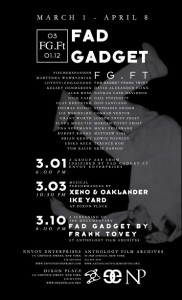
- March 1st – Group Exhibition Opening – envoy enterprises
- March 3rd – Live Performances – Dixon Place
- March 10th – “Fad Gadget by Frank Tovey” film screening – Anthology Film Archives
FGFt was inspired in 2010 by the film “Fad Gadget by Frank Tovey”, a documentary produced by the Frank Tovey Estate and Mute, and directed by Frank’s son, Morgan Tovey Frost.
The group exhibition, on view at envoy enterprises from March 1st through April 8th, will feature new work inspired by Frank Tovey and specifically made for FGFt, including works by Olaf Breuning, Kelsey Henderson, Erika Keck, Robert Knoke, Terence Koh, Alex Rose, Desi Santiago, Matt Sims, Liz Wendelbo, Granth Worth, Una Szeemann, and Fischerspooner.
The opening reception is on March 1st from 6-8pm. On March 3 at 10:30pm, Xeno & Oaklander and Ike Yard will each give live performances at Dixon Place as part of the music program. Additionally, “Fad Gadget by Frank Tovey” will make it’s US premiere at Anthology Film Archives on March 10th at 8:00pm, alongside short films from artists in the exhibition.
Here’s the complete list of participating artist: Matthew Sims, Martynka Wawrzyniak, Erik Hanson, Slava Mogutin, Una Szeemann, Olaf Breuning, Stephanie Snider, David Flinn, Kelsey Henderson, Grant Worth, Nathan Cash Davidson, Alex Rose, Liz Wendelbo, Brian Kenny, Terence Koh, Nick Cash, Gail Stoicheff, Desi Santiago, Robert Knoke, Erika Keck, Micky Pellerano, Thomas Dozol, Conrad Ventur, Edwin Pouncey, Lovett/Codagnone, Fischerspooner, Morgan Tovey Frost, Xeno & Oaklander, Ike Yard.
Mute was founded by Daniel Miller in 1978, and since then has signed and developed some of the world’s most influential recording artists – including Nick Cave & The Bad Seeds, Depeche Mode, Yazoo, Goldfrapp and Erasure – and become home to a crop of emerging talent and recent signings including Beth Jeans Houghton & The Hooves Of Destiny, Apparat and S.C.U.M. Whilst maintaining a firmly eclectic roster, from the earliest days of The Normal, Fad Gadget and DAF through to the techno era with artists such as Plastikman / Richie Hawtin and Speedy J, and to the present day artists such as Yeasayer, Josh T. Pearson and Liars. Mute also looks after a catalogue of artists such as Can, Cabaret Voltaire, and The Residents.
Fad Gadget – Collapsing New People
Mike Hoska performs with Akai Pro MAX49 & APC
Mike Hoska takes the Akai Pro MAX49 out for a performance. Also in his rig, multiple APC’s. In the studio, on stage, MAX49 gets it done.
MAX49 from Akai Professional places revolutionary MIDI and CV control at your fingertips. With an intuitive layout and included AkaiConnect automatic-mapping software, MAX49 offers an instant, fully immersive experience with your favorite music software and virtually all VST plugins. From its 49 semi-weighted keys and 12 real MPC pads, to its groundbreaking LED touch faders and vintage CV & Gate outputs, MAX49 combines cutting-edge Akai Pro technology with classic capability to give you an unprecedented music-making experience.
http://soundcloud.com/mike-hoska
http://www.blindedrecords.com
Native Instruments FM8 Tutorial: Sound Design Using the Arpeggiator + Morphing
More info – http://bit.ly/Ark8bk
In this video tutorial, Dubspot Electronic Music Production and Sound Design instructor Evan Sutton demonstrates arpeggiation and morphing function of Native Instruments’ FM8, and uses them to build TB-303 style acid/techno bassline.
__/__/__/__/__/__/__/__/__/__/__/__/__/__/
We’ll start with a classic FM pair, which consists of two oscillators, each loaded with sine waves. Once a usable tone has been created, movement is introduced by adjusting the modulator’s amplitude envelope. The arpeggiator in FM8 is designed to take incoming notes and build a new sequence according to the settings in the Pattern Editor. It blurs the line between step sequencer and arpeggiator, as it has a step matrix, with many flexible features. The last step is to create some variations on the sound. FM8’s morphing capabilities allow for four different patches to be transitioned between (morphed). Remember that not all parameters in FM8 can be morphed. All FM8 library patches have four morph variations built in. Once the sound is complete, it’s time to jam. We’ll add MIDI control for the morph box in the host DAW, and fire away. – Dubspot Instructor Evan Sutton
My God Damn Territory vs. Page – Used To Be Remix
Music: My God Damn Territory vs. Page
Song: Sexan
Remix by Eddie Bengtsson
Video: Kjahart
Http: // www.mygoddamnterritory.com
Synth spotting in Solvent´s studio
Veteran Canadian producer and hardware lover, Solvent, gave StudioFeed an inside look at his Bloor-West home studio set-up, as well as discussed everything from why he makes music to the story behind his recent RDJ-CS5 EP. Jason touched on many topics involving music in this lengthy interview, including what it’s like to have a fifteen-year career and to still be considered a “relatively obscure” musician. In addition to making music, Solvent is also involved in a documentary on modular synthesizers called “I Dream of Wires” that is expected to be released later in 2012.
From the Vault: Korg Prophecy Product Overview
Straight from the Korg USA archives, here is a product overview of the revolutionary Korg Prophecy, with demos from world renowned keyboardists, Jan Hammer and Joe Zawinul. This video was originally produced in 1995.
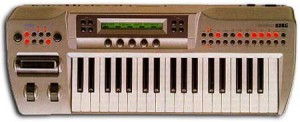
Digital does analog! The Prophecy was among one of the first synthesizers to lead a revolution started in the mid-nineties by synthesizer makers to satisfy a growing segment of the market that was lusting after old-school vintage equipment in the pursuit of making electronica-style music, by providing a state-of-the-art retro synthesizer that could sound like a classic analog.
The Prophecy Solo Synthesizer was unveiled in 1995, and was a purely monophonic solo/lead synthesizer. It employed DSP synthesis first developed for the Korg OASYS synthesizer, with algorithms for producing realistic analog timbres, VPM (Variable Phase Modulation) tones similar to FM synthesis, and physically modeled brass, reed, and plucked string instruments. At your finger tips were tons of real-time control over traditional analog editing parameters like filter cutoff and resonance, envelopes and the arpeggiator. It had a pitch wheel, a mod wheel, an expressive dual action ribbon wheel, six effects processors and more!
DM1 The Drum Machine V2.0 – Music app for iPad
Here’s some good news – the popular DM1 drum machine for the iPad has been updated to version 2.0:
Fingerlab is very happy to announce its biggest update for DM1 with version 2.0. DM1 now comes with 2 new super cool tools “The Randomizer” and “The Automation” for instant and fun beat making. Patterns are now also expandable to 32 Steps for extra creativity. We have added 24 new drum kits. As well as AudioCopy, WIST synchronisation between two iPads, MIDI In and more cool features. Yes, it is a big update!
Check the full list below of the new features:
✔ “The Randomizer” – a new exciting tool to unleash the creative potential of the Mixer step by step. Just press ‘Go” and have fun!
✔ “The Automation Panel” for a precise and intuitive control of any Mixer parameter over time. Powerful and easy.
✔ 16 or 32 Steps per patterns. Even more complex beats.
✔ 24 New Drum Kits for a total of 64 Drum Kits.
✔ WIST synchronisation technology by Korg for syncing 2 iPads together.
✔ Reversed sounds. Long-Tap the Play button on any track of the Mixer to reverse the sound.
✔ AudioCopy on exporting
✔ Colored Song Patterns
✔ New help screens with tips & tricks
Please check our videos to find out about these new exciting features.
http://www.fingerlab.net/website/Fingerlab/DM1.html
AudioGL Video 3 – Modular Software Synthesizer and Sequencer
This is a very cool demo of the AudioGL modular, check it out
Another update on the AudioGL project. This video features a crowdfunding announcement, and a software demonstration.
Crowdfunding Campaign:
http://www.audiogl.com
or
http://www.indiegogo.com/AudioGL-Crowdfunding-Campaign
Background information:
AudioGL is a Modular Software Synthesizer and Sequencer. It is designed to allow musicians to create complex compositions with ease. AudioGL has a dynamic 3D interface which focuses on streamlining workflow, so composers can spend less time navigating the interface, and more time writing music.
Here are the specifications of the computer I have been using to develop AudioGL
Make/Model: Lenovo X61 Tablet
Processor: Intel Core 2 Duo 1.8ghz
Graphics: Intel X3100 (low quality integrated graphics card)
Audio: M-Audio Fasttrack Pro & ASIO4All
Display: 1024×768 (Laptop) – 1280×1024 (External)
As you can see, AudioGL does not require a high performance computer. If your system specifications are close to or higher than mine, AudioGL should run just fine for you.
Although the interface is rendered in 3D, it does not consume any more resources than a typical 2D interface. Furthermore, the graphical quality of the interface can be raised or lowered, depending upon your preferences.
The synthesizer is designed towards low CPU usage without compromising sound quality. To provide both, the instruments you create in AudioGL will only consume CPU when they are playing. This makes it possible to create a large composition on an underpowered laptop, provided that you only have so many instruments playing at one point in time.
[de:ad:cibel] – Self Fulfilling Prophecy
taken from the EP “Self Fulfilling Prophecy”. Released by ECHOZONE. Video filmed, directed and edited by J.Tochtenhagen for BOB-MEDIA / ECHOZONE. With assistance by I.Komuczki.
The band name [de:ad:cibel] alludes to the “loudness war” in music productions – in other words moving towards higher sound levels and decreasing dynamic. Technically measured in “decibel” (dB), in music this dynamic represents the difference between low and loud passages. To get a maximum punchy sound, a dynamic mix aims for the zero level. We have substituted the word “dead” for the cipher zero, which means [de:ad:cibel] signifies very loudly mixed and aggressive music – adequate to describe our sound.
By their fans [de:ad:cibel] are called THE GERMAN BASS MACHINE. Started in 2010, [de:ad:cibel] are hitting in clubs worldwide.
Serge Modular ADSR pitch modulation
Serge Modular synthesizer doing crazy pitch slides and controlling a Moog Voyager through CV.
DATAMASKIN

