
Waldorf’s Nave has been released
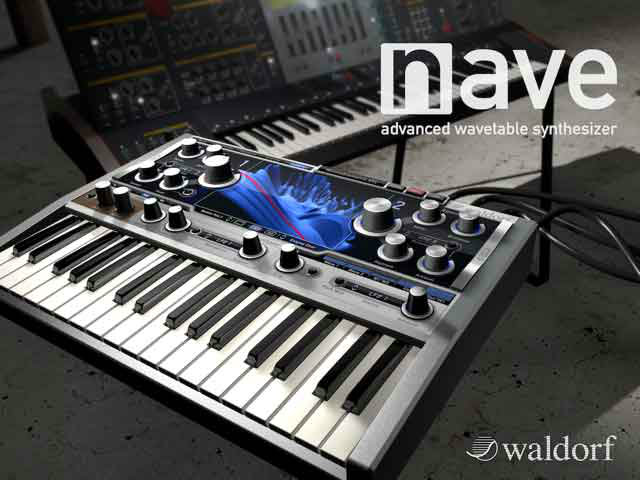
Waldorf have now announced availability of Nave, its first synthesizer app for Apple’s iPad. Waldorf says that, jointly created by Stefan Stenzel (audio algorithms), Rolf Wöhrmann (iOS development), and Axel Hartmann (graphic design).
This tutorial shows how to program a wavetable sound within a short amount of time.
It comes complete with over 500 presets from highly acclaimed sound designers like Richard Devine, Sacha Dikiciyan (of Sonic Mayhem fame), Laurence Rapaccioli (Arksun), David Boldini (7 Skies), and Fletcher Kaufman (Sunsine Audio), amongst many others. Waldorf tells us that all seriously showcase the depth and diversity of this synthesizer — so much so, in fact, that Richard Devine was suitably moved to create no fewer than 95 presets alone, all of which are included for free. Here’s more details in Waldorf’s own words…
For the benefit of those who want to indulge in some serious sound design of their own making, Nave does not disappoint. Its powerful sound engine includes two trailblazing wavetable-based oscillators, leaving all previous attempts at wavetable synthesis severely wanting. While the sound spectrum can cleverly be transposed independently of pitch, the waves can be rendered from perfectly periodic to very noisy and anywhere in between.
Nave’s clear-cut GUI invites both beginners and advanced users alike to experiment both sonically and musically while the hosting iPad’s generous display helps make wavetable creation and editing a blast! Besides integrated speech synthesis, wavetables can also be formed from analysing audio files. Furthermore, stretching, rotating, and shifting in the spectral domain allows wavetables to be refined or distorted in the fullscreen Wavetable Edit Mode. Here users can edit and fine-tune the wavetables using several 3D views that are as easy on the eye as they are to use. And in a reverential nod to Waldorf’s illustrious past and present, factory wavetables from the breakthrough Microwave, mighty Wave, and price barrier-breaking Blofeld synthesizers are all present and accounted for, complemented by an abundance of tasty new ones that make extensive use of those enhanced possibilities!
And if that’s not enough to get your creative juices flowing then Nave additionally includes a classic oscillator with an ultra useful selection of basic waveforms, plus a super-fat-sounding Überwave function for beefing up sounds by up to eight individually detuned oscillators a la Waldorf’s recently released Rocket synthesizer. Nave is, indeed, truly a sound designer’s dream machine!
But, Waldorf being Waldorf, that’s not all: Nave’s flexible Filter section delivers that high-quality synthesizer sound recognisable right away by anyone at all familiar with Waldorf’s noteworthy name, and, as such, features LP (low-pass), BP (band-pass), and HP (high-pass) filter types with either 12 dB or 24 dB slope settings. Its neighbouring Drive section offers contrasting characteristics by being positioned Pre Filter or Post Filter or as a summing overdrive Pre EQ or Post EQ — perfect for those who prefer harsh and screaming sounds rather than delicate wavetable sweeps.
An extended modulation matrix and diverse realtime control functionality also awaits anyone wishing to animate any Nave sound in any desired direction. In addition to the classic virtual chromatic keyboard, Nave can be played with the Blades that allow for dynamic triggering of polyphonic modulation by simply sliding fingers in X and/or Y direction.
Yet more flexible fun is to be had on the FX & Arp page with pro-quality ModFX (Phaser, Flanger, Chorus), Delay, Reverb, parametric Equalizer, and a highly effective Compressor all adding to Nave’s sound and performance possibilities, as does a full-featured Arpeggiator. And last, but by no means least, the Tape & System page plays hosts to an old school, four-track recorder — replete with virtual tape spools. Use it to record complete compositions or simply sketch some musical ideas inspired by the superlative sounds of Nave!
So how does Nave naturally sound, then? Totally in a class by itself. Just like Waldorf! After all, the well-known Waldorf name has been synonymous with high-quality synthesizers for nigh on 25 years; indeed, its innovative position in the musical instrument marketplace dates back to 1989 with the release of the wavetable-based Microwave, an extraordinary reincarnation of the legendary PPG Wave series — arguably amongst the most coveted high-end synthesizers of the early Eighties. Time and technology stand still for no one, of course, and today Nave takes those heady heavyweight hardware developments of yesteryear — and a whole lot more besides — and serves them up to thankful iPad-adoptees at a fraction of the cost of its forebears.
Any adventurous musical iPad owners out there intrigued by the creative possibilities of wavetable synthesis surely owe it to themselves to check out Nave, the advanced wavetable synthesizer from Waldorf. Going for a song on Apple’s App Store, right here, right now!
Pricing and Availability:
iPad owners can purchase Nave directly from Apple’s App Store for a five-day special introductory price of €10.99 EUR/$11.99 USD. (Thereafter it will rise to €17.99 EUR/$19.99 USD.)
Friday electronic music from Nils Erikson – Winner
Nils Erikson with the single “Winner”
Taken from the album “The Prophet & The Piano”
iTunes: https://itunes.apple.com/se/album/the…
Spotify:
Release: June 10, 2013
Taken from the album “The Prophet & The Piano”
Contact: delsolrecordings@gmail.com
© 2013 Del Sol Recordings
Double P Keys – New Free Ableton Pack From AfroDJMac
Free Ableton Live Pack #81: Double P Keys.
“I made a multi layered synth with lots of character. It can be morphed into a lot of cool sounds and the download even comes with a drum-like sound. Wow how fun! Best of all it’s free.”
Free Download: http://bit.ly/freesynth81
Visit his site for more stuff like this, including Live Instrument downloads, tutorials and music! http://www.afrodjmac.com
Reason 7 – Product Presentation
Last week Sonic State had a visit from Ryan Harlin – he’s the guy behind Propellerheads Music Making Month and also puts together the ongoing video content for Propellerheads.
“He showed us around the new features in the just released Reason 7, including (finally) the introduction of MIDI, some neat mixer functions – Spectrum EQ, bussing and parallel processing, plus the new audio processing module – Audiomatic.”
Nord Lead 4 Arpeggiator Party
Clavia’s product specialist Tomas Johansson demonstrating an awesome patch with multiple layers of Arpeggiators using two Nord Lead 4’s (6 slots used in total / 1,5 Nord Lead 4:-)).
All elements (3 percussion sounds and 3 synthesizer sounds) are triggered live (no external sequencers).
The Top 3 music utility apps for iPad and iPhone
Here is a quick demo of what Ryan Hemeon thinks are the Top 3 musical utility apps are for iOS that no serious iOS musician should be without. He takes a little time to explain what each app can do.
1. Audiobus
2. Audioshare
3. MidiBridge
B-Line 303 – new acid bass sound synth
Sonic XTC lets us know that their new monophonic bass line synthesizer, B-Line 303, captures the vibe and sound of classic EDM and Acid techno music synthesizers from the 70’s and 80’s. They say that B-Line 303 can easily dial up the classic Acid bass sound with all the squelch and buzz of the original classics, giving producers the unique ability to shape their sound with sub oscillators, distortion, distortion intensity, and built in Waveshaper unit. B-Line 303 comes with 14 presets to get you started but has room for up to 64 user presets. In order to create the entire Acid bass sound experience, B-Line 303 comes equipped with a Stereo “Doppler” Chorus effect and a Stereo Echo effect.
In the beginning of the song B-Line 303 sounds like your standard Roland TB 303. In the middle of the song it sounds like a Roland SH-101. At the end of the song the B-Line 303 gives you a glimpse of why we think it is special! Only used Deep 606, Deep Mono, and B-Line 303 to create this track. Side chain compression on the Deep 606 kick only external effect used.
Highlights
- 64 user presets
- 14 custom presets
- Midi automation
- Doppler Chorus, Stereo Echo effect
- VST 2.4 effect
$14.95
Reason Rack Extension: AutoTheory Harmonic Engine – generating melodies
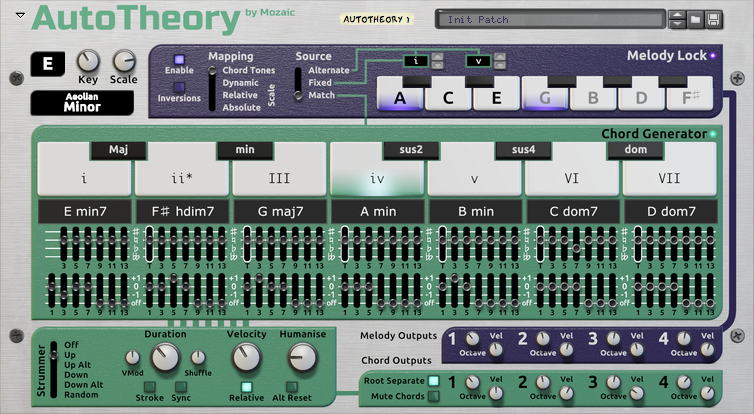
The AutoTheory Harmonic Engine enables anyone, regardless of musical theory or keyboard training, to easily create professional-sounding melodies and harmonies.
AutoTheory makes it easy to play in harmony. Simply choose a key and a scale and AutoTheory will map all relevant chords and notes to the keys of your keyboard. Connect it to one or more Reason instruments and it will transform the way you play. Play full chords with just one finger. Experiment by modifying chords with the chord sliders and modifier keys. Adjust individual chord note voicings and transpose or remove any note to create a customised chord. Create your own scales or select one from the many provided. Use what sounds good to you.
AutoTheory automatically remaps notes to match your chords. Now you can easily improvise melodies that sound good. Maintain your hand in the same position while composing melodies over different keys, scales and chord configurations. Optionally lock specific chord tones to fixed white keys. Four mapping modes accommodate different levels of user experience. All controls in AutoTheory can be automated for easy transitions anywhere in a song. This means you can change the key or scale in the middle of a song without moving your hands.
AutoTheory also provides a Strum effect that can be used to add drama to any chord. Subtle and extreme timing changes are easily applied and fully CV-controllable. AutoTheory can control multiple instruments at once. One option sends the root note of chords to a dedicated bass instrument. Four chord and four melody channels provide independent control of velocity and octave for each connected instrument. This allows you to create a rich soundscape – all from a single sequencer lane or just your own hands. CV inputs are provided, which are useful for driving AutoTheory with Arpeggiators and Pattern sequencers.
Check out the included Demo Songs that demonstrate how to use AutoTheory. A set of useful Combinators is also provided.
This guide shows how Mozaic’s AutoTheory Rack Extension applies to music theory.
For a free demo of AutoTheory please visit http://shop.propellerheads.se/product…
For the main tutorial, please watch http://youtu.be/hQVnfd3WGyM.
Nave Sound Demo from Waldorf
Pure Nave sounds, no external FX, no external processing!
All sound examples were directly recorded in Nave´s 4 track recorder.
As far as we know the Nave synth will be released today on the app store
Tony Monaco’s Blues Scale on Organ
A classic lesson from 2007, B3 expert Tony Monaco shares his tips on blues scales on the Hammond organ.
The blues scale refers to several different scales with differing numbers of pitches and related characteristics. The hexatonic, or six note, blues scale consists of the minor pentatonic scale plus the ♯4th or ♭5th degree. A major feature of the blues scale is the use of blue notes, however, since blue notes are considered alternative inflections, a blues scale may be considered to not fit the traditional definition of a scale. At its most basic, a single version of this “blues scale” is commonly used over all changes (or chords) in a twelve bar blues progression. Likewise, in contemporary jazz theory, its use is commonly based upon the key rather than the individual chord.
DATAMASKIN

