
12 days of Modular
The 12 days of Modular. A series of 12 videos themed around Modular Synthesis and sound. Demonstration of Sine Wave and accompanying waveform view. Sound and Video by Raul Pena
Infernal Noise Machine
“Trying it out… Maths into VCAs. All sounds from the INM.”
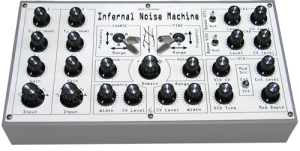
THE INM IS NOT A MUSIC SYNTHESIZER
The Infernal Noise Machine was designed towards the creation of noise, sound effects, and for the general field of sound design. Having said that, the INM can create “musical” tones and sound – and quite a few of them – but that was not the goal. It is semi-modular, which means part of the signal path is hard-wired and cannot be changed, but it does allows some variation and external control. It can be used completely independently, but is intended for use with external control voltage (CV) sources to affect or modulate various parameters, which is where the INM truly comes alive (you will see what I mean).
So what can you do with it? Incidental sounds and ambiences, unholy caterwauling, soundscapes from melancholy to manic, even percussion and other traditional musical sounds. The Infernal Noise Machine is particularly effective for making drones that evolve with time as well, with no external sources required. The internal architecture allows for a wide range of self-evolving, beat-frequency style tonal variations over an infinite range of rates. There is really no simple way to describe what the INM can do – you have to find out for yourself. This is a unique device. It requires a bit of time and patience to get a feel for how it works, but it is worth the effort.
Micro Patch Synth: patching and arpeggiator demo
“In this video I demonstrate how to patch the keyboard to VCO1.
I then play each arpeggiator pattern in sequence.
NOTE: The software still requires a fair amount of work to reduce the noise and buzzing from the waveform synthesis.”
Miditribe unboxing/ install/ first play
And here are the background details:
Miditribe
unboxing/ install/ first playkorg
tested with :
http://www.alesis.com/iodock
alesis iodock midi out with ipad running StepPolyArp
http://laurentcolson.com/steppolyarp.html
http://www.alesis.com/micron
alesis Micron midi out
!!please note you should turn off the unit before installing
the miditribe interface
please refer to the install VIDEO
http://youtu.be/9yISozPVz4g
the monotribe retains all of it’s original functionality
drums = ch 10
synth = ch 1
responds to midi tempo sync /stop/start
Many thanks to Gabriel Rodrigues of Amazing Machines
for the fast delivery it was shipped from brazil and received in under 8 days
http://www.youtube.com/AmazingMachines
http://www.amazingmachines.com.br/
Time machine – Roland Alpha Juno 2 + Oberheim Cyclone Arpeggiator
Vintage synth demo by RetroSound
Roland Alpha Juno 2 Analog Synthesizer (1986)
Oberheim Cyclone Arpeggiator
more info: http://www.retrosound.de/
More info on the Juno 2:
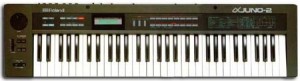
This is an upgraded version of the Alpha Juno 1. It adds an extended 61 note keyboard with velocity and aftertouch and an external memory cartridge slot. Other than that it has the same great sound and features as the Juno 1. Sliders and buttons were replaced by membrane buttons and the Alpha Dial which is used to edit and browse through the extensive selection of parameters: DCO digitally controlled oscillators, LFO, bend, ENV, pulse, waveforms, noise, PW/PWM, high pass filter, VCF filter with freq/env/res/lfo/kybd, VCA envelope, chorus, and more.
Adequate in the studio or on the stage, the Juno 2 has 64 presets and 64 user memory patches, a nice LCD display, an LFO capable of a very slow rate for some cool sweeping effects, and a great bass sound (especially nice for acid basslines) and noise effects! It also has chord memory which is perfect for rave & techno, portamento and keyboard transposing. The PG-300 Synthesizer Programmer gives you traditional slider control of each parameter for much easier and faster editing.
Addictive Synth Loop Recorder
Showing the new Loop Recorder and SoundCloud export added in Addictive Synth Version 1.2
Dynamic wavetable synthesizer
• Six dynamic wavetable oscillators per voice, up to 48 total.
• Continous morphing between two oscillator sets.
• Realtime editing of up to 128 partials (overtones).
• Realtime editing of filter structure to create arbitrary body resonances.
• Extensive modulation possibilities using up to 4 LFOs and 4 Envelopes.
• Control matrix allows real time control of five parameters using the X/Y touch pad, the modulation wheel and the tilt sensors of the iPad.
• Monophonic or polyphonic with 8 voices.
• 128 factory presets, unlimited user presets can be shared.
• Up to three effects concurrently usable selected from: equalizer, phaser, flanger, chorus and stereo/cross delay.
Interesting Kaossilator advanced arpeggios demo
And here are the details:
you can get some really great arpeggios on the kpro by simply using an odd time signature over a straight beat. Here I use a normal breakbeat, then use a side chained synth chord, but with the .75 arp speed. i use the same arp with the original breakbeat to add a really great pocket to the beat that nicely coincides with the synth chords, since they are using the same arp. lots more videos on my channel.
Time machine: ROLAND JUNO-60 Analog Synthesizer 1982
http://youtu.be/Jhn7itB7JQU
Among the first in Roland’s amazing JUNO family! Six analog voices of polyphony and patch memory storage!! The Roland Juno-60 is a classic six voice polyphonic analog synthesizer with 56 patch memory for your sounds. Although the sound architecture is rather basic, it has an excellent analogue sound. The Juno-60 can produce great basses / sequences with its fast envelopes. It can also produce warm smooth pads with its excellent filters.
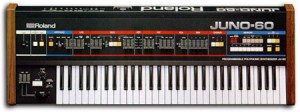
The Juno-60 was used by many professionals like Eurythmics, Howard Jones, the Madonna producers, Paul Van Dyk and many more… it has the DCB interface – the predecessor of MIDI. With a DCB to MIDI interface it is very easy to integrate the instrument in a midi setup.
To my ears the JUNO-60 sounds far better than the very similar JUNO-106 (I had both). The Juno-60 has snappier envelopes and a fater chorus. The difference is clearly notable. IMO the Juno-60 ist the best sounding Juno. But all Junos can sound great… Please note, I am talking about the original Juno series from the eighties.
I played the JUNO-60 without any additional FX or EQ (except the intro music – this is a multi track recording). Excuse the slight distortion in the first minute.
THE SOUND PROGRAMS IN THIS MOVIE:
Do you have a Juno-60 and want to play with the sounds heard in the video? You can buy the “ANALOGAUDIO1 PATCH BANK” (56 sounds) for 12,99 Euros.
After payment through PayPal you will get a MP3 with sound data for the tape interface of your Juno-60 via email.
The details about the functionality of the tape interface are described in the manual of the Juno-60, which you can download for free.The patchbank will NOT work with the Juno-106, because this one has a different data format.
If you want to buy the “ANALOGAUDIO1 PATCHBANK”, please drop me a mail.
Korg Polysix Factory Patches Demo!
At first glance the Polysix looks like a scaled-down Mono/Poly, but really it’s not! In fact it had a lot of great new features such as 32 memory patches, 6 voices of polyphony, cassette backup of memory, even programmable modulation effects and Chorus, Phase, Ensemble! The Polysix has warm-sounding real analog oscillators, softer and brassy-er sounding that the Juno. Engage the built-in Chorus on a simple single-oscillator sawtooth patch and you were pretty darned close to that expensive Prophet sound. But the big ace in the Polysix’s hand was the Ensemble effect. Instant Mellotron-like strings.
Watch the end! The end is the sound effects bank. Which is awesome. I have owned a few Polysix’s in my time and this one takes the cake by far. These patches are awesome. This polysix also has midi in installed AND I have the instructions on how to actually use it. It also has a new battery, most of the IC chips have been taken out, and put into a new board with IC sockets.
Gross Beat Demo
Gross beat is perfect for real-time or rendered gating, glitch, repeat, scratching and stutter performances. Gross Beat stores audio in a 2-bar rolling buffer under the control of 36 user definable time and volume envelopes, giving you unlimited creative control.
More info – http://www.image-line.com/documents/grossbeat.html
Gross Beat is a time manipulation effect designed for repetition and scratching effects.
Download the demo at the link above.
Thanks to Ed Chamberlain – http://soundcloud.com/ed-chamberlain for the Scratch Demo and nucleon – http://www.electroconductor.com/ for the Performance and Gating demo seen in this video
DATAMASKIN

