
Tme machine – Oberheim OB-X + Roland VP330 “Zero Gravity”
Vintage synth demo track by RetroSound – “Zero Gravity”
strings and human voice choir: Roland VP330 Vocoder Plus mk2
lead and pad sounds: Oberheim OB-X 8-Voice
recording: multitrack
The Oberheim OB-X is an analog polyphonic synthesizer. It was the first Oberheim synthesizer that was created with internal prewired modules and not with the bulky SEM modules. Because of this, it was more functional for live performance, and therefore more portable. It was introduced in 1979 and was discontinued in 1981. It came in four, six, and eight-voice models. The starting price for only 4 voices of polyphony was a steep US$4,595. Besides the generous polyphony, each OB-X came with a memory capable of holding 32 user-programmable presets, along with polyphonic portamento, and polyphonic sample and hold. The OB-X was in direct competition with the Sequential Circuits Prophet-5. The OB-X would be used by artists such as Nena, Rush, Queen, Prince, and Jean Michel Jarre. It spawned more Oberheim analog synthesizers, such as the OB-Xa, the OB-8, and the Matrix series of synthesizers.
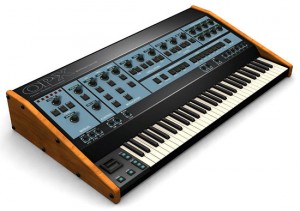
Sonicprojects have created a VSTi emulation of the OB-X, for Windows and Mac platforms called the OP-X, with near-identical sounds to the hardware version.
Synth spotting: Above & Beyond – You got to go (Kebu remix)
Here’s what Kebu has to say about the tune:
This is a remix I made for a competition. If you like it, please follow this link and vote for it by pressing “spin” (requires registration):
http://www.beatportal.com/remix/detail/ab-you-got-to-go-k…
I didn’t plan to make any more videos before my upcoming album is ready, but I stumbled upon a competition to remix Above & Beyond’s “You got to go”. Since I’ve recently discovered Anjunabeats and their great trance compilation Worldwide 03, which I’ve been spinning almost every day now for two weeks, I just had to take the time to give it a shot!
I saved only the vocals (sung by Zoë Johnston) from the original track and remade all music using only analog synths. The analog synths and analog drum machines were controlled in realtime by a MIDI sequencer and mixed together with the vocal using an analog mixer and hardware effects.
Equipment used: Korg Mono/Poly, Polysix, Poly-61; Roland Juno-60, Alpha Juno, TR-808 (w. MIDI); Moog Source; Oberheim Matrix 6R; Vermona DRM1 Mk III; Electro Harmonix Small Stone; Boss BD-2 (H2O mod), DD-3; Lexicon MPX500; DBX 290; Emagic AMT8; M-Audio Midisport 8×8/s; Alesis iO26; Cubase SL 1.06; Allen & Heath GS1; Yamaha S30 (as MIDI keyboard); Doepfer MCV1; Kenton Pro 2.
Camera: Canon HF100
Hope you enjoy my t-shirt! 😉
Finally Arturia has taken on an Oberheim
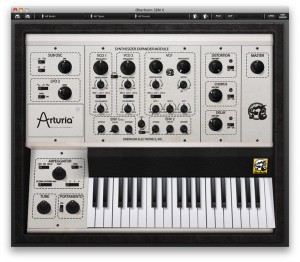
After years without any addition to their Synthesizer Anthology series, Arturia has announced that it will soon bring back to life in software format one of the world’s most sough-after synthesizers.
The Oberheim SEM V accurately emulates the famous sound and interface of the original Synthesizer Expander Module introduced by Oberheim Electronics in 1974. Faithfully reproducing the tone, waveshapes, multi-mode 12dB/octave filter and other detailed characteristics, the Oberheim SEM V also brings the benefits of polyphony, MIDI control, arpeggiation and some innovative functionalities such as the 8-voice programmer, or the advanced keyboard follow.
MAIN FEATURES:
- All the original parameters of the Oberheim SEM : two oscillators, each offering sawtooth wave and variable-width pulse wave with PWM, sine wave LFO, 12dB/oct multi-mode Filter with low-pass, high-pass, band-pass and notch, two ADSD enveloppes.
- Added functionnalities : New LFO, Noise, Sub oscillator, on board effects (distortion, chorus and delay), Arpeggiator, Portamento, and more.
- New 8-voice Programmer module.
- Advanced Keyboard follow module.
- Works in Standalone, VST, RTAS and AU formats.
- Compatible with Windows (XP/Vista/Seven), Mac OS X (Mac OS X 10.5 or higher, Intel only).
Check out the Arturia website www.arturia.com on October 25th for more information.
Do you want an Oberheim as software
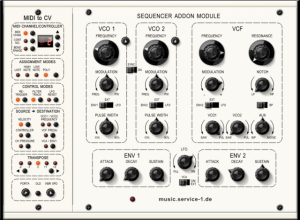
WOK has introduced SAM (Sequencer Addon Module) – a WIndows software recreation of the Oberheim SEM analogue synth module.
Here’s what they have to say about SAM:
Our goal was to catch the typical analog sound of the original hardware emulating circuit instabilities, while leaving some limitations behind; so the plugin is polyphonic, allows more than one MIDI modulation source, has an extra LFO for pitch (reacting on the mod wheel) and a noise oscillator.
But besides this extensions, the plugin is following the simplicity and sound options of the original. Clear layout, easy to use, full sound.
64 presets included. A demo version is available.
SAM for Windows (VST) is available now for 41 EUR. Audio demos are available at the WOK site.
Modular taking: DOEPFER A-100, OBERHEIM DMX, KORG KAOSSPAD3
Modular first steps, please listen with headphones.
Sample taken from an FM radio with the A-112 Sampler module.
Dual VCA gated by A-149-1 (source of uncertainty) for a crazy stereo pattern.
Nothing special, just testing and messing around.
Live modular performance – Muon Dependency
Would love to spend some time in this dude’s studio 
A live performance. A 137 space modular synthesizer, Waldorf MicroWaveXT, Dave Smith Prophet 08, Nord Lead 2X, Yamaha TX816, DX7II, and Oberheim Matrix 6.
All synthesizers are controlled either with Numerology 3 Pro or from the modular synth on-board sequencers. Recorded in Cubase 4 from Steinberg.
I played a single line at various times on the DX7II. Everything else is fully automated including a pseudo-random sequence generated by a Catgirl Synth Suboscillator/Harmonic Sequencer module by Ken Stone.
The baseline is the Prophet 08 controlled by a midi output from the synthesizers.com Q172 midi output of a Q960 8 step sequencer pattern.
Background info on the Numerology 3 Pro:
Numerology 3 is a music sequencing and audio plugin environment which uses an innovative approach to electronic music composition based on modular step sequencing. With version 3 Numerology now comes in two flavors: a Standard Edition for anyone that wants an economical step sequencing addition to their studio, and a Pro version with advanced features for users looking to make Numerology a cornerstone of their compositional workflow. Another major addition is an AudioUnit version of Numerology that allows users of supported hosts to add advanced step sequencing to their DAW-based workflow. The Numerology AU is the first Audio Unit plugin to offer sample-accurate MIDI scheduling and built-in latency control.
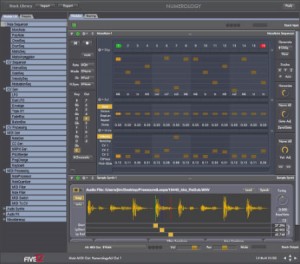
Other highlights of Numerology 3 include new generative sequencing options, a completely revised user interface, a preset playlist, a humanize function, Audio and MIDI recording for every part, and several new and updated modules. These features expand and complement the capabilities provided by Numerology’s extensive list of sequencing and signal processing modules. With version 3, Numerology’s library of modules now numbers more than 50, not including hosted Audio Units.
The Generate and Evolve features in Numerology 3 allow users to explore new compositional territory by using generative algorithms both to create new patters, and to make transformations to existing patterns. The Generate feature includes 18 algorithms for generating new patterns, and is setup to allow users to easily control the musical context in which the pattern is generated. Evolve goes a step further by allowing users to program specific algorithmic changes to a sequence. These changes can be triggered directly, or setup to automatically repeat for regularized pattern modulation.
Features specific to the Pro version of Numerology include multi-output support for hosted AudioUnits, monophonic audio routing support, OSC support, custom scale quantization, and several new modules specifically oriented for building advanced sequencer setups. Included in that set are gate generator and clock offset modules, a CV To Audio module for driving an analog synthesizer directly from Numerology (with a DC-capable audio interface), and a pair of operator modules supporting a total of 61 functions.
Both the Pro and SE versions of Numerology 3 come with much improved synthesis options for the built-in sample-based SampleSynth and DrumKit modules. These modules now include a multi-mode filter, 2 AHDSR envelopes, a beat-synchronized LFO and a modulation matrix. Complementing these additions are a new set of built-in audio effects, including tempo-synchronized delays, multi-mode filtering, and a ring modulator.
Two new features in Numerology 3 greatly expand user options for storing and sharing presets and patterns, the Stack Library and Module Presets. The Stack Library is a new centralized location for storing part-oriented sequencing and synthesis setups. The Numerology 3 download comes with a library of stacks that include a variety of demo tracks, examples and core sequencing templates. In addition, the new module preset function in Numerology 3 allows users to easily store and load settings for any module. This feature is particularly handy for keeping track of sequencer patterns as well as building preset libraries for the SampleSynth and DrumKit modules.
Vintage synth exploration – Oberheim OB-SX
Introduction to the OB-SX, a very underated synth that is a hybrid between the OB-X and OB-Xa. The OB-SX shares the voice architecture of the OB-X, but uses the discreet CEM chips later found on the OB-Xa. The OB-SX first appeared in 1980 as a preset/variable version of the OB-X.
A short demo demo of the brass sounds from A1, B1 and C1, using the variable controls. If the sounds in your OB-SX are different to mine, you could have a rare machine, as OB-X users could send in a tape of their favourite sounds to be burned into the OB-SX EPROMs. Also mine will have slightly different tunnings and voice calibrations to yours.
More vids will follow, so I hope this gives you an idea of the sounds and capabilities of this great “little” synth.
This was recorded using the inbuilt mics on the video camera, so please don’t expect pristine 24 bit audio … not yet anyway. Also this is unscripted.Note that the key clattering is normal on machines of this vintage, mine is from1982.
Cheers
Pete
Lo Mount Sound – TASMANIA
New VST recreation of the famous Oberheim™ SEM module
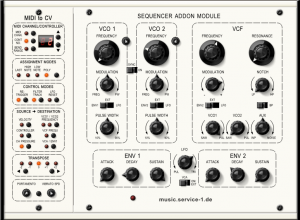
WOK has announced SAM, a VST recreation of the famous Oberheim™ SEM module.
While the soundwise construction is similar to the hardware unit, some limitations have been eliminated in the software version; so there is polyphony, a second LFO, a noise source and PWM for the saw waveform.
Special attention was given to recreate the analog variably of seperate hardware circuits for the audio paths in polyphonic mode.
SAM will be available end of August as a VST plugin for Windows with an introductory offer.
More information: WOK
Background info:
The SEM was Oberheim’s first official analog synthesizer. SEM stands for Synthesizer Expander Module. It was conceived with the notion of being used as a backup synth connected to a sequencer for layering or beefing up your existing monophonic analog synths. The SEM itself was a keyboard-less module with two analog oscillators, a 2-pole multimode filter, ADR envelopes, and an LFO. Each of the two oscillators offer triangle or rectangular waveforms. But unlike the Moog and ARP counterparts of the time, the SEM’s 2-pole (12dB/oct) filter was a little thin. The others used a 4-pole (24dB/oct) filter which has a steeper roll-off and so it sounds much better. But the SEM’s filter offered many modes in addition to low-pass, including high-pass, band-pass and band-reject.
Synth jamming on the Oberheim OB-Xa
This ’80s Italo Dance with Oberheim OB-Xa
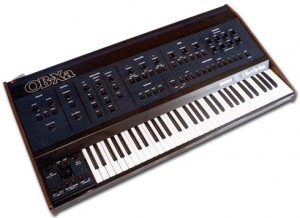
The OB-Xa is a massive analog synthesizer with a very familiar and classic Oberheim sound. Its sound, size and power are very similar to the Prophet 5 from Sequential. However this one has up to 8 voices which can be split, layered and stored!
The OB-Xa was available in four, six or eight voice polyphonic models. They all featured patch memories, also in varying degrees. A minimum of 32 patches were available on early models (4 banks of 8). The maximum amount of patch memory storage found on many OB-Xa’s is 120 patch memories. All models of OB-Xa, however, featured the new Curtis chips which offered great stability for an analog synth and they are attributed to its great filters and sounds.
The OB-X was very similar to the OB-Xa except that its voices could not be split or layered and, more significantly, the OB-X had a lowpass-only discrete SEM 12dB/oct state variable filter, which had a great and classic Oberheim sound. The OB-Xa changed that in an attempt to economize manufacturing and increase stability by switching to CEM3320 Curtis chips for its filters. The Xa offered two switchable filter modes: 12 dB/oct (2-pole) or 24 dB/oct (4-pole). This hardware change resulted in a more agressive sound, not quite as creamy as the OBX original, but what still became a “bread and butter” sound of the Oberheim line.
Splitting the keyboard mode separates the OB-Xa into two 4-voice synths with two available patches. The Layer mode plays the two patches simultaneously. There are also some added effect sources, perfect for any analog polysynth, including portamento, unison, sample & hold, chord memory and three LFO’s!
However none of the original OB-Xa’s have MIDI, unless otherwise having been modified. The OB-Xa is a classic and fat analog machine.
Working the Oberheim Matrix-12
About the Oberheim:
Oberheim’s Matrix 12 is a legendary analog synthesizer from the mid-eighties that is still the king of analog sounds. One of the fattest, roundest, pleasantly analog synthesizers around! It’s long been known for creating some of the thickest and best analog pads, sweeps, buzzes, basses and textures. It features Matrix Modulation for extremely wild virtual patching for almost unlimited range of sounds and modulation capabilities!
The Matrix 12 is similar to the Xpander and the lighter Matrix 6. But the Matrix 12 is much fatter and more programmable than either. Every control can have an effect on some other parameter thanks to Oberheim’s flexible design. For example, there are 15 types of LFOs and VCAs per voice! And there’s plenty of diagrams drawn out on the front panel of the synth to help you figure out some signal routing.
In this video:
This is sound demo of the Oberheim Matrix-12 synthesizer. All but two of the patches are my original creation and hopefully shows some of the ridiculously flexible sound architecture that is possible with this board. I’m playing some riffs both of my own original music and from some of the bands that have influenced me. The last bit, Intro to Gunslinger, while it is short it DID take a couple of weeks practice to get it right and is backed by a Machinedrum.
A summary of song riffs played:
G-Storm – Miranda (By The Sea)
Radiohead – All I Need
Depeche Mode – Enjoy The Silence
G-Storm – Cerulean Deraileur
Jimmy Van M ft. Terra Deva – bassline from Love Like Sleep
G-Storm – Spaced Out Beauty
New Order – Blue Monday
G-Storm – Aerial
808 State – breakdown from In Yer Face
Garbage – You Look So Fine
Sasha – Mr Tiddles
Go West – intro to Call Me
G-Storm – untitled track
G-Storm – Expectations (a really old unrecorded track of mine)
Spaced Out Beauty
M83 – You Appearing
Expectations
Immersion Domain – 1000 Images (I used the same Limuidz factory patch on the Xpander for that track)
Van Halen – I’ll Wait (Eddie used an OB-Xa, I believe)
G-Storm – Descendant
Vangelis – Blade Runner (Opening Titles)
G-Storm – Gunslinger
G-Storm – intro to Gunslinger
Recorded via Alesis Multimix-8 and into Macbook w/ only occasional additional effects from the Multimix added for select sounds.
DATAMASKIN

