
The poor man’s Moog has been revived
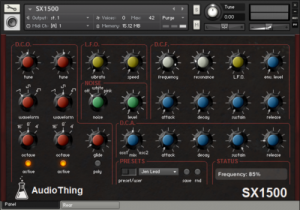
In the lab, for years, covered by other instruments and things, there was this old Italian analog synthesizer from 1979: the Jen SX1000. Monophonic with just 1 oscillator, it was often called “poor man’s Moog”. It is always hard to sample analog gears so, instead of trying to clone it (which is obviously impossible for a sampler), we decided to use the samples of each waveform to build an hybrid synthesizer taking advantage of the Kontakt Script language. It sounds both vintage and new! It is also possible to drift the oscillators to emulate the tuning problems of vintage analog synthesizers and to hear the usual knobs noise caused by dust while tweaking them. The Performance View follows the original parameters scheme adding, of course, new features.
 Documentation
Listen to it here:
SX1500 by AudioThing
About the original Jen SX1000:
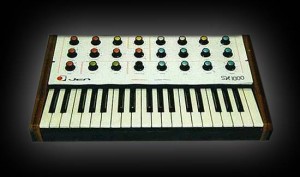
Mention the SX1000 to any serious vintage synth anorak, and you’ll be met with much laughter. But why the little Jen should have become so uniformly derided escapes me. Even in the digitally dominated days of 1985, Julian Colbeck described it as a “fine box for mucking around with, or for learning about synthesis” and “a first class first-time buy”. On its release in 1977 this might have been justified, at least in part, by its super-low recommended price of just £210. Indeed, this had dropped to £159 or thereabouts by the time that the SX1000 was discontinued in 1982, and its street price was often considerably less. But it would be unfair to suggest that the only reason for liking the SX1000 was its price. It was also a fine little synth.
At first sight, the SX1000 appeared very basic. And, on second and third sights, nothing changed this. It had a short, 37-note C-to-C keyboard, a mere 24 programming controls, no CV & Gate inputs or outputs, and no pitch-bend or modulation wheels. Indeed, it was entirely without frills: no velocity sensitivity, no pressure sensitivity, no nothing!
The sound was generated by a single oscillator, described on the control panel and the voice cards as a VCO, but by previous writers as a DCO. The truth is a strange halfway house that is neither entirely voltage-controlled nor digitally-controlled. It worked something like this… The oscillator itself was a high frequency squarewave generator stabilised by a digital circuit. So far, so DCO. The output from this was passed to a large 40-pin chip (that would now be almost impossible to replace) that shaped the wave into a wider selection of waveforms and divided it down to the standard range of audio frequencies. But what about the ‘Fine Tune’ control on the top panel? This, indeed, was a standard voltage control that affected the frequency of the high frequency oscillator. The range of its affect was rather small but it was, nonetheless, a voltage control.
Clearly, the SX1000 was a hybrid, and it suggests that, in 1978, Jen had a technological lead over much of the rest of the synthesiser industry. After all, it was to be another four years before Roland released the Juno6 – the instrument that is often credited as being the first DCO-based synth.
How to turn your videos into music
Moovmi is a Max For Live Video-to-MIDI device that produces midinote sequences from video data analysis. It works with both video files and webcam as sources.
The video source is reduced to a low-res grid where each cell generates midinotes in a predefined interval and pitch, while the velocity is determined by the luminance of the cell.
The user can influence the midi sequences by processing the source with video parameters such as brightness, contrast, saturation, threshold, colors feedback, etc…
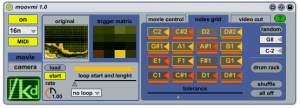
Moovmi can be used for :
- semi-random drum pattern generation
- experimental melodies and chords
- sonification of video installations (using the fullscreen feature)
Moovmi is very easy to use: just select a video source and midinote sequences will start immediately!
Moovmi comes unlocked : owners can open, edit, and re-use parts of this device as they prefer
Put an end to wow and flutter in your music with Capstan
Hehe, if you can afford it, yikes it retails at 3600€
Here’s what they have to say about it:
For over 100 years, music has been recorded on mechanical storage mediums, and for over 100 years such recordings have been plagued by the same problems: wow and flutter. Who isn’t familiar with the wobbling and warbling, the droning and dragging? Mechanical degradation caused by defective devices or sticking tapes, by aging or defective storage. Furthermore, wow and flutter were for the most part irremediable.
Countless recordings of renowned orchestras, big bands and rock groups are currently slumbering deep in archives because precisely this problem has rendered them unusable. The tapes worthless, the recordings lost to posterity. Until now.
For with Capstan there is now for the first time a program capable of removing wow and flutter from musical recordings — whether on tape, compact cassette, wax, shellac or vinyl. Capstan detects wow and flutter by analyzing the musical material itself, so the medium is of no relevance. In this, Capstan is clearly superior to solutions such as bias tracking, because Capstan still works even if the tape has already been copied several times or digitized only in low resolution.
Being musically intelligent, the Capstan algorithm is capable of recognizing not only the minutest amounts of wow and flutter but also continuous speed variations within the musical material itself and makes possible detailed editing that extends even to drawing in the curve manually. It is based on the patented DNA Direct Note Access technology made famous by the award-winning program Melodyne, which is used worldwide in all major studios for the editing of pitch and timing.
Whilst the precise detection of the wow and flutter represents the actual technological revolution, repairing the recording is easy: the musical material is simply played back with the velocity curve inverted. Pure varispeed — guaranteed free from artifacts.
More info:
http://www.celemony.com/cms/index.php?id=capstan
Propellerhead is looking for BETA-testers

Remember Reason Adapted, Reason’s smaller sibling that used to be included with various products? We’d like to introduce a new, tiny family member who’s getting ready to step into those shoes: Reason Limited. This is a compact version of the Reason+Record Duo, that will eventually be included free with products from other manufacturers. Can you help us beta test it?
https://www.propellerheads.se/betatest/sign-up/
Mute Short Circuit – With Producer Gareth Jones (Depeche Mode, Wire and Erasure)
Mute Short Circuit Festival – With Producer Gareth Jones (Depeche Mode, Einstürzende Neubauten, Wire and Erasure)
Make sure to check out Garteth CV, very very nice  and it truly speaks for itself
In this video:
On day two of Short Circuit, we had many interviews with artists and producers we very much admire – Gareth Jones was a great highlight, full of rather priceless insight on the art of production and mixing and a very interesting view on using synths with presets that really resonated with me (pardon the pun).
The Fireflies of Saturn featuring a Yusynth Voltage Controlled Quadrature LFO
The quadrature LFO is a special module that was not found on many modular synthesizers back in 1970s. Mostly, only companies like Polyfusion, Buchla or Serge would propose such a weird LFO.
Basically, it is a sinewave LFO with four outputs which are running at the same rate but are phase shifted by increment of 90°. That is, the first output has a shift of 0°, the second 90°, the third 180° and the fourth 270°. What is it useful for ? Mostly it is for modulating simultaneously up to four sources at the same rate but out of phase. This makes it possible to achieve so called “Barber pole” effects or “Shepard tones”. For example, imagine that you connect each output of the Quad-LFO to the V/oct input of four different VCOs, then you’ll hear continuous though steady (paradoxical, ain’t it !) rising and falling intermangled pitches (see ,).
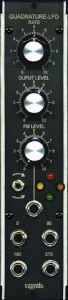
It can be used also to drive four VC-panners to create rotating sound effects that fill the stereo space. The core of the circuit is based on the quadrature oscillator circuit of Ian Fritz’s ChaQuO chaos oscillator . I modified it in order to have voltage control of the frequency and also I added buffers with output LED indicators and a toggle switch that makes it possible to exchange the phase of the 90° and 270° signals in order to change the direction of the phase rotation. This simple trick is very handy when performing “barber pole” modulations. Each LED show the positive part of the corresponding signal, they are organized on a circle to visualize the phase differences between the signals.
In this video:
Music from my modular synthesizer.
Featuring the Yusynth Voltage Controlled Quadrature LFO module. The colored lights are on the module and the phosphor green “fireflies” are from my BK Precision 2120 oscilloscope. I tapped into the 90 deg and 180 deg outputs and switched them with a Q149 Signal Selector module then sent them on to the scope channel 1. Channel 2 picked up the 270 degree output. I then fiddled with ground, DC and AC readings as well as the divisions voltage readings on the scope.
Video edited and enhanced with Final Cut. Audio of three tracks mixed and mastered in Cubase 4.
Powerful semi-modular synthesizer for NI Reaktor
Ebola is a powerful semi-modular virtual analog synthesizer with a flexible architecture, that enables you to create a wide variety of sounds with the distinct Ebola flavor! From heavily distorted leads to Hollywood style strings, sweet keys to strange and beautiful gargling sounds – Ebola can do it all! Just listen to the sound demos…
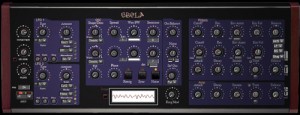
And beware, cause the Ebola is out there!
Main Features:
– A library of 200 high quality sounds, divided into 7 sound banks
– Two multimode oscillators with Ring modulation, Sync, and Frequency modulation.
– Classic mode that enables you to shape your oscillator waveform by morphing between many different waveforms
– Ultrasaw mode that uses up to 9 detuned saw-tooth waves, for the creation of extremely thick leads and pads
– Wavetable synthesis mode helps you achieving evolving and interesting pad sounds, organs and keyboards
– Sub-oscillator with ultrasaw mode
– Noise generator with color shaping option
– Two multimode resonant filters that can be connected in parallel or serial
– Three envelopes that can modulate almost any parameter of the synthesizer
– Advanced distortion section for wave-shaping: Analog saturation, Hard Clipping, Bit Crusher and more.
– Two advanced LFO’s
– Extended effects section that contains 9 high quality effects: Delay, Reverb, Chorus, Phaser, distortion, EQ, ring modulation and others
– Modulation matrix with countless modulation paths
– Envelope follower that enables you to use external audio to manipulate almost any parameter of the synthesizer
In this video:
A video demonstration of the Ebola synth. Musicrow Ebola is a powerful semi-modular synthesizer for NI Reaktor.
Inside the studio of John Foxx – video
Tara Busch & John Foxx & Benge in the studio with Moog
My friend Tara continues to deliver nice videos in conjunction with the Mute Short Circuit Festival. John Foxx was also featured by us a couple of months ago:

Anyone with the slightest interest in electronic music has come across the works of John Foxx. John more or less on his own reshaped the electronic landscape with albums like Metamatic and The Garden. Starting off in the 1970′s forming the band Tiger Lily, that later morphed into the legendary act Ultravox. However, John left the band in 1979 to pursue a solo career and over the years, since then, John has been extremely productive – to say the least. John did withdraw from the music scene for a while to pursue other areas, but reappeared in the 90′s via Nation12 and then later on actively started to pursue his music career often in collaboration with others like Louis Gordon, Harold Budd and most recently with Benge (ben Edwards). Currently we are all set for a real treat with the new album called Interplay, featuring John Foxx & the Maths. Without further a due, and introductions, we dive deep into the mind of Mr. John Foxx
Synth mama is back – Analogue Synthesizers goes Tangerine Dream
In this video:
Hi lovely Synthfolks, this is a new improvisation with my lovely Synths like Berlin old school. Froese (Tangerine dream) or Schulze are my favorits. Sorry, my dog Susi is 13 not 30;-)))
I use two sequencers, one of the Synthesizers.com and the GRP A 8Sequencer. Effects comes from the Juno 60 and Doepfer Dark Energy. Leads comes from the Minimoog. Accords comes from the Roland V-Synth.
The Revenge of the Intuitive – Brian Eno featured in Wired

I recently spent three days working with what is possibly the most advanced recording console in the world, and I have to report that it was a horribly unmusical experience. The console, which has more than 10,000 controls on its surface and a computer inside, was designed in such a way that music-making tasks once requiring a single physical switch now require a several-step mental negotiation. My engineer kept saying “Wait a minute” and then had to duck out of the musical conversation we were having so he could go into secretarial mode to execute complex computer-like operations. It’s as though a new layer of bureaucracy has interposed itself between me and the music we want to make. After days of tooth-gnashing frustration, I had to admit that something has gone wrong with the design of technology – and I was paying $2,000 a day in studio fees to discover it.
Years ago I realized that the recording studio was becoming a musical instrument. I even lectured about it, proclaiming that “by turning sound into malleable material, studios invite you to construct new worlds of sounds as painters construct worlds of form and color.” I was thrilled at how people were using studios to make music that otherwise simply could not exist. Studios opened up possibilities. But now I’m struck by the insidious, computer-driven tendency to take things out of the domain of muscular activity and put them into the domain of mental activity. This transfer is not paying off. Sure, muscles are unreliable, but they represent several million years of accumulated finesse. Musicians enjoy drawing on that finesse (and audiences respond to its exercise), so when muscular activity is rendered useless, the creative process is frustrated. No wonder artists who can afford the best of anything keep buying “retro” electronics and instruments, and revert to retro media.
The trouble begins with a design philosophy that equates “more options” with “greater freedom.” Designers struggle endlessly with a problem that is almost nonexistent for users: “How do we pack the maximum number of options into the minimum space and price?” In my experience, the instruments and tools that endure (because they are loved by their users) have limited options.
Software options proliferate extremely easily, too easily in fact, because too many options create tools that can’t ever be used intuitively. Intuitive actions confine the detail work to a dedicated part of the brain, leaving the rest of one’s mind free to respond with attention and sensitivity to the changing texture of the moment. With tools, we crave intimacy. This appetite for emotional resonance explains why users – when given a choice – prefer deep rapport over endless options. You can’t have a relationship with a device whose limits are unknown to you, because without limits it keeps becoming something else.
Indeed, familiarity breeds content. When you use familiar tools, you draw upon a long cultural conversation – a whole shared history of usage – as your backdrop, as the canvas to juxtapose your work. The deeper and more widely shared the conversation, the more subtle its inflections can be.
This is the revenge of traditional media. Even the “weaknesses” or the limits of these tools become part of the vocabulary of culture. I’m thinking of such stuff as Marshall guitar amps and black-and-white film – what was once thought most undesirable about these tools became their cherished trademark.
The Marshall guitar amplifier doesn’t just get louder when you turn it up. It distorts the sound to produce a whole range of new harmonics, effectively turning a plucked string instrument into a bowed one. A responsible designer might try to overcome this limitation – probably the engineers at Marshall tried, too. But that sound became the sound of, among others, Jimi Hendrix. That sound is called “electric guitar.” Or think of grainy black-and-white film, or jittery Super 8, or scratches on vinyl. These limitations tell you something about the context of the work, where it sits in time, and by invoking that world they deepen the resonances of the work itself.
Since so much of our experience is mediated in some way or another, we have deep sensitivities to the signatures of different media. Artists play with these sensitivities, digesting the new and shifting the old. In the end, the characteristic forms of a tool’s or medium’s distortion, of its weakness and limitations, become sources of emotional meaning and intimacy.
Although designers continue to dream of “transparency” – technologies that just do their job without making their presence felt – both creators and audiences actually like technologies with “personality.” A personality is something with which you can have a relationship. Which is why people return to pencils, violins, and the same three guitar chords.
Via Wired
DATAMASKIN

