
Here’s a new analog treat for your iPad

Fermion–much like a true classic hardware analog synthesizer–makes all synthesis parameters concurrently visible, available and tweak-able, for greater real-time performance control.
For playing hard core dance and techno, nothing beats the classic sound of a monophonic synth. Easily create and play sounds like a classic Moog or or a Roland TB-303.
Features
* Monophonic— plays one note at a time l]
* Oscillator Module
* Dual oscillators
* Square, Triangle, Sawtooth, Reverse Sawtooth waves
* Octave selector, supporting 5 octaves
* Glide between notes (Lag Processor)
* Oscillator fine tune (more than one full octave)
* Oscillator sync
* Low Pass Filter Module
* Modulation module
* Tremelo/Wave
* Vibrato/Pitch
* Filter
* Envelope Generator module
* Supports ADSR (Attack, Decay, Sustain, Release)
* Volume
* Filter (amount of low pass filter)
* Arpeggio
Fermion is a based on the open source project Mobilsynth by Allen Porter. Developers are encouraged to visit the website and contribute. For more information about the Mobilsynth, visit http://code.google.com/p/mobilesynth/”
Valhalla DSP updates ValhallaRoom reverb effect to v1.0.8
Valhalla DSP has updated ValhallaRoom, a versatile, true stereo algorithmic reverb for Windows and Mac.
It features nine original reverberation algorithms (including the latest Dark reverb modes, Nostromo and Narcissus), and has been designed from the ground up to produce a wide range of natural reverberation sounds. Sounds range from tight ambiences and rooms, through traditional hall and plate sounds, all the way up to vast modulated spaces. The algorithm designs have been influenced by some of the “classic” room simulation boxes, as well as state of the art modern theory.
Changes in ValhallaRoom v1.0.8
- Resizable GUI. Make it really tiny, or super huge, or some sane place in between.
- Two new reverb modes, Nostromo and Narcissus. These are “Dark” modes, with reduced high frequency content. The emphasis is on slowly building echo density and maximum spaciousness. Narcissus also featured a much lower CPU usage than the other reverb modes.
ValhallaRoom for Windows and Mac (VST/AU) is available to purchase for $50 USD.
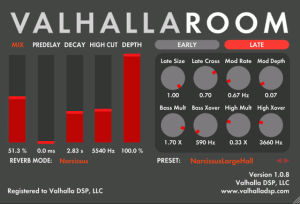
- Unique Early reverb section allows user to dial in subtle and short bursts of early reverberation energy, as well as gated reverbs up to 1 second in length.
- The Late section produces natural reverb decays ranging from 0.1 seconds to 100 seconds. The decay can be controlled in 3 adjustable frequency bands.
- Both Early and Late reverb sections have adjustable modulation, to produce sounds ranging from lush chorusing, to subtle and natural long decays.
- ValhallaRoom is true stereo. The Early and Late reverb sections are both stereo-in, stereo-out. The spread of energy between the stereo channels can be controlled over time, which helps preserve the input spatial image.
- The GUI has been designed for easy navigation, and is inspired by Joseph Müller-Brockmann, NASA control panels, and Sesame Street.
- New in version 1.0.8: Resizable GUI. Make it really big, or really tiny, or whatever suits you best.
- A comprehensive preset browser makes saving, recalling and sharing settings easy.
- Nine original reverberation algorithms:
- Large Room – designed to emulate big rooms with a wide spatial impression, with smooth “detuning” modulation
- Medium Room – sparser than Large Room, with a more random modulation
- Bright Room – a lush, shinier-than-life reverb, with deep modulation and a somewhat slower attack
- Large Chamber – a smooth decay with consistent high echo density and subtle detuning modulation
- Dark Room – a new reverb mode added to V1.0.6. A hybrid between the grungy early digital reverbs and the modern algorithms found in ValhallaRoom, with reduced high frequency content, noisy yet lush randomized modulation, a HUGE spatial image, echo density ranging from grungy to dense while retaining clarity, and tons of mojo.
- Dark Chamber. Similar to the original Large Chamber algorithm, but bigger and darker, with deeper detuning modulation.
- Dark Space. A HUGE dark space, with a somewhat sparser early echo density and deep detuning modulation.
- Nostromo (new in version 1.0.8). Deep, dark, echoing reverb. Very sparse early echo density, slow density build, random modulation, wide spatial image.
- Narcissus (new in version 1.0.8). Dark, lush, wide, with random modulation that quickly builds into rich chorusing. The little sibling of Nostromo, but it is still big. Designed for low CPU consumption.
ValhallaRoom has been designed from a psychoacoustic perspective. Instead of creating a simplified physical model of a simplified physical space, VRoom generates early and late acoustic energy that provides the spatial and phase cues needed to create an “idealized” room impression.
Demonstration of the Yamaha Voice Editor Essential
Voice Editor Essential is a simple Core MIDI iPad editor application to edit parameters in Yamaha synthesizers.
The editor focuses on detailed editing of insert effects, system effects, arpeggiator and EQ that are frequently modified and can take advantage of the iPad’s large graphic display. In addition to that, you can control parameters like EG or cutoff in real-time by using fader control or XY Pad. Some essential global parameters including tap tempo and volume control are also included.
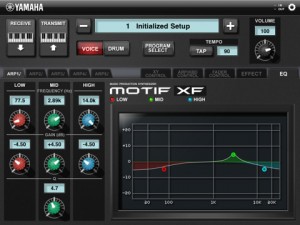
*Yamaha MOTIF XF offers you WiFi connectivity which enables wireless control.
Compatible model : MOTIF XF
Features
Effect Mode
・In effect mode you can select and edit Insert effects, the System effects and the routing and sends and returns for all the effects in a Voice.
EQ Mode
・You can edit the MOTIF XF’s Voice EQ and store different EQ setting for each of 50 Templates.
・you can adjust the Mid Bang EQ setting by pinching the band
Featuring the Xotica BX-1 Various Demos – Roland GI-20 VG-99 GR-300 GR-700 US-2
Collection of video demos featuring the Xotica BX-1. This is one of a few hand crafted boutique guitars built by Xotica, and custom guitar shop based in Kenosha, WI. Features of this guitar include a Roland GK-3 pickup, Buzz Feiten tuning system, Sperzel locking tuners, Baby Grand Hip Shot bridge, Rockfield pickups and a Honduras Mahogany body with g\orgeous Fiddle Back Maple binding.
IannixSequencer – MaxForLive Device
In case you have missed this nice Max for Live device:
A small demo of the “Iannix Sequencer” MaxForLive device I created. Using this device inside Ableton Live and Iannix you can create rhythmic patterns (like using a step – sequencer) with visual feedback of whats going on directly in Iannix.
download link: softcore.net.gr/IannixSequencer
For more info on Iannix software visit: iannix.org
For more info about Softcore visit: softcore.net.gr
Free Ableton Live Rack – Glitched Piano
Download the AfroDJMac Glitched Piano Rack @ http://bit.ly/freesynth25
This Ableton Live Rack was created by sampling my piano with the Singing Fingers iPad app and then sampling that into Ableton Live. The result is a glitchy piano pad type sound. Enjoy!
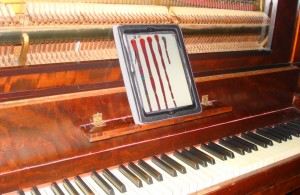
I’ve been experimenting with various apps on the iPad, and one of my favorite ones is a sampling app called Singing Fingers. This app records sound as you draw on the iPad with your finger. You then play the sounds back by tracing over what you have drawn. The sound changes depending on how fast and which direct you move your finger. It’s very easy to use, creates interesting sounds, and is fun. So, I decided to record some notes from my piano (the same piano from my reverse piano rack) into the app, and then I sampled the result into Ableton. By nature, the app has a granular-glitch type sound to it, and this is pretty evident in the sound of the rack I have created, “AfroDJMac’s Glitched Piano.” Have fun with it!
Click to Download the AfroDJMac Glitched Piano
Check out Roland’s new SPD-SX Sampling Pad
Roland has introduced the SPD-SX Sampling Pad, a multi-pad percussion instrument with 2 GB of onboard sampling memory and three powerful effects engines.
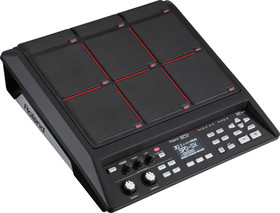
The SPD-SX replaces the popular SPD-S, the industry-leading sampling pad, which has been the overwhelming choice of professional drummers and percussionists. The SPD-SX leads the way with the latest pad-sensing technology, enhanced sampling performance, an assignable click output, and a host of other features.
SPD-SX features
- Unique sampling-pad concept — the only instrument of its kind in the world.
- 2 GB internal memory, enabling approximately 360 minutes of sampling (mono) without requiring external memory.
- Nine velocity-sensitive rubber pads, two external dual-trigger inputs.
- Easy capturing and assignment of audio data through Multi-Pad Sampling.
- Three units of multi-effects onboard, with two real-time control knobs and four dedicated effect buttons.
- Individual Pad Dynamics indicators show pad status and audio-level activity during performance.
- Expanded USB functionality (USB Mass Storage, USB MIDI/AUDIO, USB Memory).
- Wave Manager software included for easily importing, assigning, and organizing samples.
- Large backlit LCD.
The SPD-SX will be available in October with an MSRP of $1199.00 USD.
Nice demo of the Roland D-50 Linear Synthesizer (1987)
Roland D-50 Linear Synthesizer from the year 1987
a real classic synth!
8-bit attack or looped PCM samples and digital oscillators (saw & square), low pass filter, chorus and reverb fx…
this demo shows the different sound possibilities. first a few legendary D-50 patches and in then second part some special sounds.

More on the D-50:
The D-50 is an all-time favorite digital synth that’s still just as popular today as when it first came out in ’87. Once Roland’s hottest digital synth, it competed against the Yamaha DX7, and was much easier to use. By joining 8-bit PCM samples with “LAS” synth-generated sounds, the D-50 is capable of unique and complex sounds. The PCM samples contained the attack transients, while the rest of the sound came from the Linear Arithmatic Synth (LAS) section which sounds very analog, with subtractive-style synthesis and low-pass-resonant filters. Built-in chorus and (for the first time) digital reverb are also included for giving your sounds space and life! It also has a joystick controller for real-time timbre manipulation. The D-50 was great for new and non-acoustic, percussive, ethereal and beautiful pads & sounds.
Both the D-50 and D-550 benefit from the PG-1000 external controller which gives you very plain and simple slider/fader type control of all adjustable parameters of the synth. The D-50 includes MIDI on all 16 channels but because it is monotimbral you can only use one channel at a time. There is an upgrade which will give the D-50 and its rackmount version a full 16 channels of simultaneous MIDI multitimbral data communication. This popular synth has been widely used in all forms of music.
Teaser for the upcoming Audio Damage Filterstation
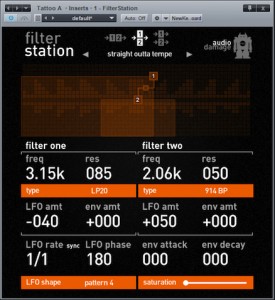
A preview of Audio Damage Filterstation– a new audio filter effect for Mac & Windows.
Here’s what he has to say about Filterstation:
It is a pair of filters that can be configured as serial, parallel stereo, and true stereo (one filter for each side).
Each filter can be one of 12 types, including our usual 2P, 3P, and 4P models, the bandpass filter that 914 Fixed Filter Bank is made up of, the original 4P LP from FilterPod (our first product, and the first filter we coded), a monster face-melting MS20 LP and HP that Adam built a month or so ago, and a VCA type.
The latter is useful if you’d like to do a filter-vibrato thing like some amps and electric pianos do (notably the Fender Vibrolux, but many others as well). It can also be used for rhythm gating and rudimentary panning. (Nothing near as sophisticated as Panstation, of course.)
The LFO has the usual suspects, and four rhythm patterns.
Audio demo below.
Phosphor to Filterstation by Chris Randall. Uploaded with Studio One
As to release date and pricing, Randall says, “I don’t have a time-frame for release, and we haven’t settled on a price. But ‘soon’ and ‘not much’ are both perfectly acceptable answers for both those questions.”
New audio processing SW from Roland
Roland is proud to announce R-MIX, a new era in audio processing software, giving recording professionals and those just starting out the tools to visually and intuitively manipulate stereo mix audio easily in real time. Featuring the newly developed proprietary V-Remastering technology and the highly-acclaimed VariPhrase® technology, R-MIX allows you to see the individual components of a stereo mix as color-coded clouds of harmonic matter and to apply effects or center cancel exactly where and as you wish within the mix. R-MIX can also help musicians learn songs by offering focused access to any desired instrument in the mix and the ability to slow down fast or complicated sections.

By graphically breaking down the stereo mix data into three elements (frequency, panning, and level), R-MIX makes it possible to actually see the instruments inside the mix, using the Harmonic Placement. Change the panning and level, erase, extract, and add effects, and independently adjust the pitch and speed of the playback as desired. Lower the level of the vocal or any other instrument within the mix to create minus-one karaoke files or create remixes using two pairs of stereo tracks. Mastering live recording sources is also possible by adjusting the instrument levels and applying noise reduction and effects, and with R-MIX, you can create the highest quality sound and then export your project as an audio file for music player playback.
Since there is only one R-MIX screen to operate, workflow increases, and there is no need to switch screens. Menus are aligned according to the workflow, easing navigation, and a simple help window for each task allows for manual free operation. Windows/Mac compatibility and the intuitive design also makes it accessible to everyone from serious DAW magicians to novice users and easily integrates into education and video production settings.
R-MIX Tab, a simplified version of R-MIX, will be available for the Apple iPad later this year. This iPad application also uses the V-Remastering technology to extract audio elements and easily creates minus-one data from an audio file.
• V-Remastering
Roland’s innovative V-Remastering digital signal-processing technology gives you total control over the elements within a stereo audio file. Built into R-MIX, V-Remastering makes it possible for you to see each stereo mix as color-coded clouds of energy and harmonic matter, and easily isolate the individual instruments or elements within the mix and change their panning positions and levels. V-Remastering also gives you the ability to erase, extract, or add effects to each element within a mix. V-Remastering enables music-editing capabilities never possible before!
• VariPhrase
In conjunction with V-Remastering, R-MIX employs Roland’s acclaimed VariPhrase technology, which can make your audio “elastic.” The secret to elastic audio is the independent control of pitch, time, and formant*. Smoothly adjust pitch without changing tempo, for example, or adjust tempo without changing pitch. Audio is elastic, and freely under your control in real time. Even more amazing is that all of this can be done without changing the sound quality of the original recording.
*Formant parameter not available in R-MIX.
R-MIX availability and MSRP details are being determined now. For more information, please visit http://www.RolandConnect.com.
DATAMASKIN

